Representative Sobieski Ross
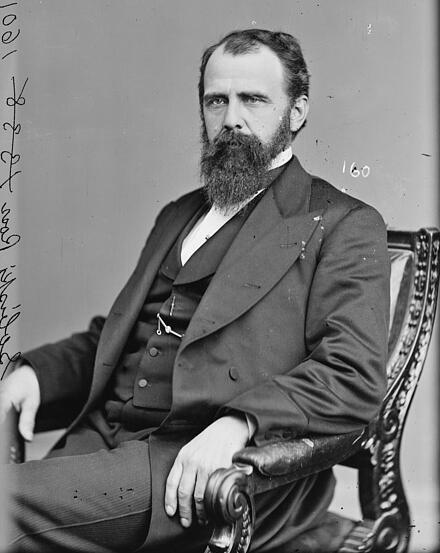
Here you will find contact information for Representative Sobieski Ross, including email address, phone number, and mailing address.
| Name | Sobieski Ross |
| Position | Representative |
| State | Pennsylvania |
| District | 16 |
| Party | Republican |
| Status | Former Representative |
| Term Start | December 1, 1873 |
| Term End | March 3, 1877 |
| Terms Served | 2 |
| Born | May 16, 1828 |
| Gender | Male |
| Bioguide ID | R000454 |
About Representative Sobieski Ross
Sobieski Ross (May 16, 1828 – October 24, 1877) was a Republican member of the United States House of Representatives from Pennsylvania who served from 1873 to 1877. Over the course of two terms in Congress, he represented his constituents during a pivotal period in the post–Civil War era and participated actively in the legislative process as a member of the Republican Party.
Ross was born on May 16, 1828, in Coudersport, Potter County, Pennsylvania, a small community in the northern part of the state that had been organized only a few decades earlier. He was educated in the local common schools and at Coudersport Academy, an institution that provided a classical and practical education to young men in the region. His early life in a developing rural county exposed him to the practical concerns of land use, transportation, and local governance that would later shape his professional pursuits.
After completing his schooling, Ross engaged in civil engineering, a profession of particular importance in mid-nineteenth-century Pennsylvania as the state expanded its roads, bridges, and other infrastructure. He also entered the real estate business, reflecting the growth and settlement of Potter County and surrounding areas. In addition to these activities, he maintained an interest in agricultural pursuits, aligning himself with the dominant economic activity of his largely rural district. His combined experience in engineering, land management, and agriculture gave him a broad understanding of the economic and developmental needs of his community.
Ross’s standing in local affairs led to his appointment as an associate judge in Potter County in 1852, a position that, in Pennsylvania at the time, often went to respected laymen rather than formally trained attorneys. As an associate judge, he participated in the administration of justice at the county level, helping to adjudicate civil and criminal matters and contributing to the maintenance of law and order in a frontier region of the state. This judicial role enhanced his public profile and provided him with experience in public service and the application of state law.
Building on his local prominence, Ross was elected as a Republican to the Forty-third Congress (March 4, 1873 – March 3, 1875) and was subsequently reelected to the Forty-fourth Congress (March 4, 1875 – March 3, 1877). His tenure in the House of Representatives thus spanned four years, from 1873 to 1877, during the later phase of Reconstruction and the nation’s transition into the Gilded Age. As a Representative from Pennsylvania, he took part in the deliberations of the House on issues of national finance, reconstruction policy, internal improvements, and the regulation of commerce, while also attending to the specific needs of his district’s constituents in matters such as transportation, land use, and agricultural development.
Ross’s congressional service occurred during a significant period in American history, when questions of federal authority, civil rights, economic modernization, and regional development were at the forefront of national debate. As a Republican, he aligned with the party that had led the Union during the Civil War and was then grappling with the challenges of reintegrating the Southern states and stabilizing the national economy. Within this context, he contributed to the democratic process by representing the interests of his Pennsylvania district and participating in the formulation of federal policy.
In 1876, Ross declined to be a candidate for renomination to the Forty-fifth Congress, choosing instead to return to private life. After leaving Congress in March 1877, he resumed his real estate business in Coudersport, continuing the work that had occupied him before his election to national office. He remained in his native community until his death later that year. Sobieski Ross died in Coudersport, Pennsylvania, on October 24, 1877. He was interred in Eulalia Cemetery in Coudersport, where his burial marked the close of a career that combined local judicial service, business enterprise, and representation in the United States Congress.