Representative South Trimble
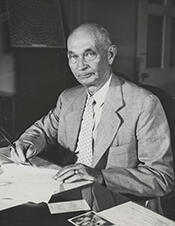
Here you will find contact information for Representative South Trimble, including email address, phone number, and mailing address.
| Name | South Trimble |
| Position | Representative |
| State | Kentucky |
| District | 7 |
| Party | Democratic |
| Status | Former Representative |
| Term Start | December 2, 1901 |
| Term End | March 3, 1907 |
| Terms Served | 3 |
| Born | April 13, 1864 |
| Gender | Male |
| Bioguide ID | T000376 |
About Representative South Trimble
South Trimble (April 13, 1864 – November 23, 1946) was a U.S. Representative from Kentucky and a long-serving Clerk of the United States House of Representatives. A member of the Democratic Party and a prominent figure in the famed South–Cockrell–Hargis family of Southern politicians, he played a notable role in both Kentucky state politics and the administration of the House during the first half of the twentieth century.
Trimble was born near Hazel Green, Wolfe County, Kentucky, on April 13, 1864. He was the son of Asberry Trimble, who was killed by his brother-in-law, Edward Hensley, on October 15, 1864, during the American Civil War, as Asberry was putting his slaves to work at the Trimble Tannery. Following this family tragedy, Trimble’s mother purchased a home in Franklin County, Kentucky, and moved the family there. In Frankfort he attended the public schools and later studied at the Excelsior Institute, receiving the education that would prepare him for a career in public life.
On November 24, 1885, Trimble married Carrie Bell Allan of Galveston, Texas, marking the beginning of a family life that ran parallel to his emerging public career. In his early adulthood he engaged in agricultural pursuits near Frankfort, Kentucky, including turkey farming. His work as a farmer would later intersect with national custom: in 1913 he became the second person known to present a turkey to the President of the United States, challenging the long-standing, roughly forty-year monopoly of Horace Vose of Westerly, Rhode Island, who had supplied presidential turkeys since 1873. Trimble promoted his birds as smaller but more flavorful, attributing their quality to a diet rich in red pepper. Although no definitive record indicates whether Trimble or Vose prevailed in that particular year, Vose’s death later in 1913 opened the way to a broader competition for the honor of supplying the presidential turkey, a rivalry that continued until the National Turkey Federation assumed responsibility for the tradition in 1947.
Trimble’s formal political career began in state government. He served as a member of the Kentucky House of Representatives from 1898 to 1900, representing his constituents during a period of political realignment and economic change in the post-Reconstruction South. In 1900 he was elected Speaker of the Kentucky House of Representatives, a position that underscored his influence within the state Democratic Party and gave him experience in legislative leadership and parliamentary procedure that would later prove valuable in his federal service.
In 1900 Trimble successfully sought national office. He was elected as a Democrat to the Fifty-seventh, Fifty-eighth, and Fifty-ninth Congresses, serving as a Representative from Kentucky from March 4, 1901, to March 3, 1907. During these three terms in the United States House of Representatives, he participated in the legislative process at a time when the nation was grappling with the consequences of industrialization, the aftermath of the Spanish–American War, and the early stirrings of the Progressive Era. As a member of the House, Trimble represented the interests of his Kentucky constituents and took part in the broader democratic process that shaped federal policy in the early twentieth century. He did not seek renomination in 1906 and instead became the Democratic candidate for Lieutenant Governor of Kentucky, though he was unsuccessful in that bid.
Following his congressional service, Trimble transitioned to an important administrative role within the House of Representatives. He was first elected Clerk of the United States House of Representatives on April 4, 1911, and served in that capacity until May 18, 1919. As Clerk, he oversaw critical administrative, financial, and record-keeping functions of the House during a period that included the presidencies of William Howard Taft and Woodrow Wilson, the Progressive Era, and World War I. His work helped ensure the orderly conduct of House business and the maintenance of official records at a time of expanding federal activity.
After leaving the clerkship in 1919, Trimble retired from public life for a period and operated a plantation near Selma, Alabama. This phase of his life reflected a return to agricultural pursuits, even as he remained a figure with long experience in both state and national government. His retirement from Washington, however, was not permanent. On December 7, 1931, he was again chosen to serve as Clerk of the House of Representatives. In this second tenure, he administered the House’s clerical operations through the Great Depression, the New Deal era, and World War II, remaining in office until his death.
South Trimble died in Washington, D.C., on November 23, 1946, while still serving as Clerk of the House of Representatives. His long career had encompassed service as a state legislator and Speaker in Kentucky, three terms as a U.S. Representative from Kentucky from 1901 to 1907, two extended periods as Clerk of the House from 1911 to 1919 and from 1931 to 1946, and a distinctive role in American political and social custom through his agricultural pursuits. He was interred in Frankfort Cemetery in Frankfort, Kentucky, closing a life deeply intertwined with the political history of his state and the institutional development of the United States House of Representatives.