Representative Steve King
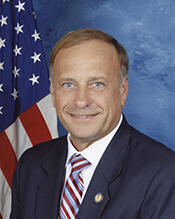
Here you will find contact information for Representative Steve King, including email address, phone number, and mailing address.
| Name | Steve King |
| Position | Representative |
| State | Iowa |
| District | 4 |
| Party | Republican |
| Status | Former Representative |
| Term Start | January 7, 2003 |
| Term End | January 3, 2021 |
| Terms Served | 9 |
| Born | May 28, 1949 |
| Gender | Male |
| Bioguide ID | K000362 |
About Representative Steve King
Steven Arnold King (born May 28, 1949, in Storm Lake, Iowa) is an American former politician and businessman who served as a Representative from Iowa in the United States Congress from 2003 to 2021. A member of the Republican Party, he contributed to the legislative process during nine terms in office and represented the interests of his constituents during a significant period in American history. He is the son of Mildred Lila (née Culler), a homemaker, and Emmett A. King, a state police dispatcher. His father is of Irish and German ancestry, and his mother has Welsh roots and American ancestry extending back to the colonial era; his grandmother was a German immigrant. King grew up in western Iowa and graduated from Denison Community High School in Denison, Iowa, in 1967.
After high school, King attended Northwest Missouri State University in Maryville, Missouri, from 1967 to 1970, where he majored in mathematics and biology and was a member of the Alpha Kappa Lambda fraternity. He did not complete his degree. In 1972 he married Marilyn Kelly; the couple has three children, including Jeff King, a consultant who later became active in his father’s political campaigns. Raised in the Methodist tradition, King converted to Catholicism approximately 17 years after his marriage and began attending his wife’s Catholic church.
King entered the private sector before seeking public office. In 1975 he founded King Construction, an earthmoving company based in western Iowa, and worked in business and environmental study. During the 1980s he founded the Kiron Business Association in Kiron, Iowa, reflecting his growing involvement in local economic and civic affairs. His work with the Iowa Land Improvement Contractors’ Association led to regional and national offices within that organization and helped cultivate his interest in public policy, particularly in areas related to land use, infrastructure, and regulation.
King’s formal political career began in the Iowa Senate. In 1996 he sought and won the Republican nomination for Iowa’s 6th Senate district, defeating incumbent Senator Wayne Bennett in the primary by 68%–31%, and then winning the general election over Democrat Eileen Heiden by 64%–35%. He was reelected in 2000, defeating Democratic nominee Dennis Ryan by 70%–30%. During his tenure in the Iowa State Senate, King advanced culturally conservative and nationalist themes, filing a bill that would have required public schools to teach that the United States “is the unchallenged greatest nation in the world and that it has derived its strength from… Christianity, free enterprise capitalism and Western civilization.” He also served as chief sponsor of a law making English the official language of Iowa, a measure consistent with his later positions on immigration and assimilation.
In 2002, following congressional redistricting after the 2000 census, King ran for the open seat in Iowa’s 5th congressional district. The incumbent, Republican Tom Latham, had been drawn into the reconfigured 4th district, leaving the 5th without an incumbent. King finished first in a four-way Republican primary with 31% of the vote, short of the 35% required to secure the nomination outright, and was subsequently nominated at a party convention, where he defeated Iowa House Speaker Brent Siegrist 51%–47%. In the November 2002 general election he defeated Council Bluffs city councilman Paul Shomshor by 62%–38%, winning all counties in the predominantly Republican district except Pottawattamie. As a member of the U.S. House of Representatives, King participated in the democratic process and represented the interests of his constituents through a period marked by the post‑9/11 security environment, the wars in Afghanistan and Iraq, the Great Recession, and contentious national debates over immigration and cultural identity.
King was reelected repeatedly from the 5th district: in 2004 he defeated Democrat Joyce Schulte 63%–37%, losing only Clarke County; in 2006 he again defeated Schulte, 59%–36%, losing Clarke and Union counties; in 2008 he defeated Democrat Rob Hubler 60%–37% and, for the first time, carried all 32 counties in the district; and in 2010 he won a fifth term, defeating Democrat Matt Campbell 66%–32%, again sweeping all 32 counties, his highest percentage to that point. After the 2010 United States census, Iowa lost a congressional district and King’s district was renumbered as the 4th, extending eastward to include Mason City and Ames. This new 4th district, with a Cook Partisan Voting Index of R+4 compared to the old 5th’s R+9, was more competitive and included only about 45% of King’s previous territory, closely resembling the area Tom Latham had represented from 1995 to 2003. Latham chose to run in the reconfigured 3rd district, and in 2012 former Iowa First Lady Christie Vilsack moved into the new 4th to challenge King. With the endorsement of figures such as Republican presidential candidate Mitt Romney, King won reelection to a sixth term, defeating Vilsack 53%–45% and losing only seven counties, none of which he had previously represented. He later characterized this victory as overcoming “$7 million, the best of everything Democrats can throw at me, their dream candidate and everything that can come from the Obama machine,” while representing a district that was 55% new to him.
King continued to win reelection in the 4th district. In 2014 he defeated Democrat Jim Mowrer with 61.6% of the vote, and in 2016 he prevailed over Democratic nominee Kim Weaver with 61.2%. In 2018 he faced his closest race, winning a ninth term with 50.4% of the vote against Democrat J. D. Scholten, who received 47%, while Libertarian Charles Aldrich took 2%. Turnout in 2018 (313,251 voters) was lower than in 2016 (370,259 voters), and observers noted that Governor Kim Reynolds’s strong performance in the district, where she received nearly 61% of the vote in her bid for a full term, likely aided King. The 2018 result was the narrowest Republican victory in that region—organized over time as Iowa’s 6th, then 5th, and later 4th district—since 1986, and one of only two occasions since that year in which a Republican did not win by double digits there.
Throughout his congressional career, King became nationally known for his hard-line positions on immigration and his opposition to multiculturalism. He developed a long record of statements widely criticized as racist and anti-immigrant, and he openly associated with European right‑wing populist and far‑right politicians accused of racism, anti‑Semitism, and Islamophobia. In 2018 The Washington Post described him as “the Congressman most openly affiliated with white nationalism.” For much of his tenure, many Republican officials and candidates were publicly silent about his rhetoric and sought his endorsement because of his popularity with voters in northwest Iowa. Shortly before the 2018 election, however, the National Republican Congressional Committee withdrew funding for his reelection campaign, and its chairman, Representative Steve Stivers, issued a public condemnation of King’s conduct, even as Iowa’s Republican senators and governor continued to endorse him. In January 2019, after King gave an interview in which he questioned why terms such as “white nationalist” and “white supremacy” had become offensive, he was widely denounced by members of both parties, by the media, and by other public figures. The House Republican Steering Committee responded by removing him from all committee assignments, sharply diminishing his influence in Congress during the remainder of his final term.
King’s political standing within his party continued to erode after the loss of his committee posts. Although he sought reelection in 2020, his fundraising and institutional support declined significantly. On June 2, 2020, he was defeated in the Republican primary for the 4th congressional district by state senator Randy Feenstra, who won by approximately 10 percentage points. King’s service in the U.S. House of Representatives concluded on January 3, 2021, at the end of his ninth term, closing a congressional career that spanned 18 years and intersected with major national debates over immigration, national identity, and the direction of the Republican Party.