Representative Steve Stockman
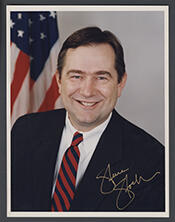
Here you will find contact information for Representative Steve Stockman, including email address, phone number, and mailing address.
| Name | Steve Stockman |
| Position | Representative |
| State | Texas |
| District | 36 |
| Party | Republican |
| Status | Former Representative |
| Term Start | January 4, 1995 |
| Term End | January 3, 2015 |
| Terms Served | 2 |
| Born | November 14, 1956 |
| Gender | Male |
| Bioguide ID | S000937 |
About Representative Steve Stockman
Stephen Ernest “Steve” Stockman (born November 14, 1956, in Bloomfield Hills, Michigan) is an American politician, a member of the Republican Party, and a convicted felon who served two nonconsecutive terms in the United States House of Representatives. Raised outside Detroit by parents who were evangelistic Christian teachers, he graduated from Dondero High School in Royal Oak, Michigan. In 1977, as he was reporting to jail for traffic tickets, jailers found Valium in his possession after his girlfriend allegedly hid some in his underwear; he was charged with felony possession of a controlled substance, but the charge was later dropped. Stockman later became a born-again Christian, an experience he has described as a turning point in his life.
After high school, Stockman attended San Jacinto College in Texas from 1985 to 1986 but dropped out, later saying he suffered from what he called “partying syndrome.” He subsequently resumed his education and, in 1990, earned a bachelor’s degree in accounting from the University of Houston–Clear Lake. During this period he worked as a computer salesman in Friendswood, Texas, establishing roots in the Houston–Galveston area that would later form the base of his political career. His early adult years also included caring for his father, who suffered from Alzheimer’s disease; the financial burden of that care ultimately drove Stockman into bankruptcy, and when his father’s condition became too severe, Stockman moved him to a veterans’ home.
Stockman’s first bid for public office came in March 1990, when he ran in the Republican primary for Texas’s 9th congressional district, a seat anchored by Beaumont and Galveston and held by Democratic Representative Jack Brooks since 1953. With Beaumont Mayor Maury Meyers as his main primary opponent and conservative figure Oliver North appearing at two of his fundraisers, Stockman finished with 41% of the vote to Meyers’s 44.3%, forcing a runoff in which Meyers, backed by third-place finisher Steve Clifford, won the Republican nomination. Stockman ran again for the same seat in 1992, this time unopposed in the Republican primary. During the 1992 Republican National Convention in Houston, he organized a “congressional cruise” on the Houston Ship Channel as a fundraising event, though no members of Congress attended. In the November 1992 general election, Brooks defeated him by a margin of 56% to 44%.
In 1994, Stockman mounted a third campaign for the 9th district. He faced John LeCour and James Milburn in the Republican primary and won decisively with 74% of the vote. In the general election he again confronted Jack Brooks, who was in line to become Dean of the House of Representatives if reelected. Initially, the National Rifle Association Political Victory Fund endorsed Brooks and contributed $5,000 to his campaign, while the Gun Owners of America endorsed Stockman. After some NRA members threatened to resign over the endorsement, the NRA withdrew its support for Brooks and remained neutral. In a major upset in November 1994, Stockman defeated Brooks 51% to 49%, beginning his first term in Congress on January 3, 1995, as the representative for Texas’s 9th congressional district. His service in Congress from 1995 to 1997 occurred during a significant period in American history, and as a member of the House of Representatives he participated in the democratic process and represented the interests of his constituents while contributing to the legislative process.
During his first term, Stockman served on the House Committee on Banking and Financial Services, including its Subcommittee on Oversight and Investigations, and on the House Committee on Science, with assignments to the Subcommittee on Energy and the Subcommittee on Environment. He opposed the U.S. bailout of the Mexican peso in 1995 and became known for strongly conservative positions. That same year he wrote an article for Guns & Ammo suggesting that the 1993 Waco siege had been orchestrated by the Clinton administration to justify a ban on so‑called “assault weapons,” writing that if President Bill Clinton had truly been unhappy with Attorney General Janet Reno’s actions, he would have fired her and sought her indictment for premeditated murder; his office later denied that he believed in Waco conspiracy theories. Also in 1995, he called for a congressional investigation into Alfred Kinsey’s 1948 study Sexual Behavior in the Human Male after learning that Kinsey had used data from the diary of a pedophile, arguing in a letter to colleagues that such research had distorted sexual education in the United States. In 1995 and 1996, Stockman supported the federal government shutdowns associated with budget conflicts between Congress and the Clinton administration and was proud to have played a role in them. A later Congressional Research Service report detailed the broad economic and administrative impacts of those shutdowns, which were widely believed to have contributed to his defeat in 1996 and to the Republican loss of seven House seats.
In the 1996 election cycle, Stockman ran unopposed in the Republican primary. After a federal court in July 1996 ordered the redrawing of 13 Texas House districts for racial gerrymandering—changes that only minimally affected his district—he faced Democratic Jefferson County assessor Nick Lampson in the general election. Stockman won a plurality of 46% in November, forcing a runoff, but Lampson prevailed in the December 1996 runoff with 53% of the vote, ending Stockman’s first congressional tenure on January 3, 1997. He remained active in Texas politics, running unsuccessfully in the 1998 Republican primary for the Texas Railroad Commission. Between 2005 and 2007, he worked with the conservative Leadership Institute as director of its Campus Leadership Program. In 2006, he attempted to run as an independent candidate for Texas’s 22nd congressional district, the seat vacated by Representative Tom DeLay; although he initially gathered enough signatures for ballot access, the Texas Secretary of State invalidated sufficient signatures to disqualify him. He then entered the special election to fill the remainder of DeLay’s term and finished third in a five‑candidate field with 10.75% of the vote.
After several years out of office, Stockman prepared for a political return. In 2011 he formed an exploratory committee, Friends of Steve Stockman, to consider a run for Texas’s 14th congressional district, which was being vacated by Representative Ron Paul. He ultimately chose instead to run in the newly created 36th congressional district in 2012, which included the Harris County portion of Friendswood, where he lived. The district was drawn to be heavily Republican, and it was widely understood that the winner of the Republican primary would almost certainly win the seat. In the May 29, 2012, primary, Stockman finished second behind financial planner Stephen Vincent Takach, who received 22% of the vote, short of the majority needed to avoid a runoff. In the July 31 runoff, Stockman defeated Takach 55% to 45%, effectively securing his return to Congress after a 16‑year absence. In the November 2012 general election, he defeated Democratic nominee Max Owen Martin, a retired pilot from Clear Lake City, Texas, with 71% of the vote, and began representing Texas’s 36th congressional district on January 3, 2013. From 1995 to 2015, across his two nonconsecutive terms, Stockman served as a Republican representative from Texas and contributed to the legislative process during those periods in office.
During his second term in Congress, Stockman took a series of high‑profile conservative stances and committee roles. He served on the House Committee on Foreign Affairs, including the Subcommittee on Africa, Global Health, Global Human Rights and International Organizations and the Subcommittee on Europe, Eurasia and Emerging Threats. He also served on the Committee on Science, Space and Technology, with assignments to the Subcommittee on Research and the Subcommittee on Space, and he was a member of the Congressional Constitution Caucus. In January 2013, he was one of ten Republicans who did not vote for John Boehner of Ohio for Speaker of the House, casting the lone “Present” vote as a protest. A strong opponent of the Affordable Care Act, he supported the 2013 federal government shutdown led by Republican members seeking to block a continuing resolution that included ACA funding. That same month, he introduced the “Safe Schools Act,” a bill to repeal the Gun‑Free School Zones Act of 1990, arguing that disarming qualified citizens and officials in schools created a dangerous situation for children. Also in January 2013, he issued a press release condemning President Barack Obama’s post–Sandy Hook gun control executive actions and pledged to resist them “by any means necessary,” including efforts to eliminate implementation funding, defund the White House, and even consider articles of impeachment.
Stockman’s social policy positions drew additional attention. In February 2013, he voted against reauthorization of the Violence Against Women Act, objecting to provisions that extended protections to transgender victims of domestic violence and publicly criticizing the inclusion of “men dressed up as women” under a bill labeled as a women’s act. That same month he invited musician and gun‑rights advocate Ted Nugent, noted for his harsh criticisms of President Obama and other Democrats, to attend the 2013 State of the Union Address as his guest. On April 25, 2014, Stockman announced that the House Ethics Committee was investigating a campaign finance reporting error made by a former campaign worker; he stated that the mistake had been corrected promptly once discovered and that the worker had been removed from his campaign organization. On December 9, 2013, Stockman filed for the Republican nomination for the U.S. Senate seat held by John Cornyn, choosing not to seek reelection to his House seat. On December 31, 2013, he visited the Bitcoin Center NYC to raise funds and became the first U.S. Senate candidate to officially accept campaign contributions in cryptocurrency. In the March 4, 2014, Republican primary, Stockman received 250,759 votes (19.2%) in a field of eight candidates, placing a distant second to Cornyn, who won 778,967 votes (59.44%) and avoided a runoff. Stockman quickly conceded and urged Texas Republicans to support the party’s ticket in the November 4, 2014, general election. Meanwhile, Brian Babin captured the open 36th district seat that Stockman had vacated, ending Stockman’s second term in Congress on January 3, 2015.
Stockman’s later life and post‑congressional career were dominated by a series of federal criminal investigations and prosecutions related to campaign finance and charitable fundraising. On March 28, 2017, following an earlier arrest that month, a federal grand jury in Houston returned a 28‑count indictment that included 24 counts against Stockman. Prosecutors alleged that beginning in January 2013 he had solicited and received $350,000 in donations from an unidentified businessman using the name of Life Without Limits, a Las Vegas‑based nonprofit intended to assist people who had experienced traumatic events, purportedly to renovate a “Freedom House” in Washington, D.C. According to the Federal Bureau of Investigation, Stockman had no formal control over Life Without Limits at the time but opened multiple bank accounts under the name “Stephen E. Stockman dba Life Without Limits,” made no significant expenditures toward the purchase, renovation, or operation of the Freedom House—which was never opened—and instead used the funds for political and personal purposes. The broader case alleged that Stockman and associates conspired to obtain approximately $1.25 million under false pretenses and to launder and conceal the true source and use of the money.
The indictment charged Stockman with eleven counts of money laundering, eight counts of mail and wire fraud, one count of conspiracy to make conduit contributions and false statements by disguising the true source of campaign donations, two counts of making false statements to the Federal Election Commission, one count of making excessive contributions, and one count of willfully filing a false 2013 federal income tax return by failing to report certain income. His former campaign worker and congressional special assistant Thomas Dodd pleaded guilty on March 20, 2017, to participating in the scheme to “bilk conservative foundations” of at least $775,000 intended for charitable or voter‑education purposes; Dodd was later sentenced to 18 months in prison and ordered to pay $800,000. Another staffer, Jason Posey, pleaded guilty before Chief U.S. District Judge Lee Rosenthal to counts of wire fraud, mail fraud, and money laundering, admitting that at Stockman’s direction he and Dodd had illegally funneled hundreds of thousands of dollars from charitable foundations and individuals to finance Stockman’s campaigns and personal expenses. Posey faced up to 45 years in prison and more than $4.8 million in fines and was ultimately sentenced on April 2, 2019, to 18 months in prison and ordered to pay $720,000. Because of the complexity of the case and the need to review more than 142,000 pages of discovery, Stockman’s court‑appointed attorney successfully sought a postponement of trial, which began on January 29, 2018.
On April 12, 2018, a federal jury convicted Stockman on 23 of the 24 felony counts against him, acquitting him on one count of wire fraud. Deemed a flight risk, he was remanded into custody pending sentencing. On November 7, 2018, he was sentenced to ten years in federal prison, to be followed by three years of supervised release, and ordered to pay $1,014,718.51 in restitution. Stockman was assigned to a low‑security federal prison facility in Beaumont, Texas, to serve his sentence. On December 22, 2020, President Donald Trump commuted Stockman’s prison term, and he was released from the Beaumont facility after serving roughly two years of his ten‑year sentence. Under the terms of the commutation, he remains subject to a period of supervised release and to the restitution order requiring payment of more than $1 million.