Representative Steven V. Carter
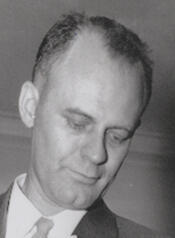
Here you will find contact information for Representative Steven V. Carter, including email address, phone number, and mailing address.
| Name | Steven V. Carter |
| Position | Representative |
| State | Iowa |
| District | 4 |
| Party | Democratic |
| Status | Former Representative |
| Term Start | January 7, 1959 |
| Term End | January 3, 1961 |
| Terms Served | 1 |
| Born | October 8, 1915 |
| Gender | Male |
| Bioguide ID | C000199 |
About Representative Steven V. Carter
Steven V. Carter (October 8, 1915 – November 4, 1959) was a Democratic member of the United States House of Representatives from Iowa who served in the Eighty-sixth Congress in 1959. His service in Congress, though brief, occurred during a significant period in American history, and as a member of the House of Representatives he participated in the democratic process and represented the interests of his south central Iowa constituents. A member of the Democratic Party, he contributed to the legislative process during his time in office and is remembered as one of the members of the United States Congress who died in office in the mid‑twentieth century.
Carter was born in Carterville (now part of Provo), Utah, on October 8, 1915. When he was fourteen years old, he moved with his parents to Lamoni, Iowa, a relocation that would shape the rest of his personal and professional life. He completed his secondary education in his new hometown, graduating from Lamoni High School, and quickly distinguished himself as a capable student with ambitions for higher education and public service.
Following high school, Carter pursued an extensive course of study in Iowa. He graduated from Graceland College in Lamoni in 1934. He then enrolled at the University of Iowa, where he received his undergraduate degree in 1937. Continuing at the same institution, he entered the University of Iowa College of Law and completed his legal education in 1939. That same year, he was admitted to the bar and commenced the practice of law in Leon, Iowa, establishing the professional foundation that would lead to his later political career.
Carter’s early career was rooted in local public service and the law. Shortly after beginning his practice in Leon, he was elected county attorney of Decatur County, Iowa, serving from 1940 to 1944. His tenure as county attorney was interrupted when he enlisted in the United States Navy during World War II. Serving as a supply officer in the South Pacific Theatre, he contributed to the war effort in a logistical and administrative capacity. After the war, he returned to Leon and resumed public legal work, serving as city attorney from 1946 to 1948, further solidifying his reputation as a dedicated local public servant.
Carter’s ambition for federal office emerged in the late 1940s. In 1948, 1950, and 1956, he ran as the Democratic candidate for the U.S. House of Representatives from Iowa, seeking to unseat Republican incumbent Karl M. LeCompte. Although he was unsuccessful in each of these campaigns, he remained a prominent Democratic figure in the district. After the closely contested 1956 race, Carter formally challenged the outcome of the election, bringing his case before Congress. In 1958, however, Congress rejected his challenge, and the certified result stood. When LeCompte chose not to seek re‑election in 1958, Carter again sought the seat, this time facing Republican John Henry Kyl. In that open‑seat contest, Carter prevailed, winning election to the House and securing his long‑sought place in national office.
Carter’s service in Congress began on January 3, 1959, when he took his seat in the Eighty‑sixth Congress as a Democratic Representative from Iowa. His term, which was to run from 1959 to 1961, placed him in Washington during a period of significant national and international developments, and he participated in the legislative process as part of the House of Representatives. As a member of the Democratic Party, he joined his colleagues in representing the interests of his Iowa constituents and contributing to the formulation of federal policy. His service in Congress thus reflected both his longstanding commitment to public life and the culmination of years of legal and political experience in Iowa.
Carter’s tenure in Congress was tragically cut short by illness. He had suffered from cancer prior to his election but believed that he had fully recovered by the time he assumed office. During his first month in Congress, however, doctors determined that the cancer had returned, and he was soon hospitalized. Despite this setback, he continued officially in office from January 3, 1959, until his death in Bethesda, Maryland, on November 4, 1959, at the age of forty‑four. Following his death, John Henry Kyl, whom Carter had defeated in 1958, won a special election to fill the vacancy in the House. Carter’s papers, documenting his legal practice, political campaigns, and brief congressional service, are preserved in the Steven V. Carter Papers at the University of Iowa Special Collections & University Archives, providing a record of his career and his role in mid‑twentieth‑century American public life.