Representative Steve Watkins
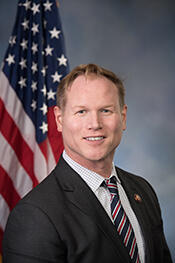
Here you will find contact information for Representative Steve Watkins, including email address, phone number, and mailing address.
| Name | Steve Watkins |
| Position | Representative |
| State | Kansas |
| District | 2 |
| Party | Republican |
| Status | Former Representative |
| Term Start | January 3, 2019 |
| Term End | January 3, 2021 |
| Terms Served | 1 |
| Born | September 18, 1976 |
| Gender | Male |
| Bioguide ID | W000824 |
About Representative Steve Watkins
Steven Charles Watkins Jr. (born September 18, 1976) is an American politician, former military officer, and businessman who represented Kansas in the United States House of Representatives from 2019 to 2021. A member of the Republican Party, he served one term in Congress, contributing to the legislative process during a significant period in American history and representing the interests of constituents in Kansas’s 2nd congressional district. He was succeeded in that seat by fellow Republican Jake LaTurner. Watkins was born at Lackland Air Force Base in Texas and later attended high school in Topeka, Kansas, before leaving the state to pursue a military education and career that would shape his early professional life.
After graduating from high school in Topeka, Watkins attended the United States Military Academy at West Point, New York, where he earned his degree in 1999. He subsequently pursued advanced studies, earning additional degrees from the Massachusetts Institute of Technology (MIT) and Harvard University. During his time in the U.S. Army, Watkins completed a series of elite military training programs, graduating from Ranger School, Airborne School, the Sapper Leader Course, Air Assault School, and Pathfinder School. These qualifications reflected a focus on combat engineering, airborne operations, and specialized infantry skills that would underpin his early military assignments.
Watkins spent five years on active duty with the United States Army. He was stationed at Fort Richardson in Alaska in 2000 and later saw combat in Afghanistan. In 2004 he served in Khost Province and conducted combat patrols along the Afghanistan–Pakistan border, attaining the rank of captain. After leaving active duty in late 2004, he began working as a defense contractor in Afghanistan. In a 2015 interview, he stated that he suffered a traumatic brain injury in 2013 and had been diagnosed with post-traumatic stress disorder nearly a decade earlier, describing the injury as a “tipping point” that pushed him toward what he called a more conventional life. While living in Alaska, he also became involved in long-distance dog sled racing, beginning to run dogs in 2000 and later competing in the Iditarod Trail Sled Dog Race. He finished 58th in the 2015 Iditarod, and he entered the race again in March 2018 but did not finish, dropping out at Unalakleet, approximately 261 miles (420 km) from the finish in Nome.
Watkins’s move into electoral politics came after many years largely spent outside Kansas. Public records cited during his 2018 campaign indicated that he had not lived in Kansas since leaving high school, nearly two decades before returning to the state to run for Congress. His father, a physician, helped underwrite his entry into politics by establishing a political action committee that made substantial advertising purchases on his behalf. In the 2018 Republican primary for Kansas’s 2nd congressional district, Watkins faced skepticism from some local Republican leaders, who questioned his limited voting history in Kansas and raised concerns about his background and residency, including his long-standing ties to Alaska, where he owned two homes and had applied for the Alaska Permanent Fund dividend 11 times. Despite these concerns and criticism over campaign materials that used images of President Donald Trump without authorization, Watkins won the seven-way Republican primary on August 7, 2018, with 26.5% of the vote. His family’s super PAC spent more than $700,000 supporting his candidacy and additional funds opposing a key rival, Caryn Tyson.
The 2018 general election in Kansas’s 2nd district, held on November 6, 2018, was widely described as one of the most negative and competitive congressional races in the country. Watkins, running as a conservative Republican, faced moderate Democrat Paul Davis. The campaign drew national attention, including an October 6, 2018 rally in Topeka at which President Trump urged voters to support Watkins. During the race, several news reports questioned aspects of Watkins’s biography, including a claim on his website that he had been praised by Everest outfitter Guy Cotter for his leadership during the 2015 Nepal earthquake; Cotter denied making the statement, and the claim was removed. Another report scrutinized Watkins’s description of his role in establishing a corporation, which he had in fact only later consulted for. In October 2018, an Alaska woman, Chelsea Scarlett, accused Watkins of making unwanted sexual advances in 2006; Watkins denied the allegation. On policy, Watkins supported Trump’s proposed border wall and called for restricting health care spending while protecting Social Security. He ultimately defeated Davis by a margin of 0.8 percentage points, winning all but the two most populous and urbanized counties in the district—Shawnee County (Topeka) and Douglas County (Lawrence), which Davis carried by wide margins.
Watkins took office as U.S. Representative for Kansas’s 2nd congressional district on January 3, 2019, serving one term until January 3, 2021. As a member of the House of Representatives, he participated in the democratic process during a contentious period in American politics and represented the interests of his Kansas constituents. In Congress, he served on the Committee on Foreign Affairs, with a seat on the Subcommittee on the Middle East, North Africa, and International Terrorism; the Committee on Education and Labor, including the Subcommittee on Health, Employment, Labor, and Pensions and the Subcommittee on Higher Education and Workforce Investment; and the Committee on Veterans’ Affairs, where he sat on the Subcommittee on Technology Modernization and the Subcommittee on Disability Assistance and Memorial Affairs. On October 23, 2019, he joined approximately thirty House Republicans in entering a Sensitive Compartmented Information Facility (SCIF) to protest the conduct of closed-door impeachment-related depositions, an action that drew criticism from House Homeland Security Committee Chairman Bennie Thompson and from Republican Senator Lindsey Graham, who admonished the tactic as an improper breach of security. During his term, Watkins also drew attention for his heavy use of taxpayer-funded communications, spending about $400,000 on radio ads and mailed materials to constituents between October 1, 2019, and March 31, 2020, a figure that far exceeded the franking expenditures of other members of the Kansas delegation in the same period.
Watkins’s tenure in Congress was overshadowed by ongoing questions about campaign financing and his personal political standing within the Kansas Republican Party. In 2019, party leaders, including former Governor Jeff Colyer, actively sought a primary challenger, ultimately encouraging State Treasurer Jake LaTurner to abandon a U.S. Senate bid and run against Watkins in the 2nd district instead. The Federal Election Commission reviewed campaign contributions made by Watkins’s father and examined the role of family money in the 2018 race, during which Watkins Sr. contributed $765,000 to a PAC supporting his son. According to a letter filed with the FEC, Watkins later forgave $225,100 in personal loans he had made to his 2018 campaign, a sum that represented much of the wealth he had reported that year. In December 2019, Watkins became the subject of a voter fraud and election perjury investigation after it was revealed that the Topeka address listed on his voter registration was a UPS Store. Local officials, including State Representative Blake Carpenter, questioned the legality of listing a commercial mailbox as a residence, and Shawnee County authorities opened a formal inquiry. Watkins’s office characterized the matter as a paperwork error, while he described the investigation as politically motivated; nonetheless, he stepped down from his committee assignments shortly thereafter.
On July 14, 2020, just before the only televised debate of the Republican primary, Shawnee County District Attorney Mike Kagay charged Watkins with interference with law enforcement by providing false information, voting without being qualified, unlawful advance voting, and failing to notify the Department of Motor Vehicles of a change of address. Three of the charges were felonies and one was a misdemeanor, and they stemmed from allegations that he had unlawfully voted in a November 2019 Topeka City Council race and attempted to mislead a sheriff’s detective. The charges further weakened his standing within the party. On August 4, 2020, Watkins lost the Republican primary to Jake LaTurner, who went on to win the November 3, 2020 general election against Democratic Topeka Mayor Michelle De La Isla. Watkins’s single term in Congress thus concluded on January 3, 2021. In March 2021, after leaving office, he entered a diversion program that deferred prosecution on the voter-related charges for six months; he publicly expressed regret for the error in his voter registration paperwork while maintaining that he had no intent to deceive. Following his completion of the diversion program, all charges against him were dismissed. Watkins was married to Fong Liu, an obstetrician/gynecologist, and his career and congressional service are documented in official sources including the Biographical Directory of the United States Congress, the Federal Election Commission, the Library of Congress, Vote Smart, and C-SPAN.