Senator Ted Stevens
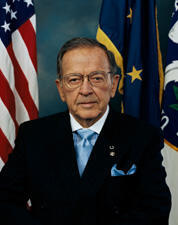
Here you will find contact information for Senator Ted Stevens, including email address, phone number, and mailing address.
| Name | Ted Stevens |
| Position | Senator |
| State | Alaska |
| Party | Republican |
| Status | Former Representative |
| Term Start | January 3, 1967 |
| Term End | January 3, 2009 |
| Terms Served | 21 |
| Born | November 18, 1923 |
| Gender | Male |
| Bioguide ID | S000888 |
About Senator Ted Stevens
Ted F. Stevens was born on November 18, 1923, in Indianapolis, Indiana, and came of age during the Great Depression, an experience that shaped his views on public service and national resilience. His family moved frequently in his youth, and he eventually settled in California, where he completed high school. During World War II, Stevens served in the United States Army Air Forces, flying transport missions over the perilous “Hump” route between India and China, an assignment that exposed him early to the strategic importance of the Pacific and the Arctic regions. This military service, combined with his Midwestern roots and Depression-era upbringing, laid the foundation for a career in which national security, infrastructure, and the development of America’s frontiers would become central themes.
After the war, Stevens pursued higher education under the G.I. Bill. He attended the University of California, Los Angeles, and then studied law at Harvard Law School in Cambridge, Massachusetts, earning his law degree and entering the legal profession. His legal training prepared him for a career that would blend law, administration, and politics, and it gave him the tools to navigate complex regulatory and legislative issues. Early in his career, Stevens worked in Washington, D.C., including service in the Department of the Interior, where he became involved with issues affecting Alaska at a time when it was still a territory. This work introduced him to the legal and political questions surrounding Alaskan statehood and resource development, and it helped establish his reputation as a capable advocate for the region.
Stevens moved to Alaska and quickly became active in territorial and then state politics, aligning himself with the Republican Party. He practiced law in Anchorage and held several governmental positions, including service as U.S. Attorney for Alaska. His work in these roles coincided with Alaska’s transition from territory to statehood in 1959, and he emerged as one of a generation of leaders focused on integrating the new state into the broader political and economic life of the United States. By the late 1960s, Stevens was a well-known figure in Alaskan public life, recognized for his understanding of federal law, his advocacy for infrastructure development, and his commitment to securing Alaska’s place in national policy debates.
On December 24, 1968, Ted F. Stevens was appointed to the United States Senate from Alaska, and he subsequently won election and re‑election, serving continuously until January 3, 2009. A member of the Republican Party, he ultimately served seven full terms in office, making him one of the longest‑serving senators in American history and the longest‑serving Republican senator at the time he left office. His tenure in Congress occurred during a significant period in American history, spanning the Vietnam War, the Cold War’s final decades, the end of the Soviet Union, the rise of globalized trade, and the post‑9/11 era. As a member of the Senate, Ted F. Stevens participated in the democratic process and represented the interests of his Alaskan constituents, contributing to the legislative process over four decades and playing a central role in shaping federal policy on energy, defense, transportation, and appropriations.
Stevens’s congressional service was particularly notable for his focus on Alaska’s strategic and economic development. He championed major infrastructure and transportation projects that would connect Alaska more fully to the rest of the United States and to international markets. Among the most visible symbols of his influence was the Anchorage International Airport, located approximately 5 miles (8 km) southwest of downtown Anchorage. Built in 1951, this airport grew into a critical hub for both passenger and cargo traffic, especially for trans‑Pacific routes between North America, Europe, and Asia. Recognizing Stevens’s long-standing advocacy for Alaska’s transportation infrastructure and his national stature, the Alaska Legislature in 2000 renamed the facility Ted Stevens Anchorage International Airport in his honor, while he was still serving in the Senate. The airport’s evolution into a major cargo hub—by 2023 ranking as the second-busiest cargo airport in the United States and the world’s fourth-busiest—reflected policy priorities Stevens had long advanced, including the use of Alaska’s geographic position as a logistical crossroads for Asia–North America trade.
The airport that now bears his name also intersected with Stevens’s personal life in a dramatic way. On December 4, 1978, he survived a plane crash at the Anchorage airport that killed his wife, Ann, underscoring both the risks of aviation in Alaska’s challenging environment and the centrality of air travel to the state’s public and political life. Over the course of his Senate career, Stevens continued to support investments in aviation safety, airport facilities, and related infrastructure, consistent with Alaska’s dependence on air transport for both passengers and cargo. His legislative work coincided with the period in which Anchorage became known as the “Crossroads of the World,” serving as a stopover for flights between Europe and East Asia during the Cold War, and later as a permanent cargo hub for carriers such as FedEx Express and UPS Airlines, which established major operations there to support Asia–Pacific trade.
Throughout his four decades in the Senate, Stevens was a central figure in appropriations and defense policy, reflecting both his seniority and his background in wartime service. He used his positions to secure funding for Alaska’s roads, ports, airports, and communications networks, arguing that such investments were essential to integrating a vast, sparsely populated, and strategically located state into the national economy and defense posture. His efforts helped ensure that facilities like Ted Stevens Anchorage International Airport were incorporated into national transportation planning, including their designation in the Federal Aviation Administration’s National Plan of Integrated Airport Systems as a medium‑hub primary commercial service facility. In this way, his legislative career and the physical infrastructure of modern Alaska became closely intertwined.
After leaving the Senate in January 2009, Stevens remained a prominent figure in Alaska and national politics, his legacy visible in the state’s transportation network, energy policy, and its enduring role in U.S. defense and trade strategy. The airport named for him continued to expand and modernize, with its South and North terminals, extensive runways, and associated facilities—such as the Lake Hood Seaplane Base and the Alaska Railroad depot opened in 2003 with federal support he helped secure—serving as daily reminders of his long commitment to connecting Alaska with the rest of the world. Ted F. Stevens died on August 9, 2010, in a plane crash near Dillingham, Alaska, but his impact on the state’s political development and its integration into national and international systems of commerce and transportation endures, symbolized most prominently by the busy international airport that bears his name and by the decades of congressional service during which he represented Alaskans in the United States Senate from 1968 to 2009.