Representative Teno Roncalio
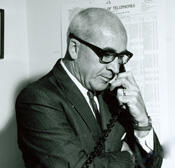
Here you will find contact information for Representative Teno Roncalio, including email address, phone number, and mailing address.
| Name | Teno Roncalio |
| Position | Representative |
| State | Wyoming |
| District | At-Large |
| Party | Democratic |
| Status | Former Representative |
| Term Start | January 4, 1965 |
| Term End | January 3, 1979 |
| Terms Served | 5 |
| Born | March 23, 1916 |
| Gender | Male |
| Bioguide ID | R000421 |
About Representative Teno Roncalio
Teno Domenico Roncalio (born Celeste Domenico Roncaglio; March 23, 1916 – March 30, 2003) was an American politician, attorney, and writer who served five terms as the at-large Representative from Wyoming in the United States House of Representatives between 1965 and 1979. A member of the Democratic Party, he was a significant figure in mid‑20th‑century Wyoming politics and, to date, is the last Democrat to have represented Wyoming in Congress. He was born in Rock Springs, Wyoming, to Frank and Ernesta Roncalio, Italian immigrants who had come to the United States in 1903. Known in childhood by the diminutive “Celestino,” he acquired the nickname “Tino,” which later evolved into “Teno,” and his family eventually dropped the “g” from their surname. In 1933, he earned his barber’s license, and after high school he worked as a reporter for the Rock Springs Rocket‑Miner, beginning a lifelong association with writing and public affairs.
Roncalio pursued higher education in Wyoming while simultaneously developing his interests in journalism and politics. In 1940, he began editing the Wyoming Collegiate features, which were published by the Casper Tribune‑Herald. While in college, he was elected president of the student body and joined the Young Democrats, activities that brought him to the attention of U.S. Senator Joseph C. O’Mahoney, who offered him a position in Washington, D.C. His education was interrupted by World War II, but he later returned to complete his studies and, in 1947, graduated from the University of Wyoming with a law degree. This legal training would underpin his later work as a prosecutor, party leader, and legislator.
Following the attack on Pearl Harbor, Roncalio enlisted in the United States Army and served with distinction during World War II. He fought in the Allied invasion of Sicily, including the Battle of Gela, and later participated in the Normandy invasion at Omaha Beach, where he was awarded the Silver Star for gallantry in action. He was discharged from the Army in 1945 with the rank of captain. After the war, he returned to Wyoming and resumed his civilian career, combining law, journalism, and politics. In 1950, he became editor of the Wyoming Labor Journal and, that same year, began serving as prosecuting attorney for Laramie County, a post he held until 1956. His prosecutorial work and labor advocacy helped establish him as a prominent Democratic figure in a predominantly Republican state.
Roncalio’s rise within the Wyoming Democratic Party accelerated during the 1950s and early 1960s. He was elected chairman of the Wyoming Democratic Party in 1957 and served as a delegate to the Democratic National Conventions in 1956, 1960, 1964, and 1968. That same year, Governor Milward Simpson proposed a civil rights bill that Roncalio had drafted after witnessing a Black couple being removed from a restaurant, reflecting his engagement with civil rights issues. As chairman of the Wyoming delegation to the 1960 Democratic National Convention, he cast the state’s fifteen votes that gave Senator John F. Kennedy the minimum needed to secure the presidential nomination. Although President‑elect Kennedy considered him for appointment to the U.S. Senate seat left vacant by Senator‑elect Edwin Keith Thomson’s death, Governor John J. Hickey instead appointed himself. Kennedy later appointed Roncalio in 1961 as chairman of the International Joint Commission on Water Rights between the United States and Canada, a binational environmental and water‑rights body, where he served until 1964 and gained experience that would inform his later environmental legislative work.
On April 28, 1964, Roncalio announced his candidacy for Wyoming’s at‑large congressional seat. In the general election that November, aided in part by President Lyndon B. Johnson’s strong showing in Wyoming, he narrowly defeated incumbent Republican Representative William Henry Harrison. Taking office in January 1965, he served in the 89th Congress and praised Johnson’s State of the Union address as a “20th century restatement of the constitutional principles on which this nation is founded.” During this first term, he served on the House Interior and Veterans’ Affairs Committees and participated actively in the legislative process, representing the interests of his Wyoming constituents. In 1965 he introduced legislation to extend the National Wool Act of 1954 through December 1972, working in tandem with Senator Gale W. McGee in the Senate, and he sponsored a bill to repeal Section 14B of the Taft–Hartley Act, which restricted union‑security agreements, though that effort failed. He also supported a bill by Representative Omar Burleson to reduce U.S. oil imports and increase domestic production, and he began efforts to have the Agate Fossil Beds authorized as a protected landscape, which Congress approved as a national monument in 1965. In 1966 he backed a constitutional amendment to lengthen House terms from two to four years and introduced a resolution supporting a constitutional amendment to lower the voting age, foreshadowing his later support for the 26th Amendment. That same year he proposed that all commercial aircraft windows be convertible to emergency exits, an idea the Federal Aviation Administration did not adopt. On June 15, 1966, he announced that he would seek a U.S. Senate seat rather than reelection to the House, but he was defeated in the general election by Republican Governor Clifford P. Hansen.
After his 1966 Senate defeat, Roncalio remained active in law, business, and politics. He filed multiple affidavits for land claims along the Snake River in Teton County, Wyoming, and in 1972 it was publicly revealed that these claims were estimated to contain as much as $7 billion in gold. He declined requests to run for the House in 1968 but remained engaged in national politics, supporting Senator Robert F. Kennedy during the 1968 Democratic presidential primaries and serving on Kennedy’s staff. Upon learning of Kennedy’s assassination, he remarked that he could not think of anything “appropriate newsworthy or decent to say,” and he subsequently aligned himself with the anti‑Humphrey movement at the 1968 Democratic National Convention. In April 1969, he was chosen by acclamation to serve as Wyoming’s Democratic National Committeeman after William A. Norris Jr. resigned. That year he announced he would not challenge Democratic Senator Gale W. McGee and instead weighed a bid for governor or a return to the House.
On June 23, 1970, Roncalio declared his candidacy for the Democratic nomination for Wyoming’s at‑large House seat. He easily defeated state representative and future governor Edgar Herschler in the primary and narrowly won the general election over Republican state Superintendent of Public Instruction Harry Roberts by 608 votes. Returning to Congress in January 1971, he embarked on four additional consecutive terms, serving until he chose not to seek reelection in 1978. During this period, he became known as a strong supporter of environmental legislation and a staunch opponent of continued American involvement in the Vietnam War. Although he had earlier, on February 12, 1965, stated that the United States should continue its intervention in Vietnam despite Chinese threats and had supported funding for a new American embassy in Saigon on April 5, 1965, his views shifted markedly by the late 1960s and early 1970s. In 1969 he criticized President Richard Nixon’s “peace with honor” plan as a “phony promise,” arguing that the United States had failed in Vietnam and should withdraw its troops. On November 10, 1971, he voted for a budget amendment to halt all defense spending by November 15 unless a withdrawal date was set, a measure that was overwhelmingly defeated, and in February 1971 he was one of ninety‑nine members to vote against a two‑year extension of the draft.
Roncalio’s later congressional service coincided with major national debates over executive power, environmental protection, and social policy. He supported the 26th Amendment lowering the voting age, consistent with his earlier advocacy, and continued to champion environmental causes, helping to establish Fossil Butte National Monument in 1972 and successfully opposing proposals in 1973 to use underground nuclear explosions to stimulate natural gas production. He also held positions on environmental committees during and after his congressional career, including service in roles that traced back to his work under President John F. Kennedy and continued into the 1980s. During the Watergate investigation, he initially remained uncommitted but, after release of the “smoking gun” tape in 1974, supported the impeachment of President Nixon. He argued that an impeachment trial should follow the confirmation of a new vice president after Spiro Agnew’s resignation, and he voted in 1973 to confirm House Minority Leader Gerald Ford as vice president. After Nixon’s resignation and Ford’s accession to the presidency, Roncalio also voted to confirm Nelson Rockefeller as vice president. In July 1974, he voted for an amendment that would have barred the use of federal funds for abortions, though it was defeated 123–247. He won reelection in 1972 against Bill Kidd by a margin similar to his 1970 victory, defeated state senator Thomas F. Stroock by more than 12,000 votes in 1974, and prevailed over Larry J. Hart by nearly 20,000 votes in 1976. Throughout these five terms, from 1965 to 1967 and again from 1971 to 1979, he contributed to the legislative process and represented Wyoming’s interests during a significant period in American history.
On September 17, 1977, during a University of Wyoming football game, Roncalio announced that he would not seek reelection in 1978 and that he would not run for governor, instead endorsing his former primary opponent Edgar Herschler for that office. In the 1978 election, Republican Dick Cheney, a former White House Chief of Staff, was elected to succeed him, and Roncalio resigned his House seat early on December 30, 1978. After leaving Congress, he returned to Wyoming and remained active in public affairs and Democratic politics. He served as Special Master in Wyoming’s Big Horn adjudication of Indian water rights until 1982, drawing on his long experience in water and environmental issues. In 1980, he endorsed Jim Rogers’s unsuccessful House campaign against Cheney; in 1982, he backed Rodger McDaniel’s unsuccessful U.S. Senate bid; and in 1990 he contributed $1,000 to Pete Maxfield’s unsuccessful House campaign against Craig L. Thomas. His wife later served as co‑chair of Kathy Karpan’s successful 1986 campaign for Wyoming Secretary of State. Roncalio also continued his interest in mineral exploration, prospecting for gold along the Snake River in Teton County in 1980.
In his later years, Roncalio remained a respected elder statesman of the Wyoming Democratic Party and an enduring symbol of its high‑water mark in a largely Republican state. He continued to support environmental causes and Democratic candidates and maintained his ties to Rock Springs and Cheyenne. In 2002, the United States Post Office in Rock Springs, Wyoming, was named in his honor, recognizing his decades of public service. Teno Roncalio died of congestive heart failure on March 30, 2003, at the Life Care Center in Cheyenne, Wyoming, and was buried in Mount Olivet Cemetery. His funeral was attended by numerous Wyoming political figures, including Governor Dave Freudenthal, former Governor Mike Sullivan, Senator Craig L. Thomas, State Chief Justice William U. Hill, former Secretary of State Kathy Karpan, and others, and a letter from Senator Edward M. Kennedy was read at the service. His career, spanning military service in World War II, leadership in the Wyoming Democratic Party, and five terms in the U.S. House of Representatives, left a lasting imprint on Wyoming’s political history and on national debates over environmental policy, civil rights, and the Vietnam War.