Representative Theodore Medad Pomeroy
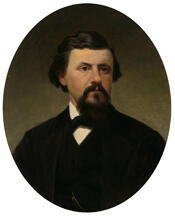
Here you will find contact information for Representative Theodore Medad Pomeroy, including email address, phone number, and mailing address.
| Name | Theodore Medad Pomeroy |
| Position | Representative |
| State | New York |
| District | 24 |
| Party | Republican |
| Status | Former Representative |
| Term Start | July 4, 1861 |
| Term End | March 3, 1869 |
| Terms Served | 4 |
| Born | December 31, 1824 |
| Gender | Male |
| Bioguide ID | P000424 |
About Representative Theodore Medad Pomeroy
Theodore Medad Pomeroy (December 31, 1824 – March 23, 1905) was an American businessman and Republican politician from New York who served four terms in the United States House of Representatives from 1861 to 1869 and briefly as the 26th speaker of the House of Representatives for one day, from March 3, 1869, to March 4, 1869, the shortest speakership in American history. He represented New York’s 24th congressional district during the Civil War and early Reconstruction era, and later served as mayor of Auburn, New York, from 1875 to 1876 and as a member of the New York State Senate from 1878 to 1879.
Pomeroy was born on December 31, 1824, and spent much of his childhood in Elbridge, New York, where he went to live at the age of nine. He was educated at Monroe Academy and, demonstrating early academic promise, entered Hamilton College as a junior at the age of fifteen. He graduated from Hamilton in 1842 at age seventeen, ranking in the first division of six students in a class of twenty-four. His family later resided in Cayuga County, and in May 1843, at the age of eighteen, he left his parents’ home in Cayuga and moved to Auburn, New York, to pursue a legal career.
In Auburn, Pomeroy entered the law firm of Beach & Underwood as a student. The firm’s counsel was William H. Seward, who had just completed his service as governor of New York (1838–1842) and would later become a United States senator and secretary of state. The firm also included Christopher Morgan and, subsequently, Samuel Blatchford, who would later serve as an associate justice of the Supreme Court of the United States. Under this distinguished tutelage, Pomeroy completed his legal studies and was admitted to practice as an attorney in the state of New York on May 23, 1846. His early professional associations with Seward and other prominent lawyers helped establish his reputation and connections in both law and politics.
Pomeroy’s public career began at the local level. In 1847 he was elected clerk of Auburn as a member of the Whig Party. In 1851 he was nominated by the Whigs and elected district attorney of Cayuga County, a position to which he was reelected in 1853, serving two terms. While serving his second term as district attorney, he married Elizabeth Leitch Watson (1835–1892) on September 4, 1855; she was the second daughter of Robert Watson of Auburn. Elizabeth’s sister, Janet MacNeil Watson (1839–1913), later married William H. Seward Jr. (1839–1920), further strengthening Pomeroy’s ties to the Seward family. Together, Theodore and Elizabeth Pomeroy had five children. At the close of his second term as district attorney, Pomeroy was chosen by the newly formed Republican Party to represent the second district of Cayuga County in the New York State Assembly, where he served in the legislature in 1857. He declined renomination after that term, but his service in the Assembly marked his transition from local to state and, soon, national politics.
In September 1860, Pomeroy was nominated and elected by the Republican Party to the United States House of Representatives from New York’s 25th congressional district, composed of Cayuga and Wayne Counties. When congressional districts were subsequently realigned, he represented New York’s 24th congressional district, which comprised the counties of Cayuga, Wayne, and Seneca. He took his seat on July 4, 1861, at the extra session of the 37th Congress convened by President Abraham Lincoln shortly after the outbreak of the Civil War. Pomeroy served continuously in Congress from 1861 to 1869, contributing to the legislative process during a critical period in American history. He was renominated by acclamation in 1862, 1864, and 1866, reflecting strong support within his party and district. Washington newspaper correspondents described him as the “youngest-looking member on the floor,” noting his small stature, keen black eyes, and “peculiarly expressive countenance,” and praised him as an energetic and effective debater “brimful to running over” with a brand of Republicanism rooted in the Declaration of Independence. He was said to be formidable in debate against both Democrats and more conservative Republicans. Throughout his four terms, Pomeroy participated actively in the democratic process, representing the interests of his constituents during the Civil War and the early years of Reconstruction.
Pomeroy’s congressional service culminated in his brief tenure as speaker of the House. On March 3, 1869, the final full day of the 40th Congress, Speaker Schuyler Colfax resigned his post in anticipation of being sworn in the next day as vice president of the United States under President Ulysses S. Grant. Upon Colfax’s resignation, the House passed a motion electing Pomeroy—himself due to leave Congress at the adjournment of the 40th Congress—the 26th speaker of the House of Representatives. He held the office from March 3 to March 4, 1869, a single day, which remains the shortest tenure of any speaker in the history of the House. With the adjournment of the 40th Congress on March 3, 1869, his eight-year service in the House came to an end.
In parallel with his political career, Pomeroy was active in business, particularly in the postwar expansion of national commerce. After the Civil War, the United States experienced a boom in industrial production and trade. In the spring of 1866, the Merchants Union Express Company was organized to transport goods across the country. The company’s leadership included Elmore P. Ross as president, William H. Seward Jr. as vice president, John N. Knapp as secretary, William C. Beardsley as treasurer, and Pomeroy as attorney. By October 1866, Merchants Union Express was transporting goods over major U.S. railroads, and by early 1867 it operated a network of express lines across the United States. The rapid expansion, however, brought heavy indebtedness, and in 1868 the company was acquired and merged with the American Merchants Union, which evolved into the American Express Company. Pomeroy remained with the merged enterprise, serving as first vice president and general counsel alongside co-founder William Fargo and later Fargo’s brother, J. C. Fargo, in 1868.
After leaving Congress, Pomeroy was briefly out of politics before returning to public life at the local and state levels. He was elected mayor of Auburn, New York, serving from 1875 to 1876, and subsequently was elected to the New York State Senate, representing the 25th District in 1878 and 1879. Following his Senate service, he retired from public life in 1879 and resided at 168 Genesee Street in Auburn. His household maintained close ties with Harriet Tubman (1822–1913), the famed abolitionist and Underground Railroad conductor, who was a close friend of the family and helped care for the Pomeroy children. Tubman attended his funeral in 1905, and it was reported that only her flowers and letter were placed on his casket and buried with him.
Pomeroy died at his home in Auburn on March 23, 1905. His descendants continued to play notable roles in public life. His grandchildren included New York state senator Robert Watson Pomeroy (1902–1989); Janet Pomeroy Avery (1891–1969), who married John Foster Dulles (1888–1959), U.S. secretary of state during the Eisenhower administration; and Josephine Herrick (1897–1972), a photographer and teacher. His great-grandchildren included John W. F. Dulles (1913–2008), a historian and specialist in Brazilian studies at the University of Texas at Austin; Lillias Dulles Hinshaw (1914–1987), a Presbyterian minister; and Avery Dulles (1918–2008), who converted to Roman Catholicism, entered the Jesuit order, and became the first American theologian to be appointed a cardinal.