Representative Theodore Sedgwick
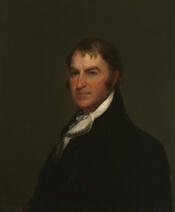
Here you will find contact information for Representative Theodore Sedgwick, including email address, phone number, and mailing address.
| Name | Theodore Sedgwick |
| Position | Representative |
| State | Massachusetts |
| District | 1 |
| Party | Federalist |
| Status | Former Representative |
| Term Start | March 4, 1789 |
| Term End | March 3, 1801 |
| Terms Served | 5 |
| Born | May 9, 1746 |
| Gender | Male |
| Bioguide ID | S000222 |
About Representative Theodore Sedgwick
Theodore Sedgwick (May 9, 1746 – January 24, 1813) was an American attorney, politician, and jurist who served in elected state government and as a delegate to the Continental Congress, a United States representative, and a senator from Massachusetts. A leading member of the Federalist Party, he served as President pro tempore of the United States Senate from June to December 1798 and as the fourth Speaker of the United States House of Representatives. He later was appointed to the Massachusetts Supreme Judicial Court in 1802 and served there for the rest of his life. His public career spanned the Revolutionary era through the early years of the federal republic, and he played a prominent role in both state and national politics.
Sedgwick was born in West Hartford in the Connecticut Colony, the son of Benjamin Sedgwick (1716–1755). His paternal immigrant ancestor, Major General Robert Sedgwick, had arrived in the Massachusetts Bay Colony in 1636 as part of the Great Migration, establishing the family’s early New England roots. Sedgwick grew up in a milieu shaped by Puritan traditions and the emerging political tensions between the colonies and Great Britain, influences that would later inform his legal and political views.
For his education, Sedgwick attended Yale College, where he studied theology and law. Although he did not graduate, he continued his legal training by reading law under attorney Mark Hopkins of Great Barrington, Massachusetts. Hopkins was the grandfather of the later Mark Hopkins who became president of Williams College. Sedgwick was admitted to the bar in 1766 and commenced practice in Great Barrington. Among the prospective attorneys who learned the law in his office was Stephen Jacob, who later served on the Vermont Supreme Court. Sedgwick subsequently moved his practice to Sheffield, Massachusetts, where he became a prominent figure in the local legal community.
During the American Revolutionary War, Sedgwick served in the Continental Army as a major and took part in the expedition to Canada and the Battle of White Plains in 1776. As a relatively young lawyer, he gained early prominence through his participation in the landmark freedom suit Brom and Bett v. Ashley (1781), in which he and fellow attorney Tapping Reeve represented two enslaved people, Elizabeth “Bett” Freeman and Brom, who sued for their freedom from Colonel John Ashley of Sheffield, Massachusetts. Relying on the 1780 Massachusetts Constitution’s declaration that “all men are born free and equal,” they successfully argued that slavery was incompatible with the new state constitution. The jury ruled that Bett and Brom were free, and the decision was upheld on appeal by the state Supreme Court. Bett, who took the name Elizabeth Freeman, chose to work for wages in the Sedgwick household, where she helped rear their children and remained associated with the family for much of her life. After her death, she was buried in Stockbridge Cemetery in the Sedgwick Pie, the family plot, beside the grave of the Sedgwicks’ fourth child, writer Catharine Maria.
A Federalist, Sedgwick began his political career in 1780 as a delegate to the Continental Congress, participating in the national deliberations that preceded the formation of the federal government under the Constitution. He was also elected as a representative to the Massachusetts state house and later as a state senator, contributing to the development of state law and governance in the post-Revolutionary period. In 1780 he was a charter member of the American Academy of Arts and Sciences, reflecting his standing in the intellectual and political life of Massachusetts. His early legislative work helped establish his reputation as a capable and reliable Federalist leader.
Sedgwick’s service in the United States Congress occurred during a significant formative period in American history. In 1789 he was elected as a Representative to Congress from Massachusetts’ first congressional district and also unsuccessfully ran for the U.S. Senate that year. Over time he also represented Massachusetts’ second district, serving continuously in the House of Representatives until 1796. During these five terms in office, he contributed to the legislative process in the First through Fourth Congresses, participating in debates over the structure of the new federal government, fiscal policy, and foreign affairs, and representing the interests of his Massachusetts constituents. In 1796 he was elected to the United States Senate from Massachusetts, where he served until 1799. While in the Senate he was chosen President pro tempore, holding that office from June to December 1798 during the tense period of the Quasi-War with France. In 1799 he returned to the House of Representatives as a member from Massachusetts’ fourth district and was elected the fifth Speaker of the House, serving as Speaker until March 1801. In this capacity he presided over the House during the closing years of the Adams administration and the contentious election of 1800, further solidifying his role as a central Federalist figure in Congress.
Sedgwick was nine years younger than John Adams and greatly admired him, supporting Adams’s successful bid for the presidency in 1796. As a U.S. senator, Sedgwick attended Adams’s inauguration on March 4, 1797, which he later described as “the most august and sublime” event he had ever witnessed. Over the course of Adams’s administration, however, policy disagreements emerged, particularly regarding Adams’s efforts to avoid an escalation of war with France by sending emissaries to Paris to negotiate a lasting peace to end the undeclared Quasi-War between 1798 and 1800. When Sedgwick learned of the mission, he criticized what he saw as Adams’s unpredictability, writing of the “vain, jealous, and half frantic mind” of the president, whom he characterized as ruled “by caprice alone.” Despite these differences, on March 4, 1801, the last day of Adams’s term and the day after Sedgwick’s retirement as Speaker of the House, the two men traveled together by carriage from Washington, D.C., back to Massachusetts, underscoring their enduring personal and political connection.
In 1802, after leaving federal office, Sedgwick was appointed a justice of the Supreme Judicial Court of Massachusetts. He held this position until his death, helping to shape the state’s jurisprudence in the early nineteenth century. His judicial service capped a long public career that had encompassed military service, state and national legislation, and leadership roles in both houses of Congress. According to research conducted by The Washington Post in 2022 and the Massachusetts Historical Society, Sedgwick himself owned at least one enslaved person: a bill of sale dated July 1, 1777, records General John Fellows selling a woman named Ton to the 30-year-old Sedgwick, a fact that complicates his legacy in light of his role in the Brom and Bett freedom suit.
Sedgwick’s personal life was marked by both prominence and tragedy. Around 1767 he married Elizabeth “Eliza” Mason, the daughter of a deacon from Franklin, Connecticut. In 1771 he contracted smallpox and transmitted the disease to his wife, who was then pregnant with their first child; she died of smallpox on April 12, 1771, at eight months’ pregnancy. On April 17, 1774, he married Pamela Dwight of the prominent New England Dwight family, daughter of Brigadier General Joseph Dwight of Great Barrington and his second wife, Abigail Williams Sargent. Abigail was the daughter of Colonel Ephraim Williams and half-sister of Ephraim Williams Jr., founder of Williams College, further linking Sedgwick to influential New England families. Theodore and Pamela Sedgwick had ten children, three of whom died within a year of birth, reflecting the high infant mortality of the era. Their children included Elizabeth Mason Sedgwick (1775–1827); an unnamed child who died at birth on March 27, 1777; Frances Pamela Sedgwick (1778–1842); Theodore Sedgwick II (1780–1839), who married children’s book author Susan Anne Livingston and whose son, also named Theodore Sedgwick, became a lawyer and author; Catherine Sedgwick (1782–1783); Henry Dwight Sedgwick (1784–1785); Henry Dwight Sedgwick (1785–1831), grandfather of lawyer and author Henry Dwight Sedgwick III; Robert Sedgwick (1787–1841), a lawyer who married Elizabeth Dana Ellery, granddaughter of Declaration of Independence signer William Ellery; Catharine Maria Sedgwick (1789–1876), who became one of the first noted female writers in the United States; and Charles Sedgwick (1791–1856), who became clerk of the Massachusetts Supreme Judicial Court and whose grandson was anatomist Charles Sedgwick Minot.
Sedgwick’s frequent absences from the family home in Stockbridge, Massachusetts, as he pursued his political career placed considerable strain on Pamela, who bore the primary responsibility for their large household, assisted by her mother, servants, and enslaved people. The deaths of three of their children, combined with the burdens of managing the family, contributed to a decline in Pamela’s physical and mental health. After the death of her mother in February 1791, Pamela developed depression and signs of hypomania. She was institutionalized for a time in December 1795, but her condition continued to worsen after her release. On September 20, 1807, she died by suicide, consuming poison. Approximately eight months later, Sedgwick announced his intention to marry Penelope Russell, eldest of ten children (six of whom died) of Dr. Charles Russell and Elizabeth (née Vassall) Russell. Charles Russell was a Harvard-educated physician who in 1771 had been appointed registrar of the Vice Admiralty Court, while Elizabeth Vassall was the daughter of Henry Vassall, a prominent Jamaican planter who left his children a sizable inheritance. The Russells and Vassalls were staunch Loyalists who sought asylum in England and Antigua during the Revolutionary War. Sedgwick and Penelope Russell met when he represented her uncle, William Vassall, in an equity case against the state of Massachusetts seeking the return of property confiscated during the war.
Sedgwick’s children were deeply distressed by his decision to remarry so soon after Pamela’s death and disapproved of Penelope Russell, whom they regarded as a spendthrift interested primarily in the Sedgwick fortune. Nevertheless, against their wishes, he married Russell on November 7, 1808, at King’s Chapel in Boston. None of his children were informed of the wedding in advance, and none attended. Despite this family estrangement, Theodore Sedgwick and Penelope Russell remained married until his death in 1813. In his final days, while on his deathbed, Sedgwick converted to Unitarianism, with his daughter Catharine Maria and the prominent minister William Ellery Channing in attendance. He died in Boston, Massachusetts, on January 24, 1813, at the age of 66 and was buried in Stockbridge, Massachusetts. His grave lies at the center of the “Sedgwick Pie,” the family plot in Stockbridge Cemetery.
Sedgwick’s descendants and extended family continued to play notable roles in American cultural and intellectual life. He was the great-grandfather of Ellery Sedgwick, owner and publisher of The Atlantic Monthly from 1908 to 1938; the third great-grandfather of Edie Sedgwick, a 1965 figure in Andy Warhol’s circle; the same ancestor to contemporary author John Sedgwick; and the fourth great-grandfather of actors Kyra Sedgwick and Robert Sedgwick. His life and times have been referenced in various historical and popular contexts, including discussions of figures such as Agrippa Hull and portrayals of the Revolutionary era in media such as the animated series “Liberty’s Kids,” episode 37.