Representative Theodore B. Werner
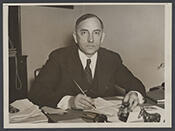
Here you will find contact information for Representative Theodore B. Werner, including email address, phone number, and mailing address.
| Name | Theodore B. Werner |
| Position | Representative |
| State | South Dakota |
| District | 2 |
| Party | Democratic |
| Status | Former Representative |
| Term Start | March 9, 1933 |
| Term End | January 3, 1937 |
| Terms Served | 2 |
| Born | June 2, 1892 |
| Gender | Male |
| Bioguide ID | W000299 |
About Representative Theodore B. Werner
Theodore B. Werner (June 2, 1892 – January 24, 1989) was a U.S. Democratic politician who served as a member of Congress from South Dakota. He was born in Ossian, Iowa, to German immigrant parents and spent his early years in that community. Raised in a German-American household, he attended parochial schools in Iowa, receiving a religiously oriented primary and secondary education that reflected the cultural traditions of his family and community.
After completing his early schooling, Werner pursued legal studies in the Midwest, studying law in Illinois and Wisconsin. Although he did not ultimately practice law as a primary profession, this legal training informed his later work in public office and in the legislative process. His education provided him with a grounding in legal principles and public policy that would prove useful in his subsequent business and political career.
In 1909, Werner moved to Rapid City, South Dakota, where he became involved in the newspaper and commercial printing businesses. He entered the local press as both a businessman and civic participant, and in 1912 he became editor and publisher of the weekly Gate City Guide. Under his leadership, the paper served as a local forum for news and opinion, and Werner continued as its publisher for more than five decades, remaining in that role until 1965. His work in journalism and printing helped establish him as a prominent figure in Rapid City’s commercial and civic life.
Werner’s public service began with federal and municipal appointments in Rapid City. He served as Rapid City’s postmaster from 1915 to 1923, overseeing local postal operations during and after World War I. He later entered city government, serving as a City Commissioner from 1927 to 1930. During this period he was elected mayor of Rapid City, holding the mayoralty in 1929 and 1930. Building on his local prominence, he sought higher office and ran for Congress in 1930, though his first bid for a seat in the U.S. House of Representatives was unsuccessful.
A member of the Democratic Party, Werner was elected to the United States House of Representatives from South Dakota in the 1932 election. He took office on March 4, 1933, at the outset of the New Deal era, and was reelected in 1934, serving two terms in Congress from March 4, 1933, to January 3, 1937. During this significant period in American history, marked by the Great Depression and sweeping federal reforms, Werner contributed to the legislative process as a Democratic representative and participated in the democratic governance of the nation. He represented the interests of his South Dakota constituents in the House of Representatives and took part in deliberations over national economic recovery and related policy issues. In 1936 he sought another term but was defeated in his bid for reelection by Republican Francis H. Case, concluding his congressional service at the start of 1937.
After leaving Congress, Werner remained active in public affairs. In 1947 he was appointed United States Marshal for South Dakota, a federal law enforcement position in which he was responsible for duties such as overseeing federal court security, executing court orders, and managing federal prisoners within the state. He served as U.S. Marshal until 1951, further extending a public career that had begun decades earlier in local government and federal service.
Werner continued to reside in Rapid City in his later years, maintaining his long-standing ties to the community where he had built his business and political life. He died in Rapid City on January 24, 1989, at the age of 96. He was buried in Mountain View Cemetery in Rapid City, South Dakota, closing a life that spanned nearly a century and included service at the local, state, and national levels of government.