Representative Thomas Ryum Amlie
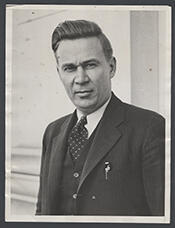
Here you will find contact information for Representative Thomas Ryum Amlie, including email address, phone number, and mailing address.
| Name | Thomas Ryum Amlie |
| Position | Representative |
| State | Wisconsin |
| District | 1 |
| Party | Progressive |
| Status | Former Representative |
| Term Start | December 7, 1931 |
| Term End | January 3, 1939 |
| Terms Served | 3 |
| Born | April 17, 1897 |
| Gender | Male |
| Bioguide ID | A000176 |
About Representative Thomas Ryum Amlie
Thomas Ryum Amlie (April 17, 1897 – August 22, 1973) was an American politician and lawyer who served as a two-time U.S. representative from Wisconsin’s 1st congressional district. He first entered Congress as a Republican, serving from 1931 to 1933, and later returned as a member of the Wisconsin Progressive Party, serving from 1935 until his retirement from Congress in 1939. Over three terms in the House of Representatives, Amlie participated actively in the legislative process during a period marked by the Great Depression, the rise of the New Deal, and significant realignments in Wisconsin and national politics.
Amlie was born on a farm near Binford, Griggs County, North Dakota, on April 17, 1897. He grew up in a rural environment and attended high school in Cooperstown, North Dakota, where he was a member of the debate team along with his brother, Hansford “Hans” Amlie, who would later become a commander in the Abraham Lincoln Battalion during the Spanish Civil War. After completing high school, Amlie enrolled at the University of North Dakota, attending from 1916 to 1918. His studies were interrupted by service in the United States Army for a short period during or immediately following World War I. Following his military service, he spent a year at the University of Minnesota, initially intending to pursue a career teaching sociology and economics. Becoming disillusioned with that path, he turned instead to political organizing and became involved with the Nonpartisan League, reflecting an early commitment to agrarian and progressive reform.
Amlie’s organizing work for the Nonpartisan League brought him to Wisconsin, where he soon decided to pursue a legal career. He enrolled in the University of Wisconsin Law School, receiving his law degree in 1923 and being admitted to the bar that same year. He then served two years as assistant clerk to the Dane County Superior Court and one year as a legal examiner for the Wisconsin State Department of Markets, positions that gave him experience in both the judicial system and state regulatory work. During the 1924 presidential election, Amlie was district chairman for Senator Robert M. La Follette’s Progressive campaign, underscoring his alignment with the La Follette wing of Midwestern progressivism. That same year he ran unsuccessfully for Eau Claire County district attorney. Later in 1924, he began practicing law in Beloit, Wisconsin, where he helped establish the firm of Fiedler, Garrigan, and Amlie. In 1927 he moved to Elkhorn, Wisconsin, which became his permanent residence and the base from which he launched his congressional career.
In October 1931, following the death of long-serving Representative Henry Allen Cooper, Amlie entered electoral politics at the national level. He ran in the special election to fill Cooper’s seat in Wisconsin’s 1st congressional district, which covered much of the southeastern corner of the state. In a crowded Republican primary that included State Senators George W. Blanchard and Edward F. Hilker and two other candidates, Amlie emerged victorious, defeating Blanchard by a margin of 1,332 votes. Elected as a Republican to the 72nd Congress, he served from October 1931 until March 3, 1933. In the run-up to the 1932 primary, the intraparty split between progressive and stalwart Republicans became pronounced, with Amlie backed by the progressives and Blanchard supported by the party’s stalwart faction and endorsed by the 1st District Republican convention. In the 1932 Republican primary, Amlie and Blanchard were the only candidates; Blanchard narrowly defeated Amlie with 51.75 percent of the vote, ending Amlie’s first congressional term.
Defeat did not diminish Amlie’s role in the evolving progressive movement. In 1933 he helped form the Farmer-Labor-Progressive League (FLPL), an organization intended to develop a platform and endorse candidates for a regional left-wing third party that would unite rural and urban producers. By this time, the Great Depression had severely worsened economic conditions in Wisconsin, and the resurgence of the state Democratic Party, combined with the decline of Progressive Republicans within the GOP, pushed many reformers to seek new political vehicles. Amlie was among the earliest and most vocal advocates of a formal break from the Republican Party. He believed that capitalism was in terminal crisis and that President Franklin D. Roosevelt’s policies could, at best, delay but not avert a more fundamental transformation. Influenced by the Frontier Thesis, he argued that the closing of the American frontier had removed a vital safety valve for economic distress, making a transition to some form of socialism necessary to preserve democracy. He articulated these views publicly at the League for Independent Political Action convention in September 1933. Working closely with former Governor Philip La Follette, Amlie pressed for a new party that would move decisively to the left, though his more radical ambitions were checked by La Follette and allies such as William T. Evjue of the Madison-based Capital Times. The FLPL, which Amlie helped found with Appleton attorney Sam Sigman, former Representative George Schneider, and former State Senator Anton M. Miller, initially risked complicating La Follette’s plans for a new party, but after La Follette addressed the League’s convention, the organization agreed to support his Progressive Party.
In the spring of 1934, the progressive faction formally split from the Republican Party of Wisconsin and established the Wisconsin Progressive Party, significantly reshaping the state’s political landscape. By the end of July 1934, Amlie had declined to seek the Progressive nomination for governor, citing financial reasons and his belief that Philip La Follette was the best candidate to lead the ticket. Instead, Amlie sought to regain his former congressional seat as a Progressive. He was elected to the 74th Congress and reelected to the 75th Congress on the Wisconsin Progressive Party ticket, serving from January 3, 1935, to January 3, 1939. During these terms, he and other Progressives were informally allied with the New Deal coalition and supported Roosevelt’s reelection in 1936. By this time, Amlie had largely abandoned his earlier hopes for a powerful third party at the national level, concluding, as many progressives did, that liberal reform would have to proceed through a Roosevelt-led Democratic Party. In Congress, Amlie remained on the left wing of the Progressive movement. In 1937 he joined the overwhelming majority of Congress in voting to ban the export of weapons to either side in the Spanish Civil War. Just two days after that vote, his brother Hans was reported to have volunteered for the pro-Republican International Brigades; Amlie later supported a fundraising drive by the Friends of the Abraham Lincoln Brigade to bring wounded American volunteers home. In 1938 he co-sponsored, with Democrats Jerry Voorhis and Robert Allen, the Industrial Expansion Bill, which proposed a planned economy in the United States. That same year he served on a committee organized to defend Fred Beal, a union organizer who, having returned from the Soviet Union, faced recommittal in North Carolina after a 1929 conspiracy conviction. On this committee Amlie worked alongside Homer Martin of the United Auto Workers, Representative Voorhis, sociologist and pacifist Emily Greene Balch, attorney and feminist Dorothy Kenyon, and poet Sara Bard Field; the committee reported hostile pressure from members of the Communist-controlled International Labor Defense and numerous anonymous threats.
In 1938 Amlie declined to run for reelection to the House and instead sought the Wisconsin Progressive Party’s nomination for the U.S. Senate, challenging incumbent Democratic Senator F. Ryan Duffy. In the Progressive primary he faced Lieutenant Governor Herman Ekern and lost by seven points. The contest reopened longstanding divisions within the Progressive Party between the La Follette family’s allies and younger radicals associated with farmer-labor organizations. Ekern enjoyed the private support of Philip and Robert M. La Follette Jr., while Amlie was endorsed by Milwaukee Mayor Daniel Hoan. Amlie later blamed his defeat on Evjue, the Capital Times, and even the Progressive Party itself. With his congressional service ending in January 1939, President Roosevelt nominated Amlie to the Interstate Commerce Commission, but at Amlie’s own request the nomination was withdrawn. Roosevelt subsequently appointed him special assistant United States attorney in the Federal Land Commission office in Milwaukee. Amlie eventually resigned that post to return to electoral politics.
By 1940 Amlie had joined the Democratic Party as a self-described “Roosevelt Democrat” and encouraged other progressives to leave the third party and follow him into the Democratic ranks. That year he ran in a special election for his old House seat in Wisconsin’s 1st district as a Democrat. He won the Democratic primary by a wide margin over Bernard Magruder and campaigned in the general election on a platform of support for Roosevelt’s domestic and foreign policies. Nevertheless, he was defeated decisively by Republican Lawrence H. Smith. In 1941 he again sought election to Congress and later ran for the Wisconsin Supreme Court and for the U.S. House from Wisconsin’s 2nd district, but he never again held elective office. After his final campaigns, Amlie returned from Washington, D.C., to Wisconsin and resumed the practice of law in Madison, where he lived for the remainder of his life.
Amlie’s personal life reflected both tragedy and continuity. In 1925 he married Marian Caldwell Strong, who died in 1930. Two years later, in 1932, he married Gehrta Farkasch Beyer, who survived him. He was the father of five children—four sons and one daughter. Through his brother Hans, who served in the XV International Brigade in the Spanish Civil War on the side of the Spanish Republicans, Amlie was the brother-in-law of journalist Milly Bennett. Thomas Ryum Amlie died in Madison, Wisconsin, on August 22, 1973. His remains were cremated and interred at Sunset Memory Gardens in Forest Hill Cemetery in Madison.