Senator Thomas Robert Bard
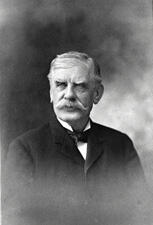
Here you will find contact information for Senator Thomas Robert Bard, including email address, phone number, and mailing address.
| Name | Thomas Robert Bard |
| Position | Senator |
| State | California |
| Party | Republican |
| Status | Former Representative |
| Term Start | February 7, 1900 |
| Term End | March 3, 1905 |
| Terms Served | 1 |
| Born | December 8, 1841 |
| Gender | Male |
| Bioguide ID | B000138 |
About Senator Thomas Robert Bard
Thomas Robert Bard (December 8, 1841 – March 5, 1915) was an American political leader and businessman in California who assisted in the organization of Ventura County and represented California in the United States Senate from 1900 to 1905 as a Republican. Widely known as the “Father of Port Hueneme” for his central role in building and expanding the community and developing the first and only deep-water port in the area, he was also one of the founders of the Union Oil Company of California (later UNOCAL). Over the course of a varied career, Bard engaged in wharfing and warehousing, banking, petroleum mining, sheep grazing, and real estate, and became a significant figure in the political and economic development of Southern California.
Bard was born in Chambersburg, Franklin County, Pennsylvania, on December 8, 1841. He attended the common schools and graduated from Chambersburg Academy in 1858. While at the academy he studied law, but his early professional experience came in the railroad industry. Before his graduation he secured employment with the Pennsylvania Railroad, and he later became an assistant to the superintendent of the Cumberland Valley Railroad. He also engaged in the grain business in Hagerstown, Maryland. During the early part of the Civil War, Bard served as a volunteer Union scout during Confederate invasions of Maryland and Pennsylvania, activity that reflected both his loyalty to the Union and his familiarity with the region’s terrain and transportation networks.
After the Civil War, Bard turned his attention westward. In 1865 he arrived in what is now Ventura County, California, to develop properties in the Ojai area owned by his uncle, Thomas A. Scott, a prominent railroad executive. Some accounts place his move to Ventura County as early as 1864, but in either case he quickly established himself as a leading local businessman. In 1867 he became the first person in California to produce oil from a drilled well, marking the beginning of a long and profitable involvement in the petroleum industry. Bard’s business interests expanded to include wharf construction and operation, warehousing, banking, sheep grazing, and extensive dealings in real estate, laying the foundation for his later role in regional development.
Bard soon entered public life in Southern California. He served as a member of the board of supervisors of Santa Barbara County from 1868 to 1873, a period when the area that would become Ventura County was still part of Santa Barbara County. In 1871 he was appointed a commissioner to organize Ventura County, and he played a key role in establishing the new county’s governmental structure. During this time he purchased and subdivided Rancho El Rio de Santa Clara o la Colonia and laid out the plans for the town and port of Hueneme, the future site of his Berylwood estate. His efforts to develop a deep-water harbor there earned him lasting recognition as the “Father of Port Hueneme.” Through his leadership in local government and land development, Bard helped shape the political and economic landscape of the region.
Beyond local affairs, Bard became active in state and national Republican politics. He served as a California delegate to the Republican National Convention in 1884, participating in the party’s presidential nominating process. From 1886 to 1887 he was a director of the California State Board of Agriculture, reflecting his interest in and influence over the state’s agricultural development. In 1887 he became a founding board member of Occidental College in Los Angeles, contributing to the establishment of one of Southern California’s early institutions of higher education. Meanwhile, his oil enterprises grew, and he became a successful businessman with profitable interests in several petroleum companies, including his role as one of the founders of the Union Oil Company of California.
Bard’s prominence in business and Republican politics led to his election to the United States Senate. On February 6, 1900, he was elected as a Republican to the Senate to fill the vacancy caused by the death of Senator Stephen M. White. He served a single term from February 6, 1900, until March 3, 1905. His service in Congress occurred during a significant period in American history, spanning the early Progressive Era and the aftermath of the Spanish-American War. As a member of the Senate, Thomas Robert Bard participated in the legislative process, represented the interests of his California constituents, and contributed to national debates. During the Fifty-seventh Congress he served as chairman of the Committee on Fisheries, and during the Fifty-eighth Congress he was a member of the Committee on Irrigation, assignments that reflected both his coastal constituency and the importance of water and natural resources to the American West. Among his notable acts in office was his role in securing the appointment of George S. Patton, later a famed World War II general, to the United States Military Academy at West Point. Bard was unsuccessful in his bid for reelection in 1904 and left the Senate at the close of his term in March 1905.
After his Senate service, Bard returned to his extensive business and civic interests in California. He continued to oversee his oil, land, and harbor enterprises and remained a respected figure in Ventura County and the broader region. Together with his brother, Dr. Cephas Little Bard, he established the Elizabeth Bard Memorial Hospital in Ventura as a memorial to their mother, contributing to the area’s medical infrastructure. His family also achieved distinction in other fields; his son, Archibald Philip Bard, became a noted physiologist and later served as dean of the Johns Hopkins University School of Medicine. Bard maintained his residence at Berylwood, his estate at Port Hueneme, which served as both a family home and a symbol of his long association with the development of the port and surrounding community.
Thomas Robert Bard died at his Berylwood home in Port Hueneme, California, on March 5, 1915. He was originally interred in the family cemetery on his estate. His remains were later moved by the military to Ivy Lawn Cemetery in Ventura, California. Bard’s name endures in several California place names, including Bardsdale and Bard, reflecting the lasting imprint of his work in land development, local government, and the early oil industry.