Representative Thomas Henry Bayly Browne
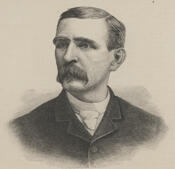
Here you will find contact information for Representative Thomas Henry Bayly Browne, including email address, phone number, and mailing address.
| Name | Thomas Henry Bayly Browne |
| Position | Representative |
| State | Virginia |
| District | 1 |
| Party | Republican |
| Status | Former Representative |
| Term Start | December 5, 1887 |
| Term End | March 3, 1891 |
| Terms Served | 2 |
| Born | February 8, 1844 |
| Gender | Male |
| Bioguide ID | B000957 |
About Representative Thomas Henry Bayly Browne
Thomas Henry Bayly Browne (February 8, 1844 – August 27, 1892) was a Virginia lawyer, Confederate veteran, and two-term Republican member of the United States House of Representatives from Virginia’s 1st congressional district, serving from 1887 to 1891. He represented Virginia in Congress during a significant period in American history, participating in the legislative and democratic processes and advocating for the interests of his constituents on the Eastern Shore and surrounding areas.
Browne was born on February 8, 1844, in Drummondtown, Accomack County, on Virginia’s Eastern Shore. Drummondtown, later renamed Accomac shortly after his death, was home to established planter families, among whom were his parents, Dr. Peter Fielding Browne (1813–1880) and Sally Cropper Bayly Browne (1813–1857). He had an elder brother, Orris Applethwaite Browne (1842–1898), and a sister who died in infancy. Raised in a family of some local prominence, he was educated first by private tutors and then attended Hanover Academy and Bloomfield Academy in Virginia, receiving the classical and preparatory education typical of young men of his social standing in the antebellum South.
With the outbreak of the American Civil War, Browne left his formal schooling to enlist in the Confederate States Army. He entered service as a private in Company F of the 39th Virginia Infantry, a unit in which his widowed father served as surgeon. By 1864, Dr. Peter Fielding Browne was overseeing a division of the large Chimborazo Hospital in Richmond, one of the principal Confederate military hospitals. Thomas Henry Bayly Browne later transferred to Chew’s Battalion of Stuart Horse Artillery, serving in the mounted artillery arm of the Army of Northern Virginia. He remained with that army through the final campaigns of the war and was present when it surrendered at Appomattox Court House on April 9, 1865. His brother, Orris Applethwaite Browne, after graduating from the Virginia Military Institute in 1862, served in the Confederate Navy aboard the commerce raider CSS Shenandoah, further underscoring the family’s deep involvement in the Confederate war effort.
After the Civil War, Browne resumed his education and turned to the study of law. He entered the law department of the University of Virginia and graduated in 1867, receiving formal legal training at one of the South’s leading institutions. He was admitted to the Virginia bar in 1868 and returned to his native Drummondtown to begin the practice of law. In the postwar years he established himself as a local attorney, while his brother Orris also returned to the Eastern Shore, where he advocated agricultural reforms and held a state position regulating the oyster industry, an important economic sector for the region.
Browne’s legal career soon led him into public office. In 1873, the voters of Accomack County elected him Commonwealth’s attorney (county prosecutor), a position of considerable responsibility in the local justice system. He was re-elected to this office, reflecting the confidence of his community in his abilities as a lawyer and public servant. During these years he also established a family life. After the war he married Anna Drummond Fletcher (1849–1926). The couple had several children, and one of their daughters and two sons survived to adulthood. Among these children was Beverly Fielding Browne, who would later serve as an artillery commander and brigadier general in World War I, extending the family’s record of military and public service into the twentieth century.
Browne’s prominence as a lawyer and local official positioned him for a broader political career. In 1886, running as a Republican in a region and state still largely dominated by Democrats in the post-Reconstruction era, he was elected to represent Virginia’s 1st congressional district in the Fiftieth Congress. In that election he defeated the incumbent Democrat, Thomas Croxton, winning 54.07 percent of the vote. Taking his seat in March 1887, Browne served as a member of the United States House of Representatives from 1887 to 1889, contributing to the legislative process and representing the interests of his Eastern Shore and Tidewater constituents during a period of economic adjustment and political realignment in the South.
In 1888, Browne successfully sought re-election as a Republican to the Fifty-first Congress. He won with 50.71 percent of the vote, defeating Democrat Gilmer S. Kendall, and continued his service in the House from 1889 to 1891. Over his two terms, Browne participated in debates and votes on issues affecting both his district and the nation, including matters of economic policy, veterans’ affairs, and federal governance in the late nineteenth century. His tenure in Congress, from 1887 to 1891, coincided with a time of growing industrialization and shifting party coalitions, and he stood out as a Republican representative from a traditionally Democratic state. In the 1890 election, however, amid changing political currents and a resurgent Democratic Party in Virginia, Browne lost his bid for a third term. He received 45.4 percent of the vote and was defeated by Democrat William A. Jones, bringing his congressional service to a close in March 1891.
After leaving Congress, Browne returned to Drummondtown (Accomac) and resumed the practice of law. He continued to live and work in the community where he had been born, maintaining his professional standing and local ties. His post-congressional years were brief. Thomas Henry Bayly Browne died in Drummondtown on August 27, 1892, only a few months after returning full-time to his legal practice. His death came just before his hometown was officially renamed Accomac, marking the end of a life that had spanned the antebellum, Civil War, Reconstruction, and post-Reconstruction eras in Virginia.