Representative Thomas Banks Cabaniss
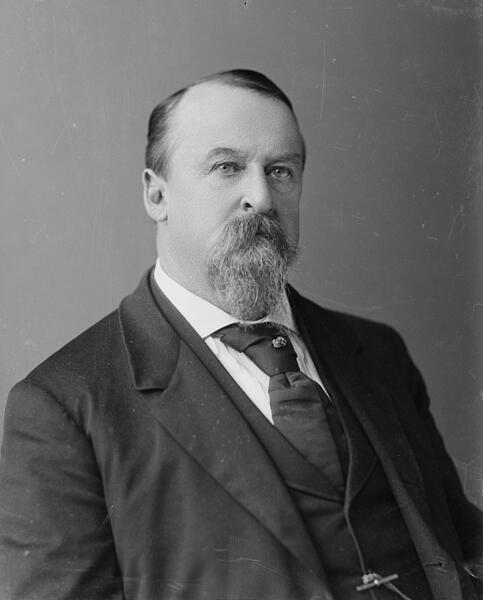
Here you will find contact information for Representative Thomas Banks Cabaniss, including email address, phone number, and mailing address.
| Name | Thomas Banks Cabaniss |
| Position | Representative |
| State | Georgia |
| District | 6 |
| Party | Democratic |
| Status | Former Representative |
| Term Start | August 7, 1893 |
| Term End | March 3, 1895 |
| Terms Served | 1 |
| Born | August 31, 1835 |
| Gender | Male |
| Bioguide ID | C000001 |
About Representative Thomas Banks Cabaniss
Thomas Banks Cabaniss (August 31, 1835 – August 14, 1915) was a United States Representative from Georgia who served one term in the U.S. House of Representatives from 1893 to 1895. A member of the Democratic Party, he represented the interests of his Georgia constituents during a significant period in American history, contributing to the legislative process in the closing years of the nineteenth century. Over the course of his public life, he combined a legal career in Forsyth, Georgia, with service in both the Georgia House of Representatives and the Georgia Senate before advancing to national office.
Cabaniss was born on August 31, 1835, and came of age in the antebellum South, a context that shaped his early experiences and later public career. He was raised in Georgia, where he developed the regional ties and familiarity with local issues that would later inform his work as a state legislator and member of Congress. Growing up in a period marked by sectional tensions and rapid political change, he entered adulthood as the nation moved toward the Civil War, an era that framed the early stages of his professional and political development.
Educated in Georgia, Cabaniss pursued the study of law, preparing for a profession that was closely linked to public life in the nineteenth century. After completing his legal studies and gaining admission to the bar, he established himself as a lawyer in Forsyth, the seat of Monroe County, Georgia. His legal practice in Forsyth placed him at the center of local civic and economic affairs, and his work as an attorney helped build the reputation and connections that would support his entry into elective office at the state level.
Cabaniss’s political career began in the Georgia General Assembly, where he served in the Georgia House of Representatives and later in the Georgia Senate. In these roles he participated in the reconstruction and post-Reconstruction governance of the state, engaging with legislation affecting Georgia’s legal framework, economy, and public institutions. His service in both chambers of the state legislature reflected the confidence of his constituents and provided him with legislative experience and familiarity with parliamentary procedure that would prove valuable when he moved on to the national stage.
In 1893, Cabaniss entered the Fifty-third Congress as a Democratic Representative from Georgia, serving in the U.S. House of Representatives until 1895. His single term in Congress coincided with a turbulent period in American politics marked by economic distress, including the Panic of 1893, and intense debates over monetary policy, tariffs, and federal responses to economic hardship. As a member of the House, he participated in the democratic process at the national level, representing Georgia’s interests and contributing to deliberations on issues of concern to his constituents and the broader region. Although he served only one term, his tenure placed him among the generation of Southern Democrats who helped shape federal policy in the late nineteenth century.
After leaving Congress in 1895, Cabaniss returned to Georgia and resumed his legal and civic activities in Forsyth. Drawing on his experience in both state and national government, he remained a respected figure in his community and in Georgia’s legal and political circles. He lived through the transition into the twentieth century, witnessing continued changes in Southern politics and national affairs. Thomas Banks Cabaniss died on August 14, 1915, closing a life that spanned from the antebellum era through the Civil War, Reconstruction, and the emergence of the modern United States, and that was marked by sustained service as a lawyer, state legislator, and member of Congress from Georgia.