Representative Thomas Clendinen Catchings
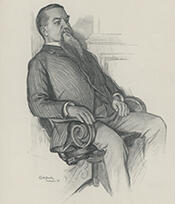
Here you will find contact information for Representative Thomas Clendinen Catchings, including email address, phone number, and mailing address.
| Name | Thomas Clendinen Catchings |
| Position | Representative |
| State | Mississippi |
| District | 3 |
| Party | Democratic |
| Status | Former Representative |
| Term Start | December 7, 1885 |
| Term End | March 3, 1901 |
| Terms Served | 8 |
| Born | January 11, 1847 |
| Gender | Male |
| Bioguide ID | C000247 |
About Representative Thomas Clendinen Catchings
Thomas Clendinen Catchings (also spelled Thomas Clendenin Catchings) (January 11, 1847 – December 24, 1927) was an American lawyer and Democratic politician who served eight consecutive terms as a U.S. Representative from Mississippi from 1885 to 1901. Over the course of his eight terms in the House of Representatives, he participated actively in the legislative process and represented the interests of his Mississippi constituents during a significant period in American history.
Catchings was born on January 11, 1847, at the family estate known as “Fleetwood” in Hinds County, Mississippi, to Dr. T. J. Catchings and Nancy M. Clendenin Catchings. He was educated at home by private tutors until September 1860, when he entered the State University at Oxford, Mississippi (now the University of Mississippi), where he became a member of the St. Anthony Hall fraternity. In 1861 he transferred to Oakland College near Rodney, Mississippi, continuing his studies there as the sectional crisis deepened into civil war.
With the outbreak of the American Civil War, Catchings entered the Confederate States Army in 1861 while still a young man. He first served as a private in Company K, 18th Mississippi Infantry Regiment, and later in Company C, 11th Mississippi Cavalry Regiment. His wartime service interrupted his formal education, but it placed him within the generation of Southern men whose early adulthood was shaped by the conflict and its aftermath.
After the war, Catchings read law and was admitted to the bar in 1866. He commenced the practice of law in Vicksburg, Mississippi, where he quickly established himself in the legal profession. His abilities at the bar and his standing in the community led him into public life. In 1875 he was elected to the Mississippi State Senate, though he resigned that position in 1877. That same year he was elected attorney general of Mississippi, a post to which he was reelected in 1881. He served as the state’s attorney general from 1877 until February 16, 1885, playing a prominent role in the legal affairs of Mississippi during the post-Reconstruction era.
A member of the Democratic Party, Catchings was elected to the Forty-ninth Congress and to the seven succeeding Congresses, serving in the U.S. House of Representatives from March 4, 1885, to March 3, 1901. His initial election followed a disputed contest against Cornelius Jones, an African American lawyer and state legislator, which Catchings ultimately won. During his sixteen years in Congress, he contributed to the legislative process and became particularly associated with issues related to internal improvements and river and harbor development, which were of central importance to his Mississippi district and the broader Mississippi River Valley.
Within the House, Catchings held several influential committee chairmanships. He served as chairman of the Committee on Levees and Improvements of the Mississippi River during the Fiftieth Congress, reflecting his district’s concern with flood control and navigation. In the Fifty-second and Fifty-third Congresses he chaired the Committee on Railways and Canals, and during the Fifty-third Congress he also chaired the Committee on Rivers and Harbors, positions that placed him at the center of federal policy on transportation infrastructure and waterway development. In January 1896 he first introduced a bill to establish the Vicksburg National Military Park, seeking to commemorate the pivotal Civil War campaign in his home state. Although the bill failed to pass in that Congress despite receiving a favorable committee report, he reintroduced the measure in December 1897 in the next Congress, underscoring his sustained commitment to the project.
After leaving Congress in 1901, Catchings returned to the practice of law and continued his professional career in the private sector. He was employed as division counsel for the Southern Railway, advising one of the major transportation companies of the era at a time when railroads remained central to the economic life of the South. He also continued to serve the state in a legal and advisory capacity; appointed by Governor James K. Vardaman, he became a member of the Mississippi Code Commission, contributing to the revision and organization of the state’s statutory law.
Thomas Clendinen Catchings spent his later years in Vicksburg, Mississippi. He died there on December 24, 1927, closing a long career in law and public service that spanned the Civil War, Reconstruction, and the turn of the twentieth century. He was interred in Cedar Hill Cemetery in Vicksburg.