Representative Thomas Corwin
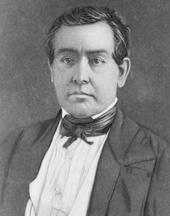
Here you will find contact information for Representative Thomas Corwin, including email address, phone number, and mailing address.
| Name | Thomas Corwin |
| Position | Representative |
| State | Ohio |
| District | 7 |
| Party | Republican |
| Status | Former Representative |
| Term Start | December 5, 1831 |
| Term End | March 3, 1863 |
| Terms Served | 8 |
| Born | July 29, 1794 |
| Gender | Male |
| Bioguide ID | C000791 |
About Representative Thomas Corwin
On This Page
Thomas Corwin (July 29, 1794 – December 18, 1865), also known as Tom Corwin, “The Wagon Boy,” and “Black Tom,” was an American politician from the state of Ohio who represented Ohio in both houses of Congress and served as the 15th Governor of Ohio and the 20th United States Secretary of the Treasury. After affiliating with the Whig Party, he joined the Republican Party in the 1850s. Corwin is best known for his sponsorship of the proposed Corwin Amendment, an unsuccessful attempt to prevent the American Civil War by forbidding the federal government from outlawing slavery.
Early Life
Corwin was born in Bourbon County, Kentucky, on July 29, 1794, the son of Matthias Corwin and Patience Halleck. His father served eleven times in the Ohio Legislature. The family moved to Lebanon, Ohio, in 1798, where young Thomas grew up. During the War of 1812, he served as a wagon boy in General William Henry Harrison’s army, earning his lifelong nickname “The Wagon Boy.”
In 1815, Corwin began the study of law in the offices of Joshua Collett. He was admitted to the bar in 1817 and commenced practice in Lebanon. He served as prosecuting attorney of Warren County from 1818 to 1828. On November 13, 1822, he married Sarah Ross.
Congressional and Gubernatorial Career
Corwin served in the Ohio House of Representatives from 1822 to 1823 and again in 1829. In 1830, he was elected as a Whig to the U.S. House of Representatives, serving from March 4, 1831, until his resignation on May 30, 1840. Known for his sharp wit, debating skills, and tireless campaigning, he was elected Governor of Ohio in 1840, defeating incumbent Wilson Shannon. Shannon defeated Corwin in a rematch two years later.
Corwin was elected to the United States Senate by the Ohio General Assembly in 1844 and served from March 4, 1845, to July 20, 1850. As a senator, he was renowned for his oratory, and his most famous speech, given on February 11, 1847, was a powerful denunciation of the Mexican-American War.
Secretary of the Treasury and Later Career
Corwin resigned from the Senate to become President Millard Fillmore’s Secretary of the Treasury in 1850. He served in that role until 1853, advocating for a protective tariff while avoiding sudden changes to the existing free-trade laws.
He was again elected to the House of Representatives in 1858 as a Republican. In 1860, as chairman of the House “Committee of Thirty-three,” he led efforts to reconcile the North and South during the secession crisis following Abraham Lincoln’s election. To that end, he sponsored a proposed constitutional amendment — later known as the Corwin Amendment — which would have forbidden the federal government from outlawing slavery. Though the amendment passed the Senate on March 2, 1861, and was ratified by five states, it failed to prevent the outbreak of the Civil War.
Corwin resigned from Congress on March 12, 1861, after being appointed by President Lincoln as Minister to Mexico, where he served until 1864. Well regarded among the Mexican public for his earlier opposition to the Mexican-American War, Corwin helped maintain friendly U.S.-Mexico relations throughout the Civil War.
Death and Legacy
After returning from Mexico, Corwin settled in Washington, D.C., in 1864 and practiced law until his death on December 18, 1865, at the age of 71. He is interred in Lebanon Cemetery, Lebanon, Ohio.
Corwin is remembered chiefly as an orator of remarkable eloquence. His dark complexion earned him the nickname “Black Tom.” Several places are named in his honor, including the village of Corwin, Ohio, and the USRC Thomas Corwin, a United States Revenue Cutter Service vessel commissioned in 1876.