Representative Thomas D’Alesandro
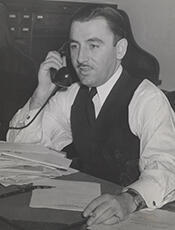
Here you will find contact information for Representative Thomas D’Alesandro, including email address, phone number, and mailing address.
| Name | Thomas D’Alesandro |
| Position | Representative |
| State | Maryland |
| District | 3 |
| Party | Democratic |
| Status | Former Representative |
| Term Start | January 3, 1939 |
| Term End | January 3, 1949 |
| Terms Served | 5 |
| Born | August 1, 1903 |
| Gender | Male |
| Bioguide ID | D000007 |
About Representative Thomas D’Alesandro
Thomas Ludwig John D’Alesandro Jr. (August 1, 1903 – August 23, 1987) was an American politician who served as the 41st mayor of Baltimore from 1947 to 1959 and as a Democratic Representative from Maryland in the United States Congress from 1939 to 1949. A prominent member of the Democratic Party, he represented Maryland’s 3rd congressional district in the U.S. House of Representatives from January 3, 1939, until his resignation on May 16, 1947, completing five terms in office and contributing to the legislative process during a significant period in American history. He later became widely recognized as the patriarch of the D’Alesandro political family, which includes his daughter Nancy Pelosi, the 52nd speaker of the United States House of Representatives, and his son Thomas D’Alesandro III, the 44th mayor of Baltimore.
D’Alesandro was born in Baltimore, Maryland, on August 1, 1903, the son of Maria Antonia Petronilla (née Foppiani) and Tommaso F. D’Alessandro. His father emigrated from Montenerodomo, in the Abruzzo region of Italy, while his mother was born in Baltimore to parents from Genoa, in Liguria, Italy. Raised in a working-class, Italian American household in Baltimore, he grew up in an environment that would later shape his political instincts and his close identification with the city’s ethnic and immigrant communities. Although of Italian heritage, he did not speak Italian, but he did speak Yiddish, reflecting his close ties to Baltimore’s Jewish community.
D’Alesandro attended Calvert Business College in Baltimore, where he received business training that prepared him for a career in the private sector before entering politics. After his studies, he worked as an insurance and real estate broker in Baltimore. This early professional experience in business and property management provided him with practical knowledge of urban economic issues, including housing and commercial development, which later informed his approach to municipal governance and legislative priorities.
D’Alesandro’s political career began at the state level. He served as a member of the Maryland House of Delegates from 1926 to 1933, representing Baltimore in Annapolis during the late 1920s and early years of the Great Depression. In 1933 he was appointed General Deputy Collector of Internal Revenue, a federal post he held from 1933 to 1934, giving him experience in federal administration and tax enforcement during the New Deal era. Returning to local politics, he was elected to the Baltimore City Council, where he served from 1935 to 1938, building a strong local base and a reputation as an energetic Democratic leader.
In 1938, D’Alesandro was elected to the 76th Congress and subsequently to the four succeeding Congresses, serving in the U.S. House of Representatives from January 3, 1939, until his resignation on May 16, 1947. As a member of the House during World War II and the immediate postwar years, he participated in the democratic process at a time of profound national and international change and represented the interests of his Maryland constituents. While in Congress, he strongly supported the Bergson Group, a political action committee organized to challenge the Roosevelt Administration’s policies on Jewish refugees during the Holocaust and later to lobby against British control of Palestine. His advocacy for the Bergson Group was notable because it coexisted with his equally strong support for most of President Franklin D. Roosevelt’s other policies, illustrating both his loyalty to the New Deal and his willingness to dissent on humanitarian and foreign policy grounds.
D’Alesandro resigned from Congress in 1947 after being elected mayor of Baltimore. He assumed office in May 1947 and served as the city’s 41st mayor for twelve years, from May 1947 to May 1959, a period marked by postwar growth, urban development, and the early stirrings of the civil rights movement. His mayoralty encompassed multiple successful reelection campaigns, including the 1947, 1951, and 1955 Baltimore mayoral elections. In 1948, in his capacity as mayor, he joined Maryland Governor William Preston Lane Jr. in dedicating the Stonewall Jackson and Robert E. Lee Monument in Baltimore, an act that drew renewed attention decades later amid national debates over Confederate memorials. His son Thomas D’Alesandro III later observed that his father’s “whole life was politics” and described him as not a “flaming liberal,” but a progressive, reflecting his generally reform-minded but pragmatic approach to governance.
During his mayoral tenure, D’Alesandro emerged as a major figure in Maryland Democratic politics and was considered a strong contender for governor in 1954. His gubernatorial ambitions were derailed, however, when he was implicated in receiving undeclared money from Dominic Piracci, a parking garage owner who was later convicted of fraud, conspiracy, and conspiracy to obstruct justice. Piracci was the father of Margie Piracci D’Alesandro, the wife of D’Alesandro’s eldest son and namesake, Thomas D’Alesandro III. Although Mayor D’Alesandro was later exonerated and never indicted, the controversy led him to withdraw from the race. After withdrawing, he tacitly supported University of Maryland President H. C. “Curley” Byrd, who ultimately lost the 1954 gubernatorial election to Republican incumbent Theodore McKeldin, D’Alesandro’s predecessor as mayor of Baltimore, by a margin of 54.5 percent to 45.5 percent. In 1958, D’Alesandro sought higher office again, running for the United States Senate against Republican incumbent J. Glenn Beall. After first defeating perennial candidate and contractor George P. Mahoney in the Democratic primary, he mounted a strong general election campaign but lost to Beall in a close race, the first electoral defeat of his career. The following year, in 1959, he was defeated in his bid for another term as mayor of Baltimore by J. Harold Grady, ending his long tenure at City Hall.
Following his mayoralty, D’Alesandro continued to serve in federal public life. President John F. Kennedy appointed him to the Federal Renegotiation Board, where he served from 1961 to 1969. The board was responsible for reviewing and renegotiating defense and other government contracts to prevent excessive profits, a role that placed him at the intersection of government oversight and the expanding Cold War defense economy. During this period, on September 21, 1966, President Lyndon B. Johnson’s assistant Mildred Stegall requested a routine FBI name check on D’Alesandro. FBI records released on January 6, 2021, revealed that he had been the subject of a Special Inquiry investigation in March and April 1961, which included numerous allegations of association with criminals in Baltimore. These allegations did not result in charges, but they added a controversial dimension to his long public career.
D’Alesandro married Annunciata M. (“Nancy”) Lombardi (1909–1995), and together they had six children: Thomas Ludwig John D’Alesandro III (1929–2019), an attorney and politician who served as mayor of Baltimore from 1967 to 1971; Nicholas M. D’Alesandro (1930–1934); Franklin Delano Roosevelt D’Alesandro (1933–2007), who also served in the U.S. Army; Hector Joseph D’Alesandro (1935–1995); Joseph Thomas D’Alesandro (1937–2004); and Nancy Patricia D’Alesandro Pelosi (born 1940), who served as speaker of the U.S. House of Representatives from 2007 to 2011 and again from 2019 to 2023, becoming the first woman elected speaker and the first woman in American history to lead a major political party in either chamber of Congress. His family’s extensive involvement in public office reinforced his standing as the head of a significant American political dynasty.
In his later years, D’Alesandro remained a respected elder statesman within Baltimore’s Democratic circles and followed the political careers of his children with interest and pride. He lived to see his daughter Nancy elected to Congress, and he was present at her swearing-in as a member of the U.S. House of Representatives. Two months after that ceremony, Thomas Ludwig John D’Alesandro Jr. died on August 23, 1987, in Baltimore, Maryland. His life and career, spanning local, state, and federal office, left a lasting imprint on Baltimore and Maryland politics and helped shape a political family that would continue to play a prominent role in national affairs.