Senator Thomas F. Eagleton
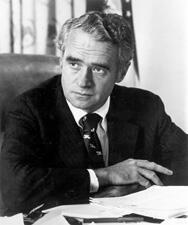
Here you will find contact information for Senator Thomas F. Eagleton, including email address, phone number, and mailing address.
| Name | Thomas F. Eagleton |
| Position | Senator |
| State | Missouri |
| Party | Democratic |
| Status | Former Representative |
| Term Start | January 3, 1967 |
| Term End | January 3, 1987 |
| Terms Served | 10 |
| Born | September 4, 1929 |
| Gender | Male |
| Bioguide ID | E000004 |
About Senator Thomas F. Eagleton
Thomas Francis Eagleton (September 4, 1929 – March 4, 2007) was an American lawyer and Democratic politician who served as a United States senator from Missouri from 1968 to 1987. Over the course of four terms in the Senate, he contributed significantly to the legislative process during a period of major political and social change in the United States. In 1972 he was briefly the Democratic vice-presidential nominee on the ticket headed by Senator George McGovern, a selection that brought national attention both to his political career and to his long-concealed struggles with depression.
Eagleton was born in St. Louis, Missouri, the son of Zitta Louise (Swanson) Eagleton and Mark David Eagleton, a lawyer and local politician who had run for mayor of St. Louis. His paternal grandparents were Irish immigrants, and his mother was of Swedish, Irish, French, and Austrian ancestry. Raised in the Roman Catholic faith, he came to see Catholicism as a vital part of American life, conscience, and thought, later describing himself as “a Pope John XXIII and an Archbishop John L. May Catholic.” His religion became a defining feature of his political identity, increasing his appeal among the working-class Catholic electorate of St. Louis while sometimes provoking resistance in the more staunchly anti-Catholic suburbs of Missouri.
Eagleton attended St. Louis Country Day School and then served for two years in the United States Navy. He graduated from Amherst College in 1950, where he was a member of the Delta Kappa Epsilon fraternity (Sigma chapter). He then studied law at Harvard Law School, receiving his degree in 1953. After graduation he returned to St. Louis to practice law at his father’s firm and later became associated with the legal department of Anheuser-Busch. On January 26, 1956, he married Barbara Ann Smith of St. Louis; the couple had two children, a son, Terence, born in 1959, and a daughter, Christin, born in 1963. His combination of elite education, youth, Catholic faith, and liberal views led contemporaries in Missouri to compare him to John F. Kennedy; in 1972 the St. Louis Post-Dispatch observed that “with his good looks, style, youth, liberal views and Catholic religion, Eagleton is the closest thing to a Kennedy Missouri has to offer.”
Eagleton’s political career advanced rapidly in Missouri. In 1956 he was elected circuit attorney of the City of St. Louis, a position in which he gained public visibility, including an appearance on the television program “What’s My Line?” as the “District Attorney of St. Louis,” successfully stumping the panel. In 1960, at age thirty-one, he was elected Missouri attorney general, becoming the youngest person in the state’s history to hold that office. Four years later, in 1964, he was elected the thirty-eighth lieutenant governor of Missouri. During this period, between 1960 and 1966, Eagleton experienced serious bouts of depression and checked himself into hospitals three times for what was publicly described as physical and nervous exhaustion; he received electroconvulsive therapy on two of those occasions and was later diagnosed with bipolar II disorder by psychiatrist Frederick K. Goodwin. At the time, these hospitalizations were not widely known and were often attributed in the press to gastric disturbances, which in turn fueled unfounded rumors of a drinking problem, but they did not impede his rise in state politics.
In 1968 Eagleton sought national office and won election to the United States Senate from Missouri. He first unseated incumbent Senator Edward V. Long in the Democratic primary and then narrowly defeated Republican Congressman Thomas B. Curtis in the general election. A member of the Democratic Party, he entered the Senate at the height of the Vietnam War and during a period of intense domestic debate over civil rights, social policy, and executive power. He was reelected in 1974 with about 60 percent of the vote in a rematch against Curtis, and again in 1980 by a closer-than-expected margin over St. Louis County Executive Gene McNary. During the 1980 campaign, his family was drawn into controversy when his niece, Elizabeth Eagleton Weigand, and attorney Stephen Poludniak were arrested and later convicted for attempting to blackmail him with false accusations that he was bisexual; Eagleton stated that the money sought in the scheme was to be turned over to the Church of Scientology, to which both conspirators belonged. Weigand’s appeal, which argued that extensive publicity in St. Louis had prejudiced potential jurors, was rejected when the United States Supreme Court declined to hear the case in 1982. Eagleton chose not to seek a fourth Senate term in 1986, and he was succeeded in 1987 by former Republican governor Christopher “Kit” Bond.
Eagleton’s brief but consequential role in national presidential politics came in 1972. After many prominent Democrats declined Senator George McGovern’s invitation to join the Democratic ticket, Senator Gaylord Nelson suggested Eagleton as a running mate. McGovern selected him after only a minimal background check, in keeping with the less formal vetting practices of the era. Eagleton did not disclose his prior psychiatric hospitalizations and, after consulting with his wife, decided to keep them secret even as he flew to meet McGovern for the first time. He was nominated for vice president at the Democratic National Convention in July 1972. On July 25, 1972, just over two weeks after the convention, press reports revealed that Eagleton had undergone electroshock therapy for clinical depression in the 1960s. Eagleton confirmed the reports, and McGovern initially declared that he supported Eagleton “1,000 percent.” However, after confidential consultations with leading psychiatrists, including Eagleton’s own doctors, McGovern was advised that a recurrence of Eagleton’s depression was possible and might endanger the country should he be required to assume presidential responsibilities. Under mounting political pressure and intense media scrutiny, Eagleton withdrew from the ticket at McGovern’s request on August 1, 1972, nineteen days after his nomination, and was replaced by Sargent Shriver. Although a Time magazine poll at the time found that 77 percent of respondents said Eagleton’s medical history would not affect their vote, the controversy over his mental health and McGovern’s handling of the affair damaged the Democratic campaign, which ultimately carried only Massachusetts and the District of Columbia. Years later, conservative columnist Robert Novak revealed that Eagleton had been the unnamed Democratic senator who, in April 1972, had described McGovern as the candidate of “amnesty, abortion, and acid,” a characterization that had already hurt McGovern’s standing with middle-American voters.
During his nearly two decades in the Senate, Eagleton was active on issues of foreign relations, intelligence, defense, education, health care, and the environment. He played a key role in the passage of landmark environmental legislation, including the Clean Air Act and the Clean Water Act. He was a prominent critic of the Vietnam War and sponsored the amendment that halted the bombing in Cambodia, effectively ending direct American military involvement in the conflict. In 1973 he was one of only three senators—along with William Hathaway of Maine and Gaylord Nelson of Wisconsin—to oppose the nomination of House Minority Leader Gerald R. Ford to be vice president under the Twenty-fifth Amendment. Although widely regarded as a liberal, Eagleton strongly opposed abortion, and he became a leading supporter of efforts to overturn the Supreme Court’s 1973 decision in Roe v. Wade. He was closely involved in the so-called Hatch–Eagleton Human Life Federalism Amendment, a proposed constitutional amendment that would have allowed states greater authority to restrict or ban abortion; it was the only version of the Human Life Amendment to receive a formal vote in the Senate.
After leaving the Senate in January 1987, Eagleton returned to Missouri and resumed legal practice, public commentary, and academic work. He became a partner in the St. Louis law firm Thompson Coburn and served as a chief negotiator for a coalition of local business interests that successfully lured the National Football League’s Los Angeles Rams to St. Louis. He joined the faculty of Washington University in St. Louis as an adjunct professor and later professor of public affairs at the university’s Institute of Public Policy, where he taught courses on economics with former Council of Economic Advisers chairman Murray Weidenbaum and co-taught a course on the Vietnam War with historian Henry W. Berger. In 2005 and 2006 he also co-taught a seminar on the U.S. presidency and the Constitution with Joel Goldstein at Saint Louis University School of Law. He remained engaged in Democratic Party politics, publicly supporting Missouri Democrat Claire McCaskill’s successful 2006 campaign for the United States Senate and, in January 2001, joining other Missouri Democrats in opposing the nomination of former Missouri governor and senator John Ashcroft as U.S. attorney general, remarking in the Senate Judiciary Committee record that “John Danforth would have been my first choice. John Ashcroft would have been my last choice.”
In his later years Eagleton continued to speak out on matters of public policy and ethics, often reflecting on the intersection of religion and politics. He served on the Council of Elders for the George and Eleanor McGovern Center for Leadership and Public Service at Dakota Wesleyan University, maintaining cordial relations with McGovern; in July 1996 he introduced McGovern warmly at a St. Louis event promoting McGovern’s book about his daughter’s struggle with alcoholism. In Missouri he led “Catholics for Amendment 2,” a group of prominent Catholics who challenged church leaders’ opposition to embryonic stem cell research and supported a state constitutional amendment to protect such research, arguing in an open letter that they had a moral obligation to counter what they described as misinformation and scare tactics. The amendment was intended to ensure that any stem cell research and treatments permitted under federal law would also be allowed in Missouri. Beyond politics, Eagleton authored three books on politics and public life, and he remained a visible public figure in St. Louis; among other honors, he threw out the ceremonial first pitch on behalf of President Ronald Reagan before Game 5 of the 1985 World Series.
Thomas Francis Eagleton died in St. Louis on March 4, 2007, of heart and respiratory complications. A Roman Catholic to the end, he had written a farewell letter to family and friends months earlier, urging them to “go forth in love and peace—be kind to dogs—and vote Democratic.” He donated his body to medical science at Washington University in St. Louis. Eagleton was survived by his wife, Barbara Ann Smith Eagleton, and their two children. His legacy is commemorated in several public honors, including the naming of the Thomas F. Eagleton United States Courthouse, the Eighth Circuit federal courthouse in St. Louis, dedicated on September 11, 2000, and his star on the St. Louis Walk of Fame.