Representative Thomas Alan Goldsborough
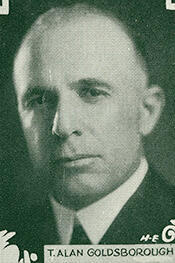
Here you will find contact information for Representative Thomas Alan Goldsborough, including email address, phone number, and mailing address.
| Name | Thomas Alan Goldsborough |
| Position | Representative |
| State | Maryland |
| District | 1 |
| Party | Democratic |
| Status | Former Representative |
| Term Start | April 11, 1921 |
| Term End | January 3, 1941 |
| Terms Served | 10 |
| Born | September 16, 1877 |
| Gender | Male |
| Bioguide ID | G000265 |
About Representative Thomas Alan Goldsborough
Thomas Alan Goldsborough (September 16, 1877 – June 16, 1951) was a United States Representative from Maryland and later a United States district judge of the United States District Court for the District of Columbia. A member of the Democratic Party, he served ten consecutive terms in the House of Representatives from 1921 to 1941, participating in the legislative process during a significant period in American history and representing the interests of his Maryland constituents.
Goldsborough was born in Greensboro, Caroline County, Maryland, where he attended the public schools and the local academy. He came from a prominent Maryland family, being the great-great-great-grandson of Robert Goldsborough and the great-grandson of Charles Goldsborough, both notable figures in Maryland’s political history. The town of Goldsboro, Maryland, is named after the Goldsborough family, reflecting their longstanding regional influence.
Goldsborough pursued higher education at Washington College in Chestertown, Maryland, receiving a Bachelor of Arts degree in 1899. He then studied law at the University of Maryland School of Law, from which he graduated with a Bachelor of Laws in 1901. That same year he was admitted to the bar and commenced the practice of law in Denton, Maryland, beginning a legal career that would underpin his later work in public office.
From 1904 to 1908, Goldsborough served as prosecuting attorney for Caroline County, Maryland. In this role he gained experience in public service and the administration of justice at the local level. After completing his term as prosecuting attorney, he returned to private practice in Denton, where he remained from 1908 until 1921. His work as a lawyer and local official helped establish his reputation and prepared him for national office.
Goldsborough was elected as a Democrat to the United States House of Representatives for the 67th Congress, beginning his congressional service on March 4, 1921. He was reelected to the nine succeeding Congresses, serving continuously until his resignation on April 5, 1939, thus completing ten terms in office. During his tenure, which spanned the Roaring Twenties, the Great Depression, and the early New Deal era, he contributed to the legislative process on a wide range of issues. In addition to his work in the House, he served as a regent of the Smithsonian Institution from 1932 to 1939, reflecting his involvement in national cultural and scientific affairs.
Goldsborough played a notable role in monetary and economic policy debates during the Depression. In 1932 he introduced the so‑called “Goldsborough bill,” a measure that declared it to be the policy of the United States to restore and maintain the value of money and directed the Secretary of the Treasury, the officers of the Federal Reserve Board, and the Federal Reserve Banks to make that policy effective. The bill, supported by figures such as former Senator Robert Latham Owen, was reported favorably by the House Committee on Banking and Currency and debated for two days. It passed the House by a bipartisan vote of 289 to 60, with 117 Republicans joining Democrats in support, but it failed in the Senate, in part, according to supporters, because it was not widely understood and lacked organized public backing. Some sources also credit Goldsborough, in the course of his work on monetary issues, with introducing the phrase “pushing on a string” to describe the difficulty the Federal Reserve faces in trying to end an economic contraction through monetary policy alone.
On January 20, 1939, President Franklin D. Roosevelt nominated Goldsborough to a new Associate Justice seat on the District Court of the United States for the District of Columbia, a position created by 52 Stat. 584. He was confirmed by the United States Senate on February 16, 1939, received his commission on February 23, 1939, and resigned his House seat on April 5, 1939, to assume the federal judgeship. The title of his office was later restyled, and he served as a judge of the United States District Court for the District of Columbia from June 25, 1948. Goldsborough remained on the federal bench until his death, presiding over a variety of cases in the nation’s capital during the closing years of the New Deal era, World War II, and the early postwar period.
Thomas Alan Goldsborough died on June 16, 1951, in Washington, D.C., while still in active judicial service. He was interred in Denton Cemetery in Denton, Maryland, returning in death to the Eastern Shore community where he had begun his legal career. His papers and writings, preserved in various collections, document a public life that spanned local prosecution, two decades in Congress, and more than a decade on the federal bench.