Representative Thomas Sylvy Gordon
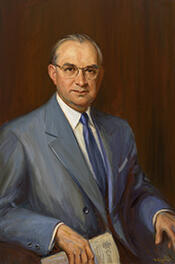
Here you will find contact information for Representative Thomas Sylvy Gordon, including email address, phone number, and mailing address.
| Name | Thomas Sylvy Gordon |
| Position | Representative |
| State | Illinois |
| District | 8 |
| Party | Democratic |
| Status | Former Representative |
| Term Start | January 6, 1943 |
| Term End | January 3, 1959 |
| Terms Served | 8 |
| Born | December 17, 1893 |
| Gender | Male |
| Bioguide ID | G000316 |
About Representative Thomas Sylvy Gordon
Thomas Sylvy Gordon (December 17, 1893 – January 22, 1959) was a Democratic member of the United States House of Representatives from Illinois who served eight consecutive terms in Congress from 1943 to 1959. His congressional career spanned a transformative period in American history, encompassing World War II, the early Cold War, and the beginnings of the civil rights era, during which he participated in the legislative process and represented the interests of his Chicago-area constituents.
Gordon was born in Chicago, Illinois, on December 17, 1893, into the city’s growing Polish American community. He attended local parochial schools, reflecting the strong role of Catholic education in many immigrant neighborhoods of Chicago at the turn of the twentieth century. He continued his studies at St. Stanislaus College in Chicago, from which he graduated in 1912. His early education in parochial institutions and at St. Stanislaus, a school serving a largely Polish Catholic population, helped shape his ties to the ethnic and religious communities that would later form a core part of his political base.
Following his graduation, Gordon entered the private sector and gained experience in finance and business administration. From 1916 to 1920 he was engaged in the banking business in Chicago, acquiring familiarity with financial operations during a period marked by World War I and postwar economic adjustment. In 1921 he joined a Polish-language daily newspaper in Chicago, an important institution in the city’s Polish American community. Over the next two decades, from 1921 to 1942, he advanced steadily within the newspaper’s management, beginning as a clerk and rising to the positions of head cashier and office manager. This work placed him at the intersection of ethnic media, community affairs, and local politics, and it provided him with administrative experience and public visibility.
Gordon’s entry into public service came through municipal and local appointments in Chicago during the 1930s, a period of New Deal expansion and Democratic Party consolidation in urban centers. He served as commissioner of Chicago West Parks from 1933 to 1936, overseeing recreational and park facilities on the city’s West Side at a time when public works and community amenities were being expanded. From 1936 to 1939 he was commissioner of public vehicle licenses, a position that involved regulating taxis and other public vehicles in a rapidly growing metropolis. His rising profile within the Democratic Party was reflected in his role as a delegate to the Democratic National Convention in 1936, held in Philadelphia, where President Franklin D. Roosevelt was renominated. Gordon further solidified his standing in city government when he served as Chicago city treasurer from 1939 to 1942, managing municipal finances on the eve of the United States’ entry into World War II.
Building on his local and party experience, Gordon was elected as a Democrat to the Seventy-eighth Congress and to the seven succeeding Congresses, serving from January 3, 1943, to January 3, 1959. Representing an Illinois district anchored in Chicago, he took part in the deliberations of the House of Representatives during World War II, the postwar reconstruction period, and the onset of the Cold War. Over the course of his eight terms, he contributed to the legislative process on issues affecting both his urban constituency and the nation at large. His long tenure reflected sustained electoral support in a heavily Democratic, ethnically diverse district that was closely tied to Chicago’s powerful party organization.
In his final term, Gordon attained one of the most prominent positions in the House when he served as chairman of the Committee on Foreign Affairs in the Eighty-fifth Congress. In that capacity, he played a role in shaping and overseeing U.S. foreign policy legislation during a critical phase of the Cold War, when questions of alliance commitments, foreign aid, and international security were central to congressional debate. His chairmanship underscored both his seniority and the confidence placed in him by his colleagues in the House Democratic leadership. After sixteen years in Congress, he chose not to be a candidate for renomination in 1958, bringing his legislative career to a close at the end of his eighth term on January 3, 1959.
Thomas Sylvy Gordon died in Chicago on January 22, 1959, only weeks after leaving office. He was interred in St. Adalbert Cemetery in Niles, a suburb of Chicago, reflecting his lifelong ties to the city and its Polish American and Catholic communities. His career traced a path from immigrant neighborhood institutions and ethnic media through municipal administration to national office, and his service in Congress, including his leadership of the Committee on Foreign Affairs, placed him among the influential Democratic legislators of mid-twentieth-century Illinois.