Representative Thomas Hardeman
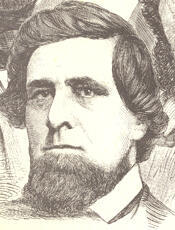
Here you will find contact information for Representative Thomas Hardeman, including email address, phone number, and mailing address.
| Name | Thomas Hardeman |
| Position | Representative |
| State | Georgia |
| District | At-Large |
| Party | Democratic |
| Status | Former Representative |
| Term Start | December 5, 1859 |
| Term End | March 3, 1885 |
| Terms Served | 2 |
| Born | January 12, 1825 |
| Gender | Male |
| Bioguide ID | H000181 |
About Representative Thomas Hardeman
Thomas Hardeman Jr. (January 12, 1825 – March 6, 1891) was an American politician, lawyer, soldier, and businessman who served as a Representative from Georgia in the United States Congress during a pivotal era in the nation’s history. Born in Eatonton, Putnam County, Georgia, he came of age in the antebellum South and would later play roles in state politics, national legislative affairs, and the Confederate military. Over the course of his public life, he was associated first with the Opposition Party and later with the Democratic Party, and he contributed to the legislative process in both the Georgia General Assembly and the U.S. House of Representatives.
Hardeman pursued higher education at Emory College in Georgia, from which he graduated in 1845. Following his graduation, he studied law and was admitted to the state bar in 1847. Although qualified as a lawyer, he chose not to establish a traditional legal practice. Instead, he turned his attention to commercial pursuits, becoming involved in the warehouse and commission business, an important sector in the economy of the cotton-producing South. This combination of legal training and business experience helped prepare him for the legislative and administrative responsibilities he would later assume.
Hardeman’s political career began in the Georgia House of Representatives, where he served multiple terms before the Civil War. He was a member of the Georgia House in 1853, 1855, and 1857, gaining experience in state-level governance and building a reputation as a capable legislator. In 1858, he was elected to the United States House of Representatives as an Opposition Party candidate from Georgia’s 3rd congressional district, reflecting the complex partisan realignments of the late 1850s. His election brought him to the national stage at a time of intensifying sectional conflict.
In the U.S. Congress, Hardeman served in the 36th United States Congress from March 4, 1859, until January 23, 1861. During this partial term, he served as a Representative from Georgia and participated in the democratic process at the federal level, representing the interests of his constituents during a period of mounting tension that would soon culminate in the Civil War. His service in Congress from 1859 to 1861 formed the first of two distinct periods in which he contributed to national legislative affairs. A member of the Democratic Party later in his career, Hardeman would again return to Congress in the 1880s, ultimately serving in the U.S. House from 1859 to 1885 across two nonconsecutive terms in office.
Hardeman resigned his congressional seat on January 23, 1861, as Georgia moved toward secession, and he entered Confederate military service. He initially became a captain in the Floyd Rifles, a local military company. During the American Civil War, he advanced to the rank of major in the 2nd Georgia Battalion of the Confederate States Army and later became a colonel in the 45th Georgia Infantry, a regiment he organized himself. Even during the war, he remained active in state politics, serving again in the Georgia House of Representatives in 1863 and 1864. From 1863 to 1865, he held the influential position of Speaker of the Georgia House, guiding legislative business for the state in the midst of the conflict.
After the Civil War, Hardeman continued to play a prominent role in Georgia’s political life. He returned to the Georgia House of Representatives in 1874 and once more served as Speaker from 1875 to 1877, underscoring his enduring influence in state government during the Reconstruction and post-Reconstruction periods. On the national party stage, he was a delegate to the 1872 Democratic National Convention, and he further solidified his standing within the Democratic Party by serving as president of the state convention and as chairman of the Democratic State executive committee for four years. These roles reflected his transition from his earlier Opposition Party affiliation to a leading position within the Democratic Party in Georgia.
Hardeman’s later congressional service came with his election as an at-large Democrat to the 48th United States Congress. He won this election in 1882 and served one full term in the U.S. House of Representatives from March 4, 1883, to March 3, 1885. During this second period in Congress, he again represented Georgia’s interests in the federal legislature as a member of the Democratic Party, contributing to the legislative process during a time when the nation was grappling with the legacies of the Civil War and Reconstruction. Taken together, his service from 1859 to 1861 and from 1883 to 1885 constituted two terms in the U.S. House, spanning a historically significant quarter-century in American public life.
Thomas Hardeman Jr. died in Macon, Bibb County, Georgia, on March 6, 1891. He was buried in Rose Hill Cemetery in Macon, a city with which he had long been associated in both his business and political endeavors. His memory was honored by the naming of the Colonel Thomas Hardeman Jr. Chapter 2170 of the United Daughters of the Confederacy, as well as by the naming of Hardeman Avenue in downtown Macon. Through his roles as legislator, party leader, and military officer, Hardeman left a lasting imprint on Georgia’s political history and on the broader narrative of the United States during the mid-19th century.