Senator Thomas Charles Hart
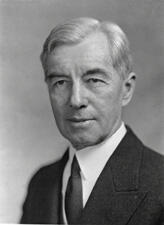
Here you will find contact information for Senator Thomas Charles Hart, including email address, phone number, and mailing address.
| Name | Thomas Charles Hart |
| Position | Senator |
| State | Connecticut |
| Party | Republican |
| Status | Former Representative |
| Term Start | February 15, 1945 |
| Term End | January 3, 1947 |
| Terms Served | 1 |
| Born | June 12, 1877 |
| Gender | Male |
| Bioguide ID | H000293 |
About Senator Thomas Charles Hart
Thomas Charles Hart (June 12, 1877 – July 4, 1971) was a four-star admiral in the United States Navy whose career spanned from the Spanish–American War through World War II, and who later served as a United States Senator from Connecticut. A member of the Republican Party, he represented Connecticut in the Senate from 1945 to 1947, completing one term in office and becoming the highest-ranking military official ever to serve in Congress. His service in Congress occurred during a significant period in American history at the close of World War II, when he participated in the legislative process and represented the interests of his constituents.
Hart was born in Davison, Genesee County, Michigan, on June 12, 1877. He entered the United States Naval Academy at Annapolis, Maryland, and graduated in 1897, standing 13th in a class of 47. In accordance with naval policy of the era, he then served two years at sea before receiving his commission as an ensign. During these early years he developed the seamanship and gunnery skills that would mark his later career as both a line officer and a technical specialist in ordnance and submarines.
Following his graduation, Hart was assigned to the battleship USS Massachusetts (BB-2), on which he served during the Spanish–American War. Massachusetts formed part of the American fleet blockading the Spanish squadron at Santiago de Cuba. Hart distinguished himself when he was placed in command of a steam cutter sent to reconnoiter Cabanas Bay for potential landing sites. Under heavy fire from Spanish shore batteries, he completed the mission and brought his boat back without casualties, although the craft was struck several times; for this action he received a letter of commendation. His handling of small craft led to his temporary assignment to the converted yacht USS Vixen (PY-4), where he served under Lieutenant Alexander Sharp Jr., with Ensign Arthur MacArthur III, elder brother of Douglas MacArthur, as executive officer; the three officers formed a lifelong friendship. After the war Hart served two years aboard the sloop-of-war USS Hartford, then returned to Annapolis as an instructor in ordnance and gunnery, where he taught for two years. While stationed at the Naval Academy he courted Caroline Robinson Brownson, daughter of Rear Admiral Willard H. Brownson, the Academy’s superintendent and later commander of the Asiatic Fleet. Hart and Caroline Brownson were married on March 30, 1910, and spent their honeymoon at the newly rebuilt Homestead resort in Hot Springs, Bath County, Virginia. The couple later had a daughter, Harriet Taft Hart, who married Francis B. Sayre Jr., son of Jessie Woodrow Wilson Sayre and grandson of President Woodrow Wilson.
Advancing through the ranks in the early twentieth century, Hart served as a division officer on the battleship USS Missouri (BB-11) and then received his first command, the destroyer USS Lawrence (DD-8). As a lieutenant commander he was assigned to oversee construction of the Delaware-class battleship USS North Dakota at the Fore River Shipyard in Quincy, Massachusetts, and he joined the ship upon her commissioning on April 11, 1910. Hart subsequently qualified for submarine command, entering a field that would define much of his later career. During World War I he served as chief of staff to the Commander, Submarine Force, Atlantic Fleet (COMSUBLANT), with headquarters at New London, Connecticut, and also held the post of Director of Submarine Operations in the Navy Department. As head of submarine operations until 1922, he worked persistently to improve the status and capabilities of the submarine arm, securing for the U.S. Navy several surrendered German U-boats after the war so that their advanced design features could be studied. The examination and testing of these submarines strongly influenced subsequent American submarine design, and Hart was also involved in the development of the Mark 6 torpedo exploder. For his World War I service he received the Distinguished Service Medal.
In the interwar period Hart continued to hold important sea and shore commands. He commanded the battleship USS Mississippi and, from 1931 to 1934, served as Superintendent of the United States Naval Academy, overseeing the education and training of a generation of future naval officers. Later, as a member of the Navy’s General Board beginning in the mid-1930s, he advocated modernization of the fleet. Although his proposal for a new class of small submarines to replace aging S-, R-, and O-class boats resulted only in the experimental submarines USS Mackerel and USS Marlin, he successfully pressed for the construction of large destroyer leaders that were later reclassified as anti-aircraft light cruisers, including the Atlanta-class cruisers. On July 25, 1939, Hart was appointed commander in chief of the United States Asiatic Fleet and was promoted to the rank of admiral the same day.
Hart commanded the Asiatic Fleet at the outbreak of hostilities between the United States and Japan in December 1941. Most of his forces were based in the Philippines, with a smaller contingent of destroyers and a light cruiser stationed in Borneo, and his command included the majority of the combat-ready U.S. submarines in the Pacific. Initially directing operations from Manila, he was compelled by rapid Japanese advances to shift his headquarters to Java on January 15, 1942. There he was designated Commander, Naval Forces, ABDA Command, the combined British, Dutch, American, and Australian command charged with defending the southern Dutch East Indies. Under his authority, Allied ships fought the Battle of Balikpapan, a tactical success but a strategic defeat in the broader campaign. The U.S. Asiatic Fleet as an independent command effectively ceased to exist on February 5, 1942, amid a general reorganization of Allied forces in the Southwest Pacific. Hart retained nominal command of ABDA naval forces until February 12, 1942, and was formally relieved on February 16, 1942, when he departed Java for reasons officially described as health-related, though his position had also been weakened by political tensions with some British and Dutch subordinates. He traveled via Batavia and Ceylon on a British passenger vessel and returned to the United States on March 8, 1942.
In July 1942 President Franklin D. Roosevelt presented Hart with a Gold Star in lieu of a second Distinguished Service Medal, recognizing his conduct of Allied naval operations in the Southwest Pacific in early 1942 as marked by sound judgment and moral courage under difficult circumstances. Hart was retired with the rank of admiral that same month, but he was recalled to active duty in August 1942 as a member of the Navy’s General Board in Washington, D.C. He served on the board through the critical middle years of World War II, contributing to high-level deliberations on naval policy and ship design. He retired from active duty a second time in February 1945, when he was appointed to the United States Senate from Connecticut to fill the vacancy caused by the death of Senator Francis T. Maloney. As a Republican Senator, Hart served from 1945 to 1947, completing the remainder of Maloney’s term. During this single term he took part in the Senate’s work at the close of World War II and the beginning of the postwar era, bringing to the legislative process the perspective of a senior naval officer with long experience in strategy, operations, and military administration.
After leaving the Senate in 1947, Hart lived in retirement, remaining a respected figure in naval and public affairs. His long career and wartime experiences later formed the basis of a classified report on the Pacific war, published posthumously as “War in the Pacific: The Classified Report of Admiral Thomas C. Hart.” He died on July 4, 1971, and was buried with full honors at Arlington National Cemetery. In 1973 the frigate USS Thomas C. Hart (FF-1092) was commissioned in his honor; the ship was sponsored by his granddaughter, Penny Hart Bragonier, reflecting the continuing connection of his family to the Navy he had served for nearly half a century.