Senator Thomas Carey Hennings
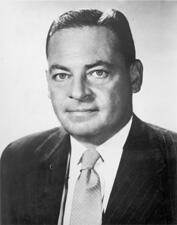
Here you will find contact information for Senator Thomas Carey Hennings, including email address, phone number, and mailing address.
| Name | Thomas Carey Hennings |
| Position | Senator |
| State | Missouri |
| Party | Democratic |
| Status | Former Representative |
| Term Start | January 3, 1935 |
| Term End | September 13, 1960 |
| Terms Served | 5 |
| Born | June 25, 1903 |
| Gender | Male |
| Bioguide ID | H000502 |
About Senator Thomas Carey Hennings
Thomas Carey Hennings Jr. (June 25, 1903 – September 13, 1960) was an American political figure from Missouri who served in both houses of the United States Congress. A member of the Democratic Party, he represented Missouri’s 11th congressional district in the United States House of Representatives from 1935 until 1940 and later served as a United States Senator from Missouri from 1951 until his death in 1960. Over the course of his congressional career, which encompassed service in the House and the Senate during a significant period in American history, he contributed to the legislative process and represented the interests of his constituents through five terms in office.
Hennings was born into a wealthy family in St. Louis, Missouri, to Judge Thomas Carey Hennings, an influential member of the Jefferson Club, an organization dedicated to overthrowing the bossism of the city’s Democratic political machine. Raised in an environment of legal practice and reform-minded politics, he attended Soldan High School in St. Louis, where he distinguished himself in athletics. He went on to Cornell University, running track and field while pursuing his undergraduate studies, and graduated from Cornell in 1924. He then returned to his home city to study law at Washington University in St. Louis, earning his law degree in 1926.
In 1926, Hennings was admitted to the Missouri bar and commenced the practice of law in St. Louis. He quickly entered public service, serving as assistant circuit attorney for the city from 1929 to 1934. During this period he also became a colonel on the Governor’s staff, a position he held from 1932 to 1936, reflecting his growing prominence in state Democratic circles. From 1934 to 1938, he was a lecturer on criminal jurisprudence at Benton College of Law in St. Louis, combining legal practice with teaching and further establishing his reputation in criminal law and public affairs.
Hennings was elected as a Democrat to the Seventy-fourth, Seventy-fifth, and Seventy-sixth Congresses and served in the U.S. House of Representatives from January 3, 1935, to December 31, 1940. He was the first Democrat in 22 years to represent Missouri’s 11th congressional district. His House career coincided with the New Deal era, and he became particularly noted for his advocacy on behalf of African American constituents in St. Louis. He enjoyed strong support from the city’s growing African American population, regularly hiring African Americans to work in his offices in Washington, D.C., and St. Louis. During the Second New Deal, he worked to establish an African American branch of the Civilian Conservation Corps at Poplar Bluff, Missouri, and within the framework of the Federal Emergency Relief Act he advocated for a “Negro Federal Employment Office” staffed entirely by African Americans. He also sponsored anti-lynching bills in the House. These efforts earned him endorsements from two of St. Louis’s leading Black newspapers, the Argus and the American, as well as from the city’s NAACP chapter. He resigned from the House in 1940 to become a candidate for circuit attorney of St. Louis.
Hennings was elected circuit attorney and served in that office from 1941 to 1944. In September 1941 he took a leave of absence to volunteer for active duty in the United States Naval Reserve during World War II. Serving in the Pacific and Caribbean theaters, he rose to the rank of lieutenant commander. His active duty service lasted approximately three years, after which he was discharged due to a physical disability incurred in the line of duty. Following his discharge, he returned to St. Louis and resumed the practice of law, becoming a partner in the firm of Green, Hennings, Henry and Evans, and remained active in Missouri Democratic politics.
In 1950, Hennings was elected to the United States Senate as a Democrat, defeating Republican incumbent and former governor Forrest Donnell in what was the only Senate election that year in which the Democrats gained a seat from the Republicans. He took office on January 3, 1951, and was reelected in 1956, serving continuously until his death in 1960. As a senator from Missouri during the early Cold War and the civil rights era, he participated in the democratic process at the national level and represented the interests of his constituents through his committee work and legislative positions. He did not sign the 1956 Southern Manifesto, distancing himself from the bloc of southern legislators opposed to desegregation, and he voted in favor of the Civil Rights Acts of 1957 and 1960, aligning himself with federal efforts to protect voting rights and combat racial discrimination.
During his Senate tenure, Hennings held significant committee responsibilities. He served as chairman of the Committee on Rules and Administration in the Eighty-fifth and Eighty-sixth Congresses, overseeing matters related to Senate procedure, administration, and internal governance. He was also a member of the United States Senate Subcommittee on Juvenile Delinquency, which undertook a widely noted investigation into the influence of comic books on youth behavior, reflecting broader mid-twentieth-century concerns about popular culture and juvenile crime. His legislative work, particularly in the areas of civil liberties and civil rights, later became the subject of scholarly study, including the volume “Decade of Fear: Senator Hennings and Civil Liberties” by Donald Kemper, published in 1965.
Thomas Carey Hennings Jr. died of abdominal cancer in Washington, D.C., on September 13, 1960, while still serving in the United States Senate. He was interred in Arlington National Cemetery, a recognition of his military service and long tenure in national office. His family remained connected to national political life; his daughter Karla Ann Hennings was briefly married to John Dean, who would later serve as White House Counsel and become a central figure in the events surrounding the Watergate burglaries and subsequent cover-up.