Senator Thomas Holliday Hicks
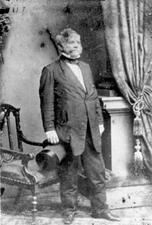
Here you will find contact information for Senator Thomas Holliday Hicks, including email address, phone number, and mailing address.
| Name | Thomas Holliday Hicks |
| Position | Senator |
| State | Maryland |
| Party | Unconditional Unionist |
| Status | Former Representative |
| Term Start | January 1, 1862 |
| Term End | December 31, 1865 |
| Terms Served | 1 |
| Born | September 2, 1798 |
| Gender | Male |
| Bioguide ID | H000567 |
About Senator Thomas Holliday Hicks
Thomas Holliday Hicks (September 2, 1798 – February 14, 1865) was a Maryland politician whose career spanned the turbulent decades before and during the American Civil War. Born near East New Market in Dorchester County, Maryland, he came of age in a slaveholding border state whose loyalties would later be sharply divided between North and South. Little is recorded of his formal education, but his early life in rural Maryland and his subsequent rise through local offices suggest a practical grounding in law, public administration, and the political culture of the Eastern Shore. His background and experiences in this environment shaped the pro-slavery yet ultimately Unionist views that would define his public life.
Hicks began his political career as a Democrat, first holding the local post of town constable in East New Market. In 1824 he was elected Sheriff of Dorchester County, marking his emergence as a figure of some prominence in county affairs. By 1830 he had advanced to state-level office as a member of the Maryland House of Delegates, to which he was re-elected in 1836. In 1837 the legislature elected him to the Governor’s Council, making him a member of the last such council chosen before that body was abolished. The following year, in 1838, he was appointed Register of Wills for Dorchester County, a position he held for nearly two decades and which provided him with administrative experience and continued visibility in state politics.
Over the course of the 1830s and 1840s, Hicks shifted his party allegiance from the Democrats to the Whig Party, reflecting the broader realignments in national politics. By the mid-1850s, as the Whig Party disintegrated under the pressures of sectional conflict, he joined the Native American Party, more commonly known as the Know-Nothing Party or American Party. Running as that party’s candidate for governor in 1858, he defeated Democrat John Charles Groome by approximately 8,700 votes. The campaign and election were notorious for fraud, open intimidation of voters, and unprecedented violence, particularly in Baltimore, where nativist gangs such as the Plug Uglies were active. Hicks, one of the oldest men to assume the governorship of Maryland, used his inaugural address in 1858 to denounce the rising numbers of foreign immigrants and to warn that they would “change the national character.”
As governor, Hicks was firmly pro-slavery and opposed to abolitionists, yet he was also anti-secession. He denounced what he called “the attacks of fanatical and misguided persons against property in slaves” and insisted that slaveholders had a constitutional right to recover enslaved people as property under the United States Constitution. In his writings about the South and its secessionist course, he often referred to the South as “we,” and criticized the North and President Abraham Lincoln for “refus[ing] to observe the plain requirements of the Constitution” regarding the admission of new slave states. At the same time, as the secession crisis deepened, he came belatedly to support the preservation of the Union and sought to prevent Maryland from joining the Confederacy—a move that would have left Washington, D.C., isolated within Confederate territory.
The outbreak of the Civil War in 1861 placed Hicks at the center of a constitutional and military crisis. On April 19, 1861, during the Baltimore riot in which Massachusetts troops were attacked while marching between railroad stations, Baltimore Mayor George William Brown, Police Marshal George P. Kane, and former Governor Enoch Louis Lowe urged Hicks to authorize the burning of railroad bridges leading into Baltimore to prevent further federal troops from entering Maryland. Hicks reportedly approved this proposal, and the destruction of the bridges later figured prominently in the famous habeas corpus case Ex parte Merryman, involving Maryland militia officer John Merryman, who was arrested by Union forces. Hicks initially denied that he had authorized such actions, but later backtracked and publicly aligned himself with the Union cause. In a letter to President Lincoln dated April 22, 1861, he advised that “no more troops be ordered or allowed to pass through Maryland,” urged Lincoln to seek a truce with the South, and even suggested British diplomat Sir Richard Lyons as a mediator. Addressing the Maryland General Assembly on April 25, 1861, Hicks declared that “The only safety of Maryland lies in preserving a neutral position between our brethren of the North and of the South.”
Under intense pressure to call the General Assembly into special session, Hicks eventually did so, but he used the choice of location to influence the outcome. Because Annapolis was occupied by Union troops, he convened the legislature instead in Frederick, a generally pro-Union town in western Maryland. Meeting there in late April 1861, the Assembly unanimously concluded that it lacked the power to take Maryland out of the Union, and on April 29, 1861, it voted 53–13 against calling a state convention that would have had authority to consider secession. In this way, Hicks’s maneuvering helped keep Maryland from formally joining the Confederacy, even as he continued to express sympathy for Southern grievances and to reflect the divided loyalties of his state.
After leaving the governorship, Hicks entered national office during the height of the Civil War. His service in the United States Congress began when he was appointed to the U.S. Senate from Maryland in December 1862, following the death of Senator James A. Pearce. A member of the Unconditional Unionist Party by this time, Hicks represented Maryland in the Senate from 1861 to 1865, serving one term during a critical period in American history. Although in poor health, he campaigned successfully for election by the Maryland legislature to complete the unexpired term, winning on January 11, 1864. In the Senate, he participated in the legislative process at a time when Congress was grappling with issues of war powers, civil liberties, and the future of slavery, and he publicly endorsed President Abraham Lincoln’s bid for re-election in 1864. As a senator, he took part in the democratic process at the national level and represented the interests of his Maryland constituents while supporting the Union war effort.
Hicks’s later life was brief, as his health continued to decline while he served in the Senate. He died in office at the Metropolitan Hotel in Washington, D.C., on February 14, 1865, just months before the end of the Civil War. President Lincoln attended his funeral, which was held in the U.S. Senate Chamber, underscoring Hicks’s prominence as a border-state Unionist leader. Initially interred at his family farm in Dorchester County, Maryland, his remains were later disinterred and reburied in Cambridge Cemetery. In 1868 the State of Maryland erected a monument over his grave, commemorating a political figure whose career embodied the tensions of a pro-slavery yet ultimately Unionist border state during one of the most consequential eras in American history.