Representative Thomas Butler King
Here you will find contact information for Representative Thomas Butler King, including email address, phone number, and mailing address.
| Name | Thomas Butler King |
| Position | Representative |
| State | Georgia |
| District | 1 |
| Party | Whig |
| Status | Former Representative |
| Term Start | December 2, 1839 |
| Term End | March 3, 1851 |
| Terms Served | 5 |
| Born | August 27, 1800 |
| Gender | Male |
| Bioguide ID | K000215 |
About Representative Thomas Butler King
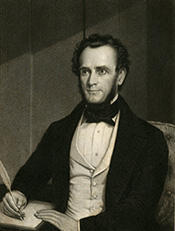
Thomas Butler King I (August 27, 1800 – May 10, 1864) was an American politician and lawyer who served as a Representative from Georgia in the United States Congress from 1839 to 1851 and later became active in the political and economic development of California. He was born on August 27, 1800, in Palmer, Massachusetts, to Daniel King and Hannah Lord. Of English descent, he traced his American ancestry to John King of Edwardstone, Suffolk, England, who settled on a tract of land in the Colony of Massachusetts in 1715. For a generation or more this tract was known as Kingstown before it was later renamed Palmer, the town in which Thomas Butler King was born.
King received his early education in Massachusetts and attended what is now Westfield State University. He subsequently studied law under his brother, Henry King, in Allentown, Pennsylvania, following the then-common practice of legal apprenticeship. After completing his legal studies, he was admitted to the Pennsylvania bar in 1822. This legal training provided the foundation for a career that would combine law, state politics, national legislative service, and later influential roles in the emerging economy of the American West.
In 1823 King moved south with his brother, Stephen Clay King, to Waynesville, Georgia, where they established a law practice. The relocation marked the beginning of his long association with Georgia, both professionally and politically. In 1824 he married Anna Matilda Page (c. 1800–1859). The couple had ten children who survived to adulthood, among them John Floyd King, who would himself later enter public life. By the early 1830s, King had become a prominent figure in coastal Georgia, particularly in Glynn County, where his legal work and growing connections among planters and businessmen led naturally into elective office.
King entered state politics as a member of the Georgia Senate, to which he was elected in 1832 to represent Glynn County. He served in the state senate in 1834, 1835, and again in 1837, participating in debates over internal improvements and the economic development of Georgia during a period of rapid expansion in the South. His legislative experience at the state level and his alignment with the principles of the emerging Whig Party—emphasizing economic development, internal improvements, and a strong but constitutionally limited national government—positioned him for national office.
In 1838 King was elected as a Whig to the United States House of Representatives for the 26th Congress, taking his seat in 1839. He went on to serve five terms in the House, remaining in Congress until 1851. As a member of the House of Representatives from Georgia, he participated in the legislative process during a significant period in American history marked by debates over territorial expansion, economic policy, and the growing sectional tensions between North and South. Throughout his tenure, he represented the interests of his coastal Georgia constituents, including matters related to commerce, transportation, and infrastructure, and contributed to the broader Whig agenda in Congress.
Late in life, King became closely associated with California during the formative years of its statehood. He spent approximately ten years in the newly admitted state and twice attempted to become a United States senator from California, reflecting his ambition to continue his national legislative career from the Pacific Coast. Under President Millard Fillmore, he accepted an appointment as tax collector for the Port of San Francisco, a strategically important federal post in a rapidly growing city shaped by the Gold Rush. After his service as collector, he worked as a lobbyist for the Southern Pacific Railroad Company, promoting railroad development that would link California’s ports and interior to national markets. He was a candidate for the U.S. Senate from California in 1849 but was unsuccessful in that bid. His prominence in the city’s commercial and political life is commemorated by San Francisco’s King Street, located near the port and major rail yards, which is named in his honor.
With the coming of the Civil War and the secession of Georgia, King returned to the South and sought to reenter public office under the Confederate government. In 1863 he attempted to regain his old seat, this time in the Confederate Congress, running against Julian Hartridge. In a closely contested race, King narrowly lost, receiving 2,909 votes to Hartridge’s 3,077, while a third candidate, C. H. Hopkins, received 766 votes. Contemporary accounts suggest that distrust of King among Savannah voters contributed to his defeat, reflecting the complex local and regional political dynamics of the Confederacy during wartime.
Thomas Butler King died in Waresboro, Georgia, on May 10, 1864. He was buried in the churchyard of Christ Church on St. Simons Island, Georgia, a region long associated with his family and public life. His career, spanning state and national legislatures, influential federal appointments, and efforts to shape the economic infrastructure of both Georgia and California, left a varied legacy that is also reflected in surviving documentary collections, including the T. Butler King papers from 1845–1851 held at the Stuart A. Rose Manuscript, Archives, and Rare Book Library at Emory University.