Representative Thomas Sanders McMillan
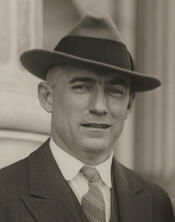
Here you will find contact information for Representative Thomas Sanders McMillan, including email address, phone number, and mailing address.
| Name | Thomas Sanders McMillan |
| Position | Representative |
| State | South Carolina |
| District | 1 |
| Party | Democratic |
| Status | Former Representative |
| Term Start | December 7, 1925 |
| Term End | January 3, 1941 |
| Terms Served | 8 |
| Born | November 27, 1888 |
| Gender | Male |
| Bioguide ID | M000572 |
About Representative Thomas Sanders McMillan
Thomas Sanders McMillan (November 27, 1888 – September 29, 1939) was a lawyer, educator, minor league baseball player and coach, and United States Representative from South Carolina. He was born in the town of Ulmer in Allendale County, South Carolina, where he received his early childhood education in the local schools. Demonstrating an early aptitude for both academics and athletics, he pursued secondary education at the Orangeburg Collegiate Institute, from which he graduated in 1907. Following his graduation, he taught school for the next two years in Perry, South Carolina, gaining early experience in public service and community leadership.
McMillan continued his education at the University of South Carolina, enrolling after his period as a schoolteacher and completing his undergraduate studies in 1912. He then entered the law course at the same institution and finished his legal training in 1913. That same year he was admitted to the bar of South Carolina. Before and around this period of legal preparation, he also pursued a parallel career in athletics, playing professional minor league baseball for five years in the South Atlantic League. His final two seasons in professional baseball were spent with the Charleston Sea Gulls, an experience that helped establish his long-standing ties to Charleston and to collegiate athletics in the state.
After his admission to the bar, McMillan moved to Charleston, South Carolina, where he began the practice of law on January 1, 1915, in partnership with James B. Heyward. In addition to his legal work, he maintained agricultural interests, reflecting the agrarian economic base of much of South Carolina during this period. His reputation as a capable athlete and organizer led to his appointment as head baseball coach at The Citadel, The Military College of South Carolina, where he served from 1916 to 1919. In that role he helped develop the college’s baseball program while simultaneously building his legal practice and expanding his public profile in Charleston.
McMillan entered elective office as a member of the South Carolina House of Representatives, serving from 1917 to 1924. During these years he represented Charleston County in the state legislature, participating in debates over education, infrastructure, and economic development in the post–World War I era. His colleagues recognized his leadership abilities, and he was elected Speaker of the South Carolina House of Representatives, serving in that position from 1923 to 1924. As Speaker, he presided over the lower chamber of the General Assembly and played a central role in managing legislative business and committee work at a time of significant political and social change in the state.
In 1924, McMillan was elected as a Democrat to the United States House of Representatives from South Carolina’s 1st congressional district for the Sixty-ninth Congress. He took his seat in March 1925 and was subsequently re-elected six more times, serving continuously until his death in 1939. During his tenure in Congress, he represented a coastal district that included Charleston and surrounding areas, focusing on issues important to his constituents such as agriculture, port development, and regional economic concerns. His service spanned the late 1920s and the Great Depression, and he served under the administrations of Presidents Calvin Coolidge, Herbert Hoover, and Franklin D. Roosevelt. In addition to his domestic legislative work, McMillan was active in international parliamentary affairs; from 1937 to 1939 he was a member of the executive committee of the Inter-Parliamentary Union, reflecting his engagement with international dialogue and cooperation among national legislatures.
While serving in the United States Congress, McMillan maintained a residence in Charleston at 171 Moultrie Street. The house, situated near The Citadel and Hampton Park, served as his home base in South Carolina during his years in Washington. In later years, this residence was recognized for its historical significance and designated a contributing structure to the Hampton Park Terrace National Register Historic District. It has been used as a faculty house for The Citadel, symbolizing the enduring connection between McMillan, the college where he once coached, and the city he represented.
Thomas Sanders McMillan died in Charleston, South Carolina, on September 29, 1939, while still serving in the U.S. House of Representatives. His death brought to a close more than two decades of continuous public service at the state and national levels. He was interred in Magnolia Cemetery in Charleston, a historic burial ground that is the resting place of many of the city’s prominent political and civic leaders.