Bios     Thomas Moore

Representative Thomas Moore
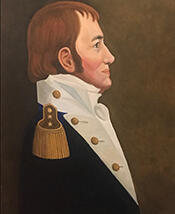
Republican | South Carolina

Representative Thomas Moore - South Carolina Republican

Here you will find contact information for Representative Thomas Moore, including email address, phone number, and mailing address.

NameThomas Moore
PositionRepresentative
StateSouth Carolina
District8
PartyRepublican
StatusFormer Representative
Term StartDecember 7, 1801
Term EndMarch 3, 1817
Terms Served7
GenderMale
Bioguide IDM000919
Representative Thomas Moore
Thomas Moore served as a representative for South Carolina (1801-1817).

About Representative Thomas Moore


Thomas Moore (28 May 1779 – 25 February 1852) was an Irish writer, poet, lyricist, and political satirist who became widely regarded in his lifetime as Ireland’s “national bard,” and he also lent his name to an American statesman, Thomas Moore of South Carolina, who served as a Representative in the United States Congress from 1801 to 1817. The Irish Moore was born over his parents’ grocery shop in Aungier Street, Dublin, to Anastasia Codd of County Wexford and John Moore of County Kerry, and he had two younger sisters, Kate and Ellen. From an early age he showed a marked interest in music and performance, staging musical plays with friends and entertaining hopes of an acting career. His early literary promise was confirmed when, at about fourteen, one of his poems appeared in the Anthologia Hibernica (“Irish Anthology”), a new Dublin literary magazine.

Moore’s education began at Samuel Whyte’s co‑educational English grammar school in Dublin, where he studied Latin and Greek and became fluent in French and Italian. Whyte had earlier taught Richard Brinsley Sheridan, the Irish playwright and Whig politician, about whom Moore would later write a biography, and this connection helped orient him toward both literature and politics. In 1795, Moore was among the first Roman Catholics admitted to Trinity College Dublin, where he prepared, as his mother hoped, for a career in law. In the charged political atmosphere of the 1790s, he moved in circles influenced by the French Revolution and the prospect of French intervention in Ireland, frequenting the literary salon of Henrietta Battier and forming friendships with Robert Emmet and Edward Hudson. Encouraged by these associates, he wrote in 1797 an appeal to his fellow students to resist proposals for a legislative union with Great Britain, and he anonymously contributed a nationalist “Fragment in imitation of Ossian” to the United Irish newspaper The Press, urging the Irish to recall ancestral heroism and strike for freedom.

In April 1798, during the run‑up to the United Irish rebellion, Moore was interrogated at Trinity College on suspicion of involvement in sedition through the Society of United Irishmen, but he was acquitted. Though a close friend of Emmet, he never took the United Irish oath and played no direct part in the 1798 rising—he was at home ill during the outbreak—or in Emmet’s failed Dublin uprising of 1803. His sympathies, however, remained with the insurgent generation, as he later made clear in his biography of Lord Edward Fitzgerald (1831) and in songs such as “O, Breathe Not His Name” (1808), which pays homage to Emmet’s execution. In 1799 Moore continued his legal training at the Middle Temple in London, supported by members of the expatriate Irish community, including Barbara, widow of Arthur Chichester, 1st Marquess of Donegall. His literary career advanced rapidly: his translations of Anacreon, celebrating wine, women, and song, were published in 1800 with a dedication to the Prince of Wales, and he briefly collaborated as a librettist with Michael Kelly on the comic opera The Gypsy Prince, staged at the Theatre Royal, Haymarket. In 1801 he issued Poetical Works of the Late Thomas Little, Esq., under a pseudonym that masked the eroticism of the verse, which nonetheless enjoyed considerable success.

While the Irish Moore was establishing himself in London literary and political society, another Thomas Moore emerged in American public life. Thomas Moore of South Carolina served as a Representative in the United States House of Representatives from 1801 to 1817, holding office for seven consecutive terms during a formative period in the early republic. A member of the Republican Party, this American Thomas Moore participated in the legislative process in Washington, D.C., representing the interests of his South Carolina constituents as the nation confronted issues of expansion, party realignment, and the aftermath of the American Revolution. His long tenure in Congress placed him among the experienced lawmakers of his day, and his service coincided with the presidencies of Thomas Jefferson, James Madison, and James Monroe, when the House of Representatives was central to debates over federal power, foreign policy, and domestic development.

The Irish Moore’s own public career took a different form, combining government service, travel, and literary production. In 1803 he accepted, with reluctance, a government post as registrar of the Admiralty Prize Court in Bermuda, secured through the patronage of Francis Rawdon‑Hastings, 2nd Earl of Moira, who had distinguished himself by protesting abuses during the Irish rebellion. Finding life in Bermuda dull, Moore appointed a deputy after about six months and embarked on an extended tour of North America. There he moved in elite circles but formed a jaundiced view of many American leaders, including President Thomas Jefferson, whom he satirised in verse for the contradiction between republican ideals and slaveholding. Returning to England in 1804, he published Epistles, Odes, and Other Poems (1806), which included both his criticisms of America and accounts of amorous adventures; the work provoked Francis Jeffrey’s denunciation in the Edinburgh Review as licentious, leading to a near‑duel that ended in police intervention and, ultimately, a lasting friendship between critic and poet. In 1809 Moore was elected a member of the American Philosophical Society in Philadelphia, and one of his poems from this period, “A Canadian Boat Song,” later influenced French‑Canadian verse and contributed to early Canadian nationalist rhetoric.

From 1808 onward Moore’s reputation increasingly rested on his Irish Melodies, a projected series of ten volumes (the first appearing in 1808) in which he set new nationalist lyrics to traditional Irish airs. These songs, including enduring pieces such as “The Minstrel Boy” and “The Last Rose of Summer,” articulated themes of dispossession, loss, and resistance and helped secure his status as Ireland’s “national bard.” Between 1808 and 1810 he appeared annually in Kilkenny, Ireland, in charitable theatricals, favouring comic roles in plays such as Sheridan’s The Rivals. Among the professional actresses there was Elizabeth “Bessy” Dyke, whom he married on 25 March 1811 at St Martin‑in‑the‑Fields, London. The couple lived successively in London, Kegworth in Leicestershire, Mayfield Cottage in Staffordshire near Lord Moira, and finally Sloperton Cottage in Wiltshire, close to the estate of Henry Petty‑Fitzmaurice, 3rd Marquess of Lansdowne. Their marriage, though shadowed by the deaths of all five of their children—three daughters in childhood and two sons as young men, including Thomas Lansdowne Parr Moore, killed in action with the French Foreign Legion in Algeria on 6 February 1846 while suffering from tuberculosis—is generally regarded as a happy one, even as Bessy largely avoided the fashionable society in which her husband moved.

Moore’s literary and political career reached a wider European audience with the publication of Lalla Rookh in 1817, a romantic, chivalric verse narrative that used an elaborate orientalist allegory to explore the same themes of oppression and resistance that animated his Irish work. Translated into several languages and adapted for musical performance by composers such as Robert Schumann, Lalla Rookh established Moore as a leading exemplar of European romanticism. At the same time, he became a prominent Whig satirist in England, moving in aristocratic circles where he was prized as a salon performer and as a writer of political squibs. His Intercepted Letters, or the Two‑Penny Post‑Bag (1813) mocked the Prince Regent, once his patron, for his conduct and his opposition to Catholic relief; and in works such as Tom Crib’s Memorial to Congress (1818), To the Ship in Which Lord Castlereagh Sailed to the Continent (1818), Fables for the Holy Alliance (1823), and the verse novel The Fudge Family in Paris (1818), he pilloried Foreign Secretary Lord Castlereagh for his role in suppressing the United Irishmen, forcing the Act of Union through the Irish Parliament, and accommodating reactionary regimes at the Congress of Vienna. These satires, widely read and sometimes personally wounding to their targets, positioned Moore as a partisan voice for reform, even as he remained sceptical of both Whig and Tory party spirit.

Financial difficulties and political commitments shaped Moore’s later life. In 1818 it was discovered that his Bermuda deputy had embezzled £6,000, for which Moore was legally liable. To avoid debtor’s prison he left for France in September 1819 with Lord John Russell, later a Whig prime minister and editor of Moore’s journals and letters. In Venice in October 1819 he met Lord Byron for the last time and accepted from him the manuscript of his memoirs, which Moore, as literary executor, undertook to publish after Byron’s death—a promise that later became controversial when the memoirs were destroyed. Settling for a time in Paris, where he was joined by Bessy and their children, Moore moved between British establishment figures and Irish exiles such as Myles Byrne, though attempts to bridge these worlds were not always successful. Once Lord Lansdowne helped clear the Bermuda debt, Moore returned to Sloperton Cottage and devoted himself increasingly to political and religious prose: The Memoirs of Captain Rock (1824), a satirical history of agrarian resistance in Ireland; his Letter to the Roman Catholics of Dublin (1810), advocating a Gallican‑style royal veto on episcopal appointments as a condition of Catholic emancipation; and Travels of an Irish Gentleman in Search of a Religion (1833), in which a fictional Catholic student at Trinity, freed by the 1829 Catholic Relief Act, examines Protestant claims and ultimately reaffirms Catholic doctrine, exposing what Moore saw as the inconsistency and arrogance of evangelical polemic.

In his final decades Moore continued to write, to correspond with leading political and literary figures, and to reflect on the fate of Ireland within the United Kingdom. Although he acknowledged Catholicism as Ireland’s “national faith” and had been shaped by a devout mother, he appears to have abandoned regular religious practice early in his adult life, adopting what later commentators have described as a “cheerful paganism” or selective, aestheticised Catholicism that prized music, ritual, and symbolism. His works, particularly the Irish Melodies, remained central to Irish cultural memory, even as some contemporaries and later critics faulted him for his role in the destruction of Byron’s memoirs. Thomas Moore died on 25 February 1852 at Sloperton Cottage, Wiltshire, closing a career that had linked Dublin, London, Paris, and the broader European romantic movement, and that unfolded in parallel with the American congressional career of his namesake, Representative Thomas Moore of South Carolina, who had earlier contributed to the legislative life of the young United States between 1801 and 1817.