Representative Thomas Wharton Phillips
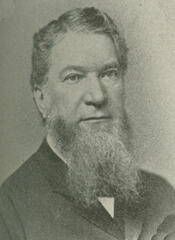
Here you will find contact information for Representative Thomas Wharton Phillips, including email address, phone number, and mailing address.
| Name | Thomas Wharton Phillips |
| Position | Representative |
| State | Pennsylvania |
| District | 25 |
| Party | Republican |
| Status | Former Representative |
| Term Start | August 7, 1893 |
| Term End | March 3, 1897 |
| Terms Served | 2 |
| Born | February 23, 1835 |
| Gender | Male |
| Bioguide ID | P000313 |
About Representative Thomas Wharton Phillips
Thomas Wharton Phillips (February 23, 1835 – July 21, 1912) was a Republican member of the U.S. House of Representatives from Pennsylvania who served two terms in Congress from 1893 to 1897. He was born near Mount Jackson, Pennsylvania, in that section of Beaver County that later became part of Lawrence County, Pennsylvania. He was the son of Ephram Phillips (1795–1835) and Ann Phillips (1796–1866), and was a descendant of the Reverend George Phillips, an early New England clergyman. Phillips attended the common schools and also received private instruction, acquiring the education that would support his later work in business and public life.
Before entering national politics, Phillips built a substantial career in the oil industry and local finance. He engaged in the production of oil during the formative years of the petroleum business in western Pennsylvania and became a prominent figure in that field. From 1887 to 1890 he served as president of the Producers’ Protective Association, an organization representing the interests of independent oil producers. He also held significant banking responsibilities as president of the Citizens’ National Bank of New Castle, Pennsylvania. In addition to his business pursuits, he was active in higher education governance, serving on the board of trustees of Bethany College in West Virginia and Hiram College in Ohio.
Phillips was elected as a Republican to the Fifty-third and Fifty-fourth Congresses, serving as a Representative from Pennsylvania in the United States Congress from March 4, 1893, to March 3, 1897. A member of the Republican Party, he contributed to the legislative process during his two terms in office, participating in the democratic process and representing the interests of his constituents during a significant period in American history marked by industrial expansion and labor unrest. During the Fifty-fourth Congress he served as chairman of the United States House Committee on Labor, a position that placed him at the center of debates over labor policy and industrial relations in the late nineteenth century. He did not seek renomination in 1896 and concluded his congressional service at the end of his second term.
After leaving Congress, Phillips resumed his former business pursuits in oil and banking while continuing to play a role in national economic policy. He was appointed by President William McKinley as a member of the United States Industrial Commission, a body created to investigate and report on industrial, labor, and economic conditions in the United States. Phillips served on the commission until its dissolution, contributing to its inquiries into the changing structure of American industry. He remained active in Republican politics and was a delegate to the Republican National Convention in 1908, reflecting his continued influence within the party after his congressional career.
Phillips also became known for his philanthropy in religious and educational causes, particularly in the developing Southwest. In 1906, he was approached by his friend, Dr. Ely Zollars, for assistance in establishing a Bible college in what was then Oklahoma Territory. Phillips agreed to pay Zollars’s salary for one year while a location for the school was secured. He became a longtime benefactor of the institution, which was initially called Oklahoma Christian University. Following his death, the trustees of the school voted to change its name to Phillips University in his honor. Although Phillips University closed in 1998, Phillips Theological Seminary, which separated from the university in 1987, continued to exist into the twenty-first century.
In his personal life, Phillips was married twice, both times within the same extended family. His first marriage, in 1862, was to Clarinda Hardman (1837–1866), the daughter of David Hardman and Nancy Rebecca (née Arter) Hardman. They were the parents of two sons: Herbert Clyde Phillips (1864–1912), who married Idell Houghton in 1894, and Norman Arter Phillips (1865–1893), who became a banker. After Clarinda’s death in 1866, Phillips married her younger sister, Pamphila Hardman (1844–1933), in 1871. With Pamphila he had three sons: Victor Karl Phillips (1872–1901), who married Mary Mayme Lusk in 1898; Thomas Wharton Phillips Jr. (1874–1956), who would himself become a U.S. Representative from Pennsylvania; and Benjamin D. Phillips (1885–1968), who served for fifty years as a member of the board of Citizens National Bank and married first Undine Conant and, after her death, Mildred Welshimer.
Thomas Wharton Phillips died in New Castle, Pennsylvania, on July 21, 1912. He was buried in Oak Park Cemetery in New Castle. His career as an oil producer, banker, legislator, industrial commissioner, and educational benefactor left a lasting imprint on both Pennsylvania and the institutions he supported, and his family continued his public and civic legacy into the next generation.