Representative Thomas Addis Emmet Weadock
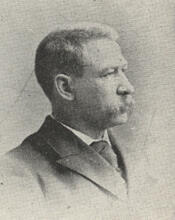
Here you will find contact information for Representative Thomas Addis Emmet Weadock, including email address, phone number, and mailing address.
| Name | Thomas Addis Emmet Weadock |
| Position | Representative |
| State | Michigan |
| District | 10 |
| Party | Democratic |
| Status | Former Representative |
| Term Start | December 7, 1891 |
| Term End | March 3, 1895 |
| Terms Served | 2 |
| Born | January 1, 1850 |
| Gender | Male |
| Bioguide ID | W000219 |
About Representative Thomas Addis Emmet Weadock
Thomas Addis Emmet Weadock (January 1, 1850 – November 18, 1938) was an Irish-born American judge, lawyer, and Democratic politician from the state of Michigan who served two terms as a Representative from Michigan in the United States Congress from 1891 to 1895. His congressional service occurred during a significant period in American history, and as a member of the House of Representatives he participated in the legislative process and represented the interests of his constituents, contributing to national debates and committee work during the 52nd and 53rd Congresses.
Weadock was born in Ballygarrett, County Wexford, on the island of Ireland (then a part of the United Kingdom). In infancy he immigrated to the United States with his parents, Lewis Weadock and Mary (Cullen) Weadock, who settled on a farm near St. Marys, Ohio. He was educated in the common schools and at the Union School in St. Marys. Before entering the legal profession, he taught school for five years in the Ohio counties of Auglaize, Shelby, and Miami, gaining early experience in public service and education. His family was active in public life; his brother, George W. Weadock, later became mayor of Saginaw, Michigan, and was the father and grandfather of state senators.
Pursuing a legal career, Weadock enrolled in the law department of the University of Michigan at Ann Arbor and graduated in March 1873. He was admitted to the bar the same year and commenced the practice of law in Bay City, Michigan. In 1874 he married Mary E. Tarsney, who was a sister of two future members of Congress: Timothy E. Tarsney of Michigan and John Charles Tarsney of Missouri, linking him to a prominent political family. Alongside his growing legal practice, Weadock became active in civic and military affairs. He served in the State militia from 1874 to 1877, reflecting his engagement in public duty beyond the courtroom.
Weadock’s early political and legal career advanced rapidly at the local and state levels. He served as prosecuting attorney of Bay County in 1877 and 1878, gaining prosecutorial and administrative experience. A committed Democrat, he emerged as a party leader in Michigan, serving as chairman of the Democratic State conventions in 1883 and 1894. He was elected mayor of Bay City, serving from 1883 to 1885, and was a member of the Bay City board of education in 1884, roles in which he helped guide municipal governance and local educational policy. His first wife, Mary E. Tarsney Weadock, died in 1889. In 1893 he married Nannie E. Curtiss, who remained his spouse until her death in 1927.
In national politics, Weadock was elected as a Democrat from Michigan’s 10th congressional district to the 52nd Congress in 1890 and was re-elected in 1892 to the 53rd Congress. He served in the U.S. House of Representatives from March 4, 1891, to March 3, 1895. During his second term he held a significant leadership role as chairman of the Committee on Mines and Mining in the 53rd Congress, where he helped oversee legislative matters related to the mining industry, an important sector in Michigan and the nation at the time. A member of the Democratic Party throughout his career, he declined to be a candidate for reelection in 1894 but continued to participate in national party affairs, serving as a delegate at large to the 1896 Democratic National Convention.
After leaving Congress, Weadock resumed the practice of law in Bay City before later relocating to Detroit, where he continued his legal career. He remained active in public life and the judiciary, running unsuccessfully as the Democratic candidate for judge of the Michigan Supreme Court in 1904. His professional reputation in the law led to his appointment in 1912 as a professor of law at the University of Detroit, where he contributed to the training of future lawyers. In 1933 he was appointed an associate justice of the Michigan Supreme Court, crowning a long legal and public service career with a position on the state’s highest court.
Throughout his life, Weadock was involved in professional and fraternal organizations that reflected both his legal standing and his Irish heritage. He was a member of the American Bar Association, underscoring his prominence within the legal profession, and of the Ancient Order of Hibernians, a Catholic Irish-American fraternal organization. Thomas Addis Emmet Weadock died in Detroit, Michigan, on November 18, 1938, at the age of eighty-eight. He was interred in St. Patrick’s Cemetery in Bay City, Michigan, returning in death to the community where he had first established his legal and political career.