Representative Tilman Bacon Parks
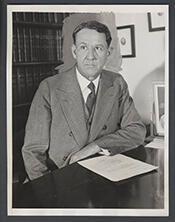
Here you will find contact information for Representative Tilman Bacon Parks, including email address, phone number, and mailing address.
| Name | Tilman Bacon Parks |
| Position | Representative |
| State | Arkansas |
| District | 7 |
| Party | Democratic |
| Status | Former Representative |
| Term Start | April 11, 1921 |
| Term End | January 3, 1937 |
| Terms Served | 8 |
| Born | May 14, 1872 |
| Gender | Male |
| Bioguide ID | P000075 |
About Representative Tilman Bacon Parks
Tilman Bacon Parks (May 14, 1872 – February 12, 1950) was an American lawyer and Democratic politician who served eight consecutive terms as a U.S. Representative from Arkansas from 1921 to 1937. His congressional career spanned a significant period in American history, encompassing the post–World War I era, the Roaring Twenties, and the Great Depression, during which he participated in the legislative process and represented the interests of his Arkansas constituents in the House of Representatives.
Parks was born near Lewisville, Lafayette County, Arkansas, on May 14, 1872. He attended the local common schools in and around Lewisville, receiving the basic education typical of rural Arkansas in the late nineteenth century. Seeking further study, he attended the University of Texas at Austin and later the University of Virginia at Charlottesville, institutions that were important centers of legal and classical education in the South and Southwest. After completing his legal studies, he was admitted to the bar in 1900 and opened a private law practice in Lewisville, Arkansas, beginning a professional career that would underpin his later work in public office.
Parks entered public life early in the new century. He was elected as a member of the Arkansas House of Representatives, serving his first term from 1901 to 1904. In 1904, reflecting his growing prominence in state Democratic politics, he was selected by the Democratic Party to serve as a presidential elector. After a brief interval out of the legislature, he returned to the Arkansas House of Representatives for another period of service from 1909 to 1911. In 1910 he was chosen as temporary chairman of the Democratic State convention, a role that underscored his influence within the party. He further advanced his legal and political career when he was appointed and served as prosecuting attorney of the eighth judicial circuit of Arkansas from 1914 to 1918, handling criminal prosecutions across the circuit. In 1915 he moved his residence and law practice to Hope, Hempstead County, Arkansas, where he continued to build his reputation as an attorney and party leader.
In 1920, Parks sought national office by running for the U.S. House of Representatives from Arkansas. He challenged incumbent Congressman William S. Goodwin in the Democratic primary, which was then the decisive contest in the heavily Democratic state. Parks won a close primary election and subsequently prevailed in the general election with more than 70 percent of the vote. He took his seat as a Democrat in the Sixty-seventh Congress on March 4, 1921, and was thereafter reelected to the seven succeeding Congresses, serving continuously until January 3, 1937. Over these eight terms, he contributed to the legislative process during a transformative era in American politics and governance.
During his tenure in the House of Representatives, Parks held assignments on a range of committees that reflected both regional interests and national concerns. At various times he served on the Committee on Accounts, the Committee on Education, the Committee on Expenditures on the Interior, the Committee on Interstate and Foreign Commerce, and the Committee on Rivers and Harbors, where issues of transportation, navigation, and infrastructure were of particular importance to his Arkansas district. He also served on the powerful Committee on Appropriations, which oversaw federal spending and played a central role in shaping the federal budget. For much of his congressional career, Parks was either unopposed or faced only token opposition in his reelection campaigns, indicating a strong political base and consistent support among his constituents.
Parks’s political security was tested in the mid-1930s. In 1934 he became embroiled in a bitterly contested election against local attorney Wade Kitchens. Although Parks was initially declared the winner and was seated in the House, the election was challenged on grounds of fraud. Several months later, a federal court overturned the results based on allegations of irregularities in the conduct of the election. Despite this judicial finding, the U.S. House of Representatives, which retains constitutional authority over the seating of its members, had already seated Parks, and he remained in office for the duration of his term. Aware of his increased political vulnerability and the controversy surrounding the election, Parks chose not to be a candidate for renomination in 1936, thereby concluding his congressional service on January 3, 1937.
After leaving Congress, Parks returned to private life and resumed the practice of law in Arkansas. He continued his legal work for several years, drawing on the experience and connections he had developed over decades in public service. His personal life was marked by tragedy when his wife, Fay Newton Parks, died in 1928 while he was still serving in the House of Representatives. In his later years, Parks’s health declined significantly. As his condition worsened, he lived for a time with his son and was eventually institutionalized for several years due to severe illness.
Tilman Bacon Parks died in Washington, D.C., on February 12, 1950. In recognition of his long service in the national legislature, he was interred in the Congressional Cemetery in Washington. His career, spanning state and national office, reflected the trajectory of a Southern Democrat who rose from rural Arkansas to play a role in the federal government during some of the most consequential decades of the early twentieth century.