Representative Timothy Edward Tarsney
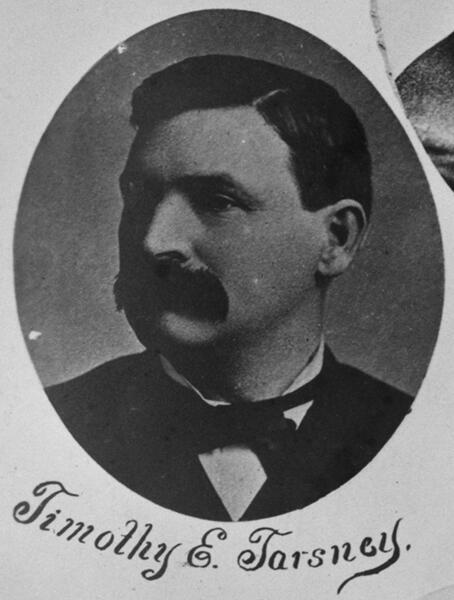
Here you will find contact information for Representative Timothy Edward Tarsney, including email address, phone number, and mailing address.
| Name | Timothy Edward Tarsney |
| Position | Representative |
| State | Michigan |
| District | 8 |
| Party | Democratic |
| Status | Former Representative |
| Term Start | December 7, 1885 |
| Term End | March 3, 1889 |
| Terms Served | 2 |
| Born | February 4, 1849 |
| Gender | Male |
| Bioguide ID | T000044 |
About Representative Timothy Edward Tarsney
Timothy Edward Tarsney (February 4, 1849 – June 8, 1909) was an American lawyer and Democratic politician from the state of Michigan who served two terms as a United States Representative from 1885 to 1889. Over the course of his public career, he held a series of local and federal offices and participated actively in the legislative and political life of his state and nation during a significant period in American history.
Tarsney was born on February 4, 1849, in Ransom, Hillsdale County, Michigan. He attended the common schools and later high school, receiving the basic education typical of mid-19th-century Michigan. As a young man during the closing years of the Civil War, he worked on Government roads in Tennessee until the end of the conflict, gaining early experience in public works and infrastructure projects. After the war, he returned to Michigan and settled in Saginaw, a growing lumber and industrial center that would remain an important base for his early professional and political life.
In Saginaw, Tarsney was first employed as a sawmill engineer, reflecting the prominence of the lumber industry in the region. In 1867 he became a marine engineer, working in an occupation closely tied to the Great Lakes shipping and commercial networks that were vital to Michigan’s economy. Seeking a professional career in the law, he enrolled in the law department of the University of Michigan at Ann Arbor and graduated in 1872. That same year he was admitted to the bar and commenced the practice of law in East Saginaw, marking the beginning of a legal career that would underpin his later political service.
Tarsney quickly moved into local public office. In 1873 he was elected justice of the peace, a position that involved handling minor civil and criminal matters and provided him with practical judicial and administrative experience. He subsequently served as city attorney of East Saginaw from 1875 to 1878, when he resigned the post. His work as city attorney placed him at the center of municipal legal affairs during a period of rapid urban and industrial growth. Tarsney came from a politically active family: his brother, John Charles Tarsney, later served as a U.S. Representative from Missouri, and his sister, Mary E. Tarsney, married Thomas A. E. Weadock, who would become a U.S. Representative from Michigan after her death.
Tarsney’s first bid for national office came in 1880, when he ran as a Democrat for election to the Forty-seventh Congress from Michigan’s 8th congressional district. He was unsuccessful in that attempt, losing to Republican Roswell G. Horr. Remaining active in party affairs, he served as a delegate at-large to the Democratic National Convention in 1884, participating in the selection of the party’s national ticket at a time when Democrats were seeking to consolidate gains in the post-Reconstruction era.
In the 1884 elections, Tarsney again challenged Roswell G. Horr and this time defeated him, winning election as a Democrat from Michigan’s 8th congressional district to the Forty-ninth Congress. He took his seat in the U.S. House of Representatives on March 4, 1885. He was re-elected in 1886, again defeating Horr, and served in the Fiftieth Congress from March 4, 1887, to March 3, 1889. During his two terms in Congress, Tarsney participated in the legislative process and represented the interests of his constituents from a district shaped by lumber, shipping, and emerging industrial concerns. His service in Congress occurred during a significant period in American history marked by debates over tariffs, economic policy, and federal regulation, and he contributed to the work of the House as a member of the Democratic Party. In 1888 he was an unsuccessful candidate for re-election to the Fifty-first Congress, losing to Republican Aaron T. Bliss.
After leaving Congress, Tarsney returned to the practice of law. In 1893 he moved to Detroit, the state’s largest and most rapidly developing city, where he resumed his legal career. His expertise in municipal and corporate matters led to his appointment to the office of corporation counsel of Detroit, a position he held from 1900 to 1908. In that capacity, he served as the city’s chief legal officer, advising municipal authorities and representing Detroit in legal affairs during a period of significant urban expansion and modernization.
Timothy Edward Tarsney died in Detroit on June 8, 1909, at the age of sixty. Although he had spent his later professional years in Detroit, he was interred in Calvary Cemetery in Saginaw, Michigan, reflecting the enduring importance of Saginaw in his personal and professional life. His career encompassed engineering, law, local office, and national legislative service, and he remained closely connected to a family that produced multiple members of Congress.