Representative Todd Russell Platts
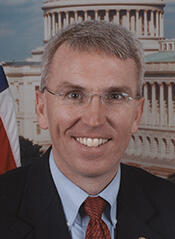
Here you will find contact information for Representative Todd Russell Platts, including email address, phone number, and mailing address.
| Name | Todd Russell Platts |
| Position | Representative |
| State | Pennsylvania |
| District | 19 |
| Party | Republican |
| Status | Former Representative |
| Term Start | January 3, 2001 |
| Term End | January 3, 2013 |
| Terms Served | 6 |
| Born | March 5, 1962 |
| Gender | Male |
| Bioguide ID | P000585 |
About Representative Todd Russell Platts
Todd Russell Platts (born March 5, 1962) is an American attorney, jurist, and Republican Party politician who has served as a judge on the York County Court of Common Pleas and is a former U.S. Representative for Pennsylvania’s 19th congressional district. He represented the district in the United States House of Representatives from January 3, 2001, to January 3, 2013, serving six terms in Congress. During his tenure, he contributed to the legislative process at the federal level while representing a south-central Pennsylvania district that, before later redistricting and renumbering, included all of York and Adams Counties and a large portion of Cumberland County, encompassing the cities and towns of York, Hanover, Gettysburg, and Carlisle.
Platts was born in York, Pennsylvania, on March 5, 1962, and was raised in the surrounding community. He graduated from York Suburban Senior High School in 1980. Remaining in south-central Pennsylvania for his undergraduate studies, he attended Shippensburg University of Pennsylvania, where he graduated summa cum laude in 1984 with a Bachelor of Science degree in public administration. He then pursued legal studies at Pepperdine University School of Law in Malibu, California, earning his Juris Doctor degree cum laude in 1991. Platts is an Episcopalian, and his professional formation combined legal training with a strong interest in public policy and public service.
Platts entered elective office in state government before moving to the national stage. In November 1992, he was first elected to public office as a member of the Pennsylvania House of Representatives, representing the 196th legislative district. This election was the first in which the 196th district was contested under its then-new boundaries; following the 1990 census and subsequent reapportionment, the district had been moved from Philadelphia to its new configuration in south-central Pennsylvania. Platts took office in the Pennsylvania House on January 5, 1993, and served there until November 30, 2000. His years in the state legislature provided him with legislative experience and a political base in York County that would later support his bid for Congress.
In 2000, Platts was elected to the U.S. House of Representatives from Pennsylvania’s 19th congressional district, succeeding Republican Congressman Bill Goodling, who chose not to seek re-election. Platts won a crowded Republican primary with a little over half of the vote and then defeated Democratic nominee Jeff Sanders, a college professor, in the general election. He took office on January 3, 2001, and went on to serve six consecutive terms, fulfilling a self-imposed pledge to limit his service in the House to twelve years. During his time in Congress, he refused to accept contributions from special interests or political action committees, emphasizing a personal standard of independence in campaign financing. In January 2012, he announced his intention to retire from Congress at the end of his sixth term, and he left office in January 2013.
Platts’s congressional career unfolded during a period of significant national and international events, including the aftermath of the September 11, 2001, terrorist attacks, the wars in Afghanistan and Iraq, and major domestic policy debates. A Republican representing a generally conservative district—one that voted 64–36 for President George W. Bush in 2004—Platts supported many of President Bush’s key initiatives. He voted for tax cuts, drilling in the Arctic National Wildlife Refuge (ANWR), the Medicare Prescription Drug, Improvement, and Modernization Act establishing the Medicare prescription drug benefit, the authorization and conduct of the Iraq War, and a proposed constitutional amendment to ban same-sex marriage. He also supported offshore oil drilling and backed efforts to increase government-regulated fuel efficiency standards for automobiles. At the same time, he opposed any version of Bush’s school voucher proposal and supported the McCain–Feingold campaign finance reform legislation. The National Journal’s political index in 2006 characterized his voting record as moderate relative to the conservative nature of his district, assigning him “conservative” ratings of 53 percent on economic issues, 65 percent on social issues, and 73 percent on foreign policy in the 2004 Congress.
Platts’s electoral record in Congress reflected both the security of his seat and the evolving political landscape. He ran unopposed by the Democratic Party in the 2002 and 2004 general elections, though he did face a notable Republican primary challenge in 2002 from Tom Glennon. In 2006, he was opposed by York College professor and decorated Vietnam veteran Phil Avillo Jr., the Democratic nominee, and Derf Maitland of the Green Party; Platts won with 64 percent of the vote to Avillo’s 33 percent and Maitland’s 3 percent. In 2008, Platts and Avillo faced each other again, and Platts was re-elected with 67 percent of the vote, making him, at that time, one of the most electorally successful Republican congressional candidates in the Northeast. In 2010, he was challenged by Democratic nominee Ryan Sanders and Independent Patriots nominee Joshua Monighan and was re-elected to a sixth term with 72 percent of the vote.
Throughout his congressional service, Platts developed a record that combined party loyalty on many fiscal and national security issues with periodic breaks from Republican orthodoxy. He was a member of the Republican Main Street Partnership, a group generally associated with more moderate Republican positions. Early in his political career, after his initial election to the Pennsylvania House, he supported abortion rights, but he later changed his position and became anti-abortion; as a congressman he maintained an anti-abortion voting record. He supported stem-cell research and voted for the Matthew Shepard and James Byrd Jr. Hate Crimes Prevention Act. He was one of fifteen Republican House members to vote in favor of repealing the U.S. military’s “Don’t Ask, Don’t Tell” policy, thereby allowing openly gay service members to serve. He supported President Barack Obama’s expansion of the State Children’s Health Insurance Program (SCHIP) and voted for the Edward M. Kennedy Serve America Act, which expanded national service programs. Conversely, he consistently voted against bailouts of the financial industry and automakers, opposed major economic stimulus legislation, and voted against the fiscal year 2009 Omnibus Appropriations Act and the fiscal year 2010 Budget Resolution. He voted in favor of Representative Paul Ryan’s “Path to Prosperity” budget proposal in its initial iteration but joined nine other Republicans in voting against a subsequent Ryan budget the following year.
Platts held several significant committee assignments during his time in the House. He served on the Committee on Armed Services, where he sat on the Subcommittee on Tactical Air and Land Forces and the Subcommittee on Seapower and Projection Forces, giving him a role in oversight of defense policy and military procurement. He was also a member of the Committee on Education and the Workforce, serving on the Subcommittee on Early Childhood, Elementary and Secondary Education and the Subcommittee on Higher Education and Workforce Training, where he participated in shaping federal education and labor policy. On the Committee on Oversight and Government Reform, he chaired the Subcommittee on Government Organization, Efficiency and Financial Management and served on the Subcommittee on National Security, Homeland Defense and Foreign Operations, reflecting his interest in government accountability and national security matters. In addition, he was a member of the Congressional Arts Caucus.
After leaving Congress in January 2013, Platts returned to public service at the county level in the judiciary. That year, he announced his candidacy for a seat on the York County Court of Common Pleas. In a poll conducted by the York County Bar Association, 77 percent of responding members rated him “not qualified” to serve on the bench, an assessment that became a point of discussion during the campaign. Platts and incumbent Judge Mike Flannelly, also a Republican who had been appointed to the seat in 2012 following the death of Judge Chuck Patterson, both cross-filed to run in the Democratic and Republican primaries. Platts won the Republican primary by a margin of 56 percent to 44 percent, while Flannelly won the Democratic primary by the same margin. The two then faced each other in the November 2013 general election, in which Platts prevailed with 58 percent of the vote, earning a ten-year term on the Court of Common Pleas. In 2023, he was retained by an overwhelming margin and elected to a second ten-year term, extending his service on the York County bench through 2033.