Representative Tom Bliley
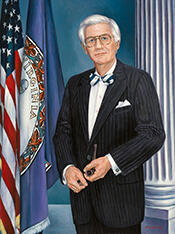
Here you will find contact information for Representative Tom Bliley, including email address, phone number, and mailing address.
| Name | Tom Bliley |
| Position | Representative |
| State | Virginia |
| District | 7 |
| Party | Republican |
| Status | Former Representative |
| Term Start | January 5, 1981 |
| Term End | January 3, 2001 |
| Terms Served | 10 |
| Born | January 28, 1932 |
| Gender | Male |
| Bioguide ID | B000556 |
About Representative Tom Bliley
Thomas Jerome Bliley Jr. (January 28, 1932 – November 16, 2023) was an American businessman, Navy veteran, and politician who served as a U.S. Representative from the Commonwealth of Virginia from 1981 to 2001. Over ten consecutive terms in Congress, he became a prominent Republican legislator and spent six years as chairman of the influential House Energy and Commerce Committee, then formally known as the House Commerce Committee. His congressional service occurred during a significant period in American history, and he played a central role in shaping major legislation affecting telecommunications, financial services, securities regulation, and public health.
Bliley was born in Chesterfield County, Virginia, on January 28, 1932, the son of Carolyn and Thomas J. Bliley. Raised in the Roman Catholic faith, he attended Catholic schools in the Richmond area and graduated in 1948, at age 16, from Benedictine High School, a military and college preparatory school in Richmond. He went on to study at Georgetown University in Washington, D.C., where he earned a Bachelor of Arts degree in political science in 1952. Shortly after completing his studies, he entered military service, reflecting both his early interest in public affairs and a commitment to national service.
From 1952 to 1955, Bliley served as a lieutenant in the United States Navy. Following his naval service, he returned to Richmond and entered the family business, the Joseph W. Bliley Co. Funeral Home. He worked as a funeral director and eventually became president of the firm, gaining experience as a businessman and community leader. His professional work in the funeral industry, combined with his civic involvement and ties to the local Catholic community, helped establish his reputation in Richmond and laid the groundwork for his entry into elective office. Bliley, who remained a practicing Roman Catholic throughout his life, married Mary Virginia Kelley, and the couple had two children.
Bliley’s political career began at the local level in Richmond. Originally a conservative Byrd Democrat, aligned with the fiscally conservative and segregationist political organization that dominated mid-20th-century Virginia politics, he was elected vice mayor of Richmond in 1968. In 1970 he successfully ran for mayor and held that office until 1977. During his tenure as mayor, he presided over a city undergoing demographic and political change, and he emerged as a key figure in Richmond’s municipal governance. After his term as mayor, he shifted his party allegiance and became a Republican, reflecting broader political realignments in Virginia and the South. He later became a leader in the successful effort to create a public referendum to allow for the direct election of Richmond’s mayor, a reform intended to increase accountability and citizen participation in city government.
In 1980, Bliley won the Republican nomination for Congress from Virginia’s 3rd congressional district after eight-term Democratic incumbent David Satterfield announced his retirement. In the general election that year, he was elected to the U.S. House of Representatives with 52 percent of the vote, defeating Democrat John A. Mapp, Independent Howard Hearnes Carwile, and Libertarian James B. Turney. His victory made him the first Republican to win an undisputed election in the district since the Reconstruction era; the last comparable case had been in 1890, when the House of Representatives awarded Republican Edmund Waddill the seat after a disputed contest. The 3rd District had been trending Republican at the national level for decades, having not supported a Democratic presidential candidate since 1948 and coming close to electing a Republican to Congress twice in the 1960s, when Democrats held on by fewer than 1,000 votes. Nonetheless, conservative Democrats continued to dominate most local offices and seats in the Virginia General Assembly well into the 1980s.
Once in Congress, Bliley consolidated his position quickly and never again faced a race as close as his first. He was reelected in 1982 with 59 percent of the vote, defeating Democrat John A. Waldrop; in 1984 with 86 percent of the vote, defeating Independent Roger L. Coffey; in 1986 with 67 percent of the vote, defeating Democrat Kenneth E. Powell and Independent J. Stephens Hodges; and in 1988 he was reelected unopposed. In 1990 he secured another term with 66 percent of the vote, defeating Democrat Jay Starke and Independent Rose L. Simpson. Following the 1990 census, the Democratic-controlled Virginia General Assembly, acting under a Justice Department order to create a majority-Black district in compliance with the Voting Rights Act, redrew the state’s congressional boundaries. Most of the city of Richmond, by then majority Black, was shifted into a new majority-Black 3rd District. Bliley’s constituency was renumbered as the 7th District and retained most of the whiter and more affluent sections of Richmond along with several suburbs, making it one of the most Republican districts in Virginia and the broader South.
Representing the newly configured 7th District, Bliley continued to win reelection by wide margins. In 1992 he was reelected with 83 percent of the vote, defeating Independent Gerald E. Berg; in 1994 he again defeated Berg, this time with 84 percent of the vote. In 1996 he was reelected with 75 percent of the vote, defeating Democrat Roderic H. Slayton and Independent Bradley E. Evans, and in 1998 he secured his final term with 79 percent of the vote, defeating Independent Evans. After the 1992 redistricting, the district was so heavily Republican that Bliley faced a Democratic opponent only once, in 1996. Over the course of his ten terms, from January 3, 1981, until his retirement in January 2001, he participated actively in the legislative process and represented the interests of his Virginia constituents during a period marked by the Reagan, George H. W. Bush, and Clinton administrations and the end of the Cold War.
Bliley’s most prominent role in Congress came after the Republican Party gained control of the House of Representatives in the 1994 elections. In 1995 he was elected chairman of the House Commerce Committee, later known as the House Energy and Commerce Committee, a position he held for six years. As chairman, he became a principal author and key negotiator of several major laws. These included the Telecommunications Act of 1996, which overhauled federal communications policy and deregulated large segments of the telecommunications industry; the Food and Drug Administration Modernization Act of 1997, which updated the regulatory framework for drugs and medical devices; the Private Securities Litigation Reform Act, aimed at curbing perceived abuses in securities class-action lawsuits; and the Financial Services Modernization Act of 1999, commonly known as the Gramm–Leach–Bliley Act, which repealed parts of the Glass–Steagall Act and reshaped the structure of the U.S. financial services industry. Through this work, Bliley became a central figure in late 20th-century economic and regulatory policy.
After retiring from Congress in January 2001, Bliley returned to private life, drawing on his experience as a businessman and former legislator. He remained associated with public affairs and policy discussions, including appearances on C-SPAN, and continued to be recognized for his long tenure and influence in Congress. A lifelong Virginian, he spent his later years in the Richmond area. Thomas Jerome Bliley Jr. died in Henrico, Virginia, on November 16, 2023, at the age of 91.