Representative Torbert H. Macdonald
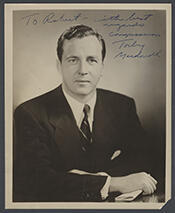
Here you will find contact information for Representative Torbert H. Macdonald, including email address, phone number, and mailing address.
| Name | Torbert H. Macdonald |
| Position | Representative |
| State | Massachusetts |
| District | 7 |
| Party | Democratic |
| Status | Former Representative |
| Term Start | January 5, 1955 |
| Term End | January 3, 1977 |
| Terms Served | 11 |
| Born | June 6, 1917 |
| Gender | Male |
| Bioguide ID | M000005 |
About Representative Torbert H. Macdonald
Torbert Hart Macdonald (June 6, 1917 – May 21, 1976) was an American Democratic politician from Massachusetts who served as a Representative in the United States Congress from 1955 to 1976. A member of the Democratic Party, he represented the northern suburbs of Boston, including his hometown of Malden, and contributed to the legislative process during 11 terms in office. Over the course of his congressional career, he became a close political and personal ally of President John F. Kennedy, with whom he had shared a room at Harvard College, and he played a significant role in shaping federal policy in areas such as broadcasting and commerce.
Macdonald was born in Everett, Massachusetts, on June 6, 1917, to Harriet (Hart) Macdonald and John Macdonald, and he grew up in nearby Malden. After attending local public schools for several years, he entered Phillips Academy in Andover, Massachusetts, where he received a rigorous preparatory education that positioned him for admission to Harvard University. His upbringing in the working communities north of Boston later informed his political sensitivity to the concerns of his constituents in the region he would go on to represent in Congress.
Macdonald attended Harvard University, where he distinguished himself both academically and athletically. He was captain of the Harvard Crimson football team and shared a room with John F. Kennedy, beginning a lifelong friendship that would later have important political dimensions. He received his Bachelor of Arts degree from Harvard in 1940. After military service in World War II, he returned to Harvard and earned his Bachelor of Laws (LL.B.) from Harvard Law School in 1946. His connection with Kennedy remained close throughout their lives; Macdonald served as an usher at then-Senator Kennedy’s wedding and later as an honorary pallbearer at President Kennedy’s funeral.
During World War II, Macdonald served in the United States Navy from 1942 to 1944 as a PT boat commander in the Southwest Pacific theater. His combat service was recognized with several decorations, including the Silver Star for gallantry, the Purple Heart for wounds received in action, and the Presidential Unit Citation awarded to his unit. Following his discharge, he was admitted to the bar in 1946 and commenced the practice of law in Boston as a partner in the firm of Stoneman, Macdonald & Chandler. From 1948 to 1952 he served as a member of the National Labor Relations Board for the New England area, gaining experience in labor and regulatory issues that would later inform his legislative work. He was also active in national party politics, serving as a delegate to the Democratic National Conventions in 1960, 1964, and 1968.
Macdonald was elected as a Democrat to the 84th Congress in 1954 and took office in January 1955, beginning a congressional career that would span more than two decades. As a member of the House of Representatives, he participated actively in the democratic process and represented the interests of his constituents in the northern Boston suburbs. Over the course of his service, he was reelected ten times, serving continuously until his death in 1976. During this period, he rose in the House leadership to serve as majority whip and became the ranking Democrat on the influential House Committee on Interstate and Foreign Commerce, where he helped shape legislation affecting transportation, communications, and trade.
Macdonald’s most enduring legislative legacy was in the field of broadcasting and communications policy. He was widely referred to as the “Father of Public Broadcasting” because he was one of the principal architects of the Public Broadcasting Act of 1967, which established the framework for federally supported public radio and television in the United States. He was also responsible for the so‑called “sports blackout bill,” which provided for the broadcast of local sold-out sporting contests, balancing the interests of professional sports franchises, broadcasters, and the viewing public. Another major focus of his work was the reform of campaign broadcasting practices. Concerned that capable candidates were being priced out of electoral politics while others could effectively buy their way into office through paid media, he advocated changes to ensure more equitable access to the airwaves for political campaigns. In addition to his legislative accomplishments, Macdonald was recognized for his attentive service to individual constituents, addressing a wide range of personal and local problems brought to his office. Among his colleagues he was known for his sharp wit and sense of humor, earning him the nickname “The Needle” in the House.
Torbert Hart Macdonald’s service in Congress occurred during a significant period in American history, encompassing the Cold War, the civil rights era, the Great Society, and the Vietnam War. Throughout these years he remained a loyal Democrat and a prominent figure in the Massachusetts delegation, closely aligned with the Kennedy political circle while maintaining his own legislative identity. He continued to serve in the House of Representatives until his death in office on May 21, 1976, in Bethesda, Maryland, at the age of 58.