Representative Trent Franks
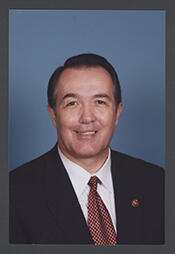
Here you will find contact information for Representative Trent Franks, including email address, phone number, and mailing address.
| Name | Trent Franks |
| Position | Representative |
| State | Arizona |
| District | 8 |
| Party | Republican |
| Status | Former Representative |
| Term Start | January 7, 2003 |
| Term End | December 8, 2017 |
| Terms Served | 8 |
| Born | June 19, 1957 |
| Gender | Male |
| Bioguide ID | F000448 |
About Representative Trent Franks
Harold Trent Franks (born June 19, 1957) is an American businessman and former politician who served as a Republican member of the United States House of Representatives from Arizona from 2003 to 2017. He represented Arizona’s 2nd congressional district from January 3, 2003, to January 3, 2013, and, following redistricting, Arizona’s 8th congressional district from January 3, 2013, until his resignation on December 8, 2017. Over eight terms in office, Franks participated in the legislative process during a significant period in American history, representing the interests of his constituents and playing a prominent role in several House committees, particularly on issues related to constitutional law and national defense.
Details of Franks’s early life and education are not extensively documented in the available sources, but he entered public life as a businessman with strong conservative views that would shape his later political career. Before attaining federal office, he was active in Republican politics in Arizona and developed a reputation as a social and fiscal conservative, which helped form the basis of his subsequent congressional campaigns and his alignment with the broader Republican Party platform.
Franks’s early attempts at federal office included a run for Arizona’s 4th congressional district in 1994, after incumbent U.S. Representative Jon Kyl vacated the seat to run for the United States Senate. In that race, Franks lost the Republican primary to John Shadegg by a margin of 43 percent to 30 percent. Despite this defeat, he remained engaged in political and public policy activities, including work in conservative advocacy and charitable efforts. He served as a past chairman of the Children’s Hope Scholarship Foundation, reflecting his interest in education and school choice, and he was also active with Operation Smile, a nonprofit organization providing cleft lip and palate surgeries to children worldwide.
Following the 2000 census, Arizona gained two additional seats in the U.S. House of Representatives. Franks’s home in Glendale was drawn into the newly configured 2nd congressional district, which had previously been the 3rd district represented by 13-term Republican incumbent Bob Stump. Stump chose not to seek reelection, and his longtime chief of staff, Lisa Jackson Atkins, entered the race as the early favorite with his endorsement. In a closely contested seven-candidate Republican primary in 2002, Franks narrowly defeated Atkins, 28 percent to 26 percent, a difference of just 797 votes. He then won the November 2002 general election against Democrat Randy Camacho by a margin of 60 percent to 37 percent, securing his first term in Congress.
During his early congressional career, Franks consolidated his position in a strongly Republican district. In 2004, he faced competition in the Republican primary from businessman Rick Murphy, whom he defeated 64 percent to 36 percent, and he went on to win reelection to a second term by again defeating Randy Camacho, 59 percent to 38 percent. He won reelection to a third term in 2006 with 59 percent of the vote, and to a fourth term in 2008, also with 59 percent of the vote. In 2010, Franks was again challenged in the Republican primary, this time by Charles Black, but he easily prevailed, 81 percent to 19 percent, and won a fifth term in the general election with 65 percent of the vote.
For his first five terms, Franks represented a geographically vast district encompassing much of northwestern Arizona, stretching from the fast-growing West Valley suburbs of Phoenix to the California border and including Lake Havasu City and the Grand Canyon. Although the district appeared largely rural, the bulk of its population resided in the West Valley, which had dominated the district since it was first drawn in 1967. The district’s configuration included a narrow tendril connecting the Hopi reservation to the rest of the district, a feature that made it appear gerrymandered; however, this arrangement reflected longstanding efforts to keep the Hopi and Navajo reservations in separate congressional districts due to historical disputes between the two tribes.
After the 2010 census, Arizona underwent redistricting, and Franks’s district was renumbered as the 8th congressional district and reduced to essentially the Maricopa County portion of the old 2nd district. The new 8th District included most of Glendale, as well as all of Sun City and Surprise, almost all of Peoria, and much of western Phoenix. As an indication of how strongly the West Valley had dominated the old district, Franks retained approximately 92 percent of his former constituents, even as he lost about 85 percent of the district’s land area. In the 2012 Republican primary, he was challenged by Tony Passalacqua but defeated him easily, 83 percent to 17 percent, and then won a sixth term in the general election with 63 percent of the vote. In 2014, Franks again secured his party’s nomination in the August 26 Republican primary and, facing no Democratic opponent in the general election, was reelected with over 75 percent of the vote against Americans Elect candidate Stephen Dolgos. In 2016, he faced a Republican primary challenge from Clair Van Steenwyck, winning renomination with over 71 percent of the vote; in the general election, with no Democratic candidate on the ballot, he defeated Arizona Green Party nominee Mark Salazar by a margin of 68.5 percent to 31.5 percent.
During his tenure in Congress from 2003 to 2017, Franks was an active member of the Republican Conference and a consistent conservative voice on social, constitutional, and national security issues. He served as vice chairman of the United States House Armed Services Subcommittee on Strategic Forces, where he was involved in oversight of nuclear weapons, missile defense, and related defense programs. He also served as chairman of the United States House Judiciary Subcommittee on the Constitution, Civil Rights and Civil Liberties, a position that placed him at the center of debates over constitutional interpretation, civil rights legislation, and issues such as abortion, marriage, and religious liberty. Franks was known for his opposition to same-sex marriage and for his strong pro-life positions, often sponsoring or supporting legislation to restrict abortion. In the realm of environmental policy, he stated during the 2008 campaign that he was skeptical about global warming and other widely accepted scientific theories related to climate change. On gun policy, Franks opposed gun control measures; the interest group Gun Owners of America gave him high approval ratings, and in 2011 he voted to pass the National Right-to-Carry Reciprocity Act, which sought to allow individuals with concealed-carry permits to carry firearms across state lines subject to certain conditions.
Franks’s congressional career ended abruptly amid an ethics controversy. In December 2017, the House Ethics Committee announced that it would investigate allegations of sexual harassment against him. According to the allegations, Franks had repeatedly asked two female staffers to bear his children as surrogate mothers and had allegedly offered one of them $5 million to carry his child, later retaliating against her when she declined. The women reported that they feared Franks intended to impregnate them sexually as part of the surrogacy arrangement. Franks acknowledged that he had discussed surrogacy with his aides but denied the other allegations. Immediately after the ethics investigation was announced, he resigned from Congress, citing what he described as “the current cultural and media climate” as a factor in his decision to step down.
Following his resignation, a special election was held to fill the vacancy in Arizona’s 8th congressional district. Republican Debbie Lesko won that election and succeeded Franks in representing the district in the U.S. House of Representatives. Lesko later chose to retire ahead of the 2024 election, leaving the seat open once again. On November 1, 2023, Franks announced that he would run in the Republican primary in an effort to regain his former seat. In that primary contest, he finished in fourth place, and the nomination was won by Abraham Hamadeh. After leaving Congress, Franks returned to private life as a businessman and conservative advocate, with his public record defined by his long-standing involvement in Republican politics, his leadership roles on key House committees, his advocacy on social and constitutional issues, and the ethics controversy that precipitated the end of his congressional service.