Representative Trinidad Romero
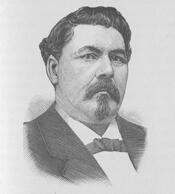
Here you will find contact information for Representative Trinidad Romero, including email address, phone number, and mailing address.
| Name | Trinidad Romero |
| Position | Representative |
| State | New Mexico |
| District | -1 |
| Party | Republican |
| Status | Former Representative |
| Term Start | October 15, 1877 |
| Term End | March 3, 1879 |
| Terms Served | 1 |
| Born | June 15, 1835 |
| Gender | Male |
| Bioguide ID | R000416 |
About Representative Trinidad Romero
Trinidad Romero (June 15, 1835 – August 28, 1918) was an American politician, rancher, and merchant who served as the Republican Delegate to the United States Congress from the Territory of New Mexico from 1877 to 1879. He represented New Mexico in the Forty-fifth Congress during a significant period in American history, participating in the legislative process and advocating for the interests of his territorial constituents.
Romero was born on June 15, 1835, in Santa Fe, Santa Fe County, in what was then the Republic of Mexico and later became the Territory of New Mexico. He was educated by private tutors, a common arrangement for children of established families in the region during that era. Growing up in a period of transition from Mexican to United States sovereignty, Romero’s early life was shaped by the evolving political and economic landscape of the Southwest.
As a young man, Romero engaged in merchandising and became involved in the overland freighting trade, operating ox-team caravans between Kansas City and Santa Fe. This work placed him at the center of the commercial life of the Santa Fe Trail, linking the developing markets of the American Midwest with the Southwest. He later expanded his activities into stock raising, building interests in ranching that would remain an important part of his livelihood throughout his life.
Romero entered public service in the Territorial government during the Civil War era. In 1863 he served as a member of the Territorial house of representatives of New Mexico, participating in the governance of the territory at a time when federal authority and local institutions were being consolidated. He subsequently served as probate judge of San Miguel County, New Mexico, in 1869 and 1870, an office that carried responsibility for overseeing estates, guardianships, and related legal matters in one of the territory’s important counties.
Building on his experience in territorial politics and local office, Romero was elected as a Republican Delegate to the Forty-fifth Congress, serving from March 4, 1877, to March 3, 1879. As a Delegate from the Territory of New Mexico, he sat in the United States House of Representatives, where he could debate and serve on committees but, like other territorial delegates, did not possess a vote on final passage of legislation. During his single term in Congress, he contributed to the legislative process and represented the interests of New Mexico’s residents as the territory sought greater development and federal support. He did not stand as a candidate for renomination in 1878, thereby concluding his congressional service after one term.
After leaving Congress, Romero continued to play a role in federal service. He was appointed United States marshal for the Territory of New Mexico by President Benjamin Harrison and held that position from November 13, 1889, to May 30, 1893. As U.S. marshal, he was responsible for enforcing federal law, overseeing deputies, and supporting the federal courts in a region still marked by frontier conditions and rapid change.
In his later years, Romero returned to private pursuits while remaining a prominent figure in New Mexico. He engaged in mercantile enterprises and continued stock raising on his ranch near Wagon Mound, New Mexico, maintaining his long-standing ties to the territory’s commercial and agricultural life. Trinidad Romero died in Las Vegas, San Miguel County, New Mexico, on August 28, 1918. He was interred in Calvary Cemetery, leaving a legacy as a territorial legislator, county judge, congressional delegate, and federal law enforcement official during a formative period in New Mexico’s history.