Representative Ulysses Stevens Stone
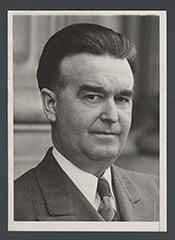
Here you will find contact information for Representative Ulysses Stevens Stone, including email address, phone number, and mailing address.
| Name | Ulysses Stevens Stone |
| Position | Representative |
| State | Oklahoma |
| District | 5 |
| Party | Republican |
| Status | Former Representative |
| Term Start | April 15, 1929 |
| Term End | March 3, 1931 |
| Terms Served | 1 |
| Born | December 17, 1878 |
| Gender | Male |
| Bioguide ID | S000964 |
About Representative Ulysses Stevens Stone
Ulysses Stevens Stone (December 17, 1878 – December 8, 1962) was an American politician and a U.S. Representative from Oklahoma. Born on a farm near Weldon, DeWitt County, Illinois, he was the son of David C. Stone and Sarah J. Hollenbeck Stone. In 1894 he moved with his parents to Jones, Oklahoma Territory, where the family settled as the region was undergoing rapid development following the opening of the Oklahoma lands to non-Indigenous settlement.
Stone was educated in the country schools of the Jones area and later attended the University of Oklahoma at Norman, reflecting the growing opportunities for higher education in the young territory and, later, state of Oklahoma. On August 27, 1902, he married Menor Minnie Butler; the couple had one daughter, Helen. His early years in Oklahoma combined both formal education and practical experience in emerging local enterprises.
Stone began his career in business at a young age. From 1894 to 1905 he engaged in the banking business in Jones, Oklahoma, participating in the financial life of a frontier community transitioning into a more settled agricultural and commercial economy. In 1905 he entered the oil industry as an operator at Norman and in Oklahoma City, aligning his career with one of the most dynamic sectors of Oklahoma’s early twentieth-century economy. Over time he expanded his interests to include investments and real estate, building a diversified business portfolio that supported his later public ambitions.
A member of the Republican Party, Stone became active in state politics as Oklahoma moved from territorial status to statehood and beyond. He sought higher office several times, reflecting his persistent engagement in public affairs. He was an unsuccessful candidate for Governor of Oklahoma in 1918, during the period immediately following World War I, and later ran unsuccessfully for election to the United States Senate in 1926. These campaigns, though not victorious, established him as a prominent Republican figure in a state that was often politically competitive in its early decades.
Stone was elected as a Republican to the Seventy-first Congress and served as a Representative from Oklahoma from March 4, 1929, to March 3, 1931. His single term in the U.S. House of Representatives coincided with a significant period in American history, including the onset of the Great Depression following the stock market crash of 1929. During his tenure, he participated in the legislative process, represented the interests of his Oklahoma constituents, and contributed to the work of the House of Representatives at a time of mounting economic crisis and shifting national priorities.
After his term in Congress, Stone continued to seek elective office. He was an unsuccessful candidate for reelection in 1930 to the Seventy-second Congress and again an unsuccessful candidate for election in 1934 to the Seventy-fourth Congress. Following these defeats, he resumed his activities as an oil operator and maintained his interests in investments and real estate, remaining a figure in Oklahoma’s business community even as his direct role in electoral politics diminished.
Ulysses Stevens Stone died in Oklahoma City, Oklahoma, on December 8, 1962, at the age of 83 years and 356 days. He was cremated, and his ashes were interred at Rose Hill Burial Park in Oklahoma City. His life spanned the transformation of Oklahoma from territory to state and the broader evolution of the United States through periods of economic expansion, war, and depression, and he left a record of service that included both business leadership and a term in the United States Congress.