Representative Usher Lloyd Burdick
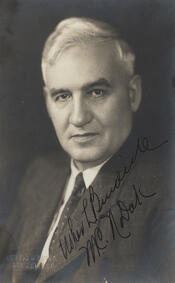
Here you will find contact information for Representative Usher Lloyd Burdick, including email address, phone number, and mailing address.
| Name | Usher Lloyd Burdick |
| Position | Representative |
| State | North Dakota |
| District | At-Large |
| Party | Republican |
| Status | Former Representative |
| Term Start | January 3, 1935 |
| Term End | January 3, 1959 |
| Terms Served | 10 |
| Born | February 21, 1879 |
| Gender | Male |
| Bioguide ID | B001079 |
About Representative Usher Lloyd Burdick
Usher Lloyd Burdick (February 21, 1879 – August 19, 1960) was a Republican member of the United States House of Representatives from North Dakota who served ten terms in Congress between 1935 and 1959. A prominent figure in North Dakota politics for more than half a century, he participated actively in the legislative process during a significant period in American history, representing the interests of his largely rural constituents. He was the father of Quentin Burdick, who would later serve in both the U.S. House of Representatives and the U.S. Senate.
Burdick was born in Owatonna, Minnesota, the son of Lucy (Farnum) and Ozias Perry Warren Burdick, both of whom were farmers. In 1882 he moved with his parents to Dakota Territory, where he was raised in an agricultural setting that shaped his later advocacy for farmers and rural communities. He attended local schools and went on to graduate from the North Dakota State Normal School at Mayville in 1900, preparing for a career in education before turning to the law.
After completing his teacher training, Burdick served as deputy superintendent of schools of Benson County, North Dakota, from 1900 to 1902. He then enrolled in the University of Minnesota Law School, from which he graduated in 1904. While attending the university he played football and taught in a business college to support himself. He was admitted to the bar in 1904 and commenced the practice of law in Munich, North Dakota. In 1907 he moved to Williston, North Dakota, where he continued his legal practice, began engaging in livestock breeding and farming, and later developed an additional career as an author.
Burdick entered public office as a member of the North Dakota House of Representatives, serving from 1907 to 1911 and rising to the position of speaker in 1909. He was elected the eighth lieutenant governor of North Dakota, serving from 1911 to 1913. In that capacity, he presided over the 1911 impeachment trial of Judge John F. Cowan, the first impeachment trial in the state’s history; Cowan was ultimately found not guilty. Burdick subsequently served as state’s attorney of Williams County from 1913 to 1915, further cementing his reputation as a lawyer and public official. Later, from 1929 to 1932, he was assistant United States district attorney for North Dakota. His professional life during these years combined law, agriculture, and writing, reflecting his broad interests and his close ties to the state’s rural economy.
During the early 1930s, amid the economic crisis of the Great Depression, Burdick emerged as a leader in farm protest movements. In 1932 he was elected president of the Farmers’ Holiday Association, an organization that advocated strikes by farmers and endorsed radical direct action to resist farm foreclosures. That same year he was an unsuccessful candidate for the Republican nomination to the 73rd Congress. In that campaign he favored the election of Franklin D. Roosevelt as president and supported the repeal of Prohibition, positions that set him apart from many in his party.
Burdick was elected as a Republican to the 74th Congress and to the four succeeding Congresses, serving from January 3, 1935, to January 3, 1945. His service in Congress thus began during the New Deal era and extended through World War II. While in the House of Representatives he supported many New Deal programs, reflecting his long-standing concern for farmers and working people, and he was notably supportive of Native American issues, advocating for the rights and welfare of Indigenous communities. He did not seek renomination to the House in 1944, instead running unsuccessfully for the Republican nomination for United States Senator from North Dakota. Also in 1944 he ran unsuccessfully as an Independent candidate for election to the 79th Congress.
Returning to electoral politics after a brief absence from Congress, Burdick was elected to the 81st Congress and to the four succeeding Congresses, serving from January 3, 1949, to January 3, 1959. During this second period of congressional service, which coincided with the early Cold War and the beginnings of the modern civil rights movement, he often took independent positions within his party. He was the only Republican congressional representative to vote against the Communist Control Act, which banned the Communist Party, reflecting his civil libertarian concerns about outlawing political organizations. He also voted in favor of the Civil Rights Act of 1957, supporting the first major civil rights legislation enacted since Reconstruction. In 1958, concerned that he might be defeated for re-election in the Republican primary, Burdick offered to withdraw his candidacy if the Democratic–Nonpartisan League Party would support his son Quentin as its candidate. The party endorsed Quentin Burdick in April 1958, and Quentin went on to win election to the House in November.
In his personal life, Burdick experienced both loss and late-life change. His first wife, Emma, with whom he had children including Quentin, died in the mid-1950s. On February 28, 1958, nearly three years after Emma’s death, the 79-year-old Burdick married his 30-year-old secretary, Jean Rodgers. His final years were marked by declining health but continued interest in public affairs and in the political career of his son.
Usher Lloyd Burdick died on August 19, 1960, in Washington, D.C., only eleven days after Quentin Burdick was sworn into the United States Senate. He was 81 years old at the time of his death. Burdick was interred on his ranch near Williston, North Dakota, underscoring his lifelong connection to the land and people of the state he had served in various capacities—as educator, lawyer, state legislator, lieutenant governor, prosecutor, farm leader, and long-serving member of the United States House of Representatives.