Representative Vannoy Hartrog Manning
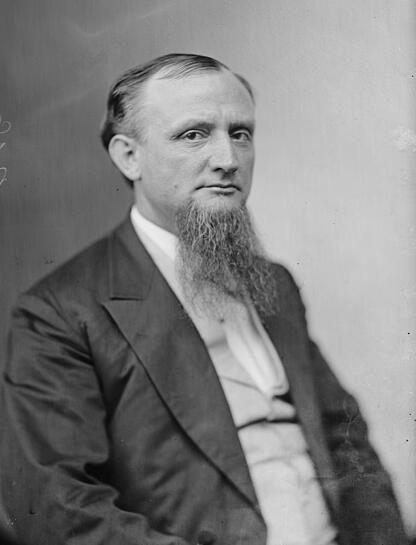
Here you will find contact information for Representative Vannoy Hartrog Manning, including email address, phone number, and mailing address.
| Name | Vannoy Hartrog Manning |
| Position | Representative |
| State | Mississippi |
| District | -1 |
| Party | Democratic |
| Status | Former Representative |
| Term Start | October 15, 1877 |
| Term End | March 3, 1885 |
| Terms Served | 4 |
| Born | July 26, 1839 |
| Gender | Male |
| Bioguide ID | M000111 |
About Representative Vannoy Hartrog Manning
Vannoy Hartrog Manning (July 26, 1839 – November 3, 1892) was an American politician, lawyer, and military officer who served as a Democratic U.S. Representative from Mississippi from 1877 to 1885, representing Mississippi’s 2nd congressional district from 1877 to 1883. His congressional service, spanning four terms in office, took place during the turbulent post-Reconstruction era, when Mississippi and the broader South were redefining political and social structures following the Civil War.
Manning was born on July 26, 1839, in Wake County, North Carolina. In 1841, when he was still a small child, he moved with his parents to Mississippi. He was educated in De Soto County in the Mississippi Delta, attending the private Horn Lake Male Academy. Manning later pursued higher education at the University of Nashville in Tennessee, where he studied law. After completing his legal studies, he married Mary Z. Wallace of Holly Springs, Mississippi. In 1860 the couple moved to Arkansas, where Manning was admitted to the Arkansas bar in 1861 and commenced the practice of law in Hamburg, Ashley County.
With the outbreak of the Civil War, Manning quickly became involved in the Confederate military effort. In May 1861, he and Dr. W. H. Tebbs recruited and organized what became the 3rd Arkansas Infantry Regiment, drawing volunteers from Ashley, Drew, Union, Dallas, and Hot Spring counties, as well as one company from other parts of Arkansas and additional recruits from Tennessee and Kentucky. The regiment initially marched to Vicksburg, Mississippi, where it was turned down for Confederate service. Manning then secured the assistance of Arkansas politician Albert Rust, under whose patronage the regiment was accepted into Confederate service. Rust was commissioned colonel and the regiment was sent to Lynchburg, Virginia, for training before being assigned to General Robert E. Lee’s Army of Northern Virginia.
Manning and Tebbs first served as captains in the 3rd Arkansas, but Manning’s leadership and battlefield performance led to his promotion to colonel after Rust was elevated to brigadier general. Under his command, the 3rd Arkansas took part in nearly every major engagement of the Army of Northern Virginia. Manning earned a reputation for conspicuous gallantry and was repeatedly cited in official reports. At the Battle of Antietam (Sharpsburg) in September 1862, Confederate General John G. Walker commended him for leading his men in a bold advance across open fields under heavy fire, driving Union forces before them until they were checked by strong post-and-rail fences. During this action Manning was severely wounded and compelled to leave the field, having suffered heavy losses in his command. He was again commended for bravery at the Battle of Gettysburg in July 1863 by Brigadier General Jerome B. Robertson of the Texas Brigade, to which the 3rd Arkansas had been attached. In the fierce fighting around Devil’s Den, the 1st, 4th, and 5th Texas regiments and the 3rd Arkansas secured their objective at great cost, and Robertson credited much of their success to Manning’s leadership; Manning was wounded toward the end of that engagement after helping his regiment hold under overwhelming odds.
Manning’s combat service continued until the Battle of the Wilderness in Virginia in 1864, where he was wounded for a third time and captured by Union forces. He was held as a prisoner of war until the end of the Civil War. The toll on his regiment was severe: of the 1,353 men originally mustered into the 3rd Arkansas Infantry, only 144 survived by the war’s end. Following his release and the conclusion of hostilities, Manning returned to civilian life and moved with his family to Holly Springs, Mississippi. There he resumed the practice of law, rebuilding his career in a state undergoing Reconstruction and political realignment.
As Mississippi Democrats regained control of state politics in the 1870s, Manning entered public life. He was elected as a Democrat from Mississippi’s 2nd congressional district to the Forty-fifth Congress and was subsequently re-elected to the Forty-sixth and Forty-seventh Congresses, serving from March 4, 1877, to March 3, 1883. During these four terms in the U.S. House of Representatives, he participated in the legislative process during a significant period in American history, representing the interests of his Mississippi constituents as federal authority and Southern state governments negotiated the end of Reconstruction and the emergence of the “New South.” In 1883 he presented his credentials as a Member-elect to the Forty-eighth Congress, having again stood for election in 1882. His election, however, was contested by his opponent, James R. Chalmers, who had run as an Independent Democrat on a fusion ticket supported by Republicans and Greenbackers.
While the contest over the seat proceeded, Manning resumed the practice of law in Washington, D.C., in 1883. On June 25, 1884, after reviewing the contested election, Congress awarded the disputed seat in the Forty-eighth Congress to Chalmers, effectively ending Manning’s congressional career. He did not return to elective office thereafter, instead devoting his remaining years to his legal practice in the nation’s capital. His congressional service, from 1877 to 1885, thus encompassed both his three undisputed terms and the contested period associated with the Forty-eighth Congress.
Manning’s family life was marked by both personal loss and notable achievements by his children. He and his wife, Mary Z. Wallace, had a large family of four sons and four daughters. Their firstborn son died in January 1861, shortly after their move to Arkansas. Their second son, Levi H. Manning, later became mayor of Tucson, Arizona, reflecting the family’s continued engagement in public affairs. Another son, Van H. Manning, went on to serve as the second director of the U.S. Bureau of Mines, contributing to the development of federal oversight of mineral resources and industrial safety. Through these descendants, Manning’s legacy extended into the civic and administrative life of the late nineteenth and early twentieth centuries.
In his later years, Manning lived in the Washington, D.C., area while maintaining his law practice. He died on November 3, 1892, in Prince George’s County, Maryland. He was interred in Glenwood Cemetery in Washington, D.C., closing a life that had spanned the antebellum era, the Civil War, Reconstruction, and the early consolidation of post-Reconstruction political order in the South.