Representative Vernon J. Ehlers
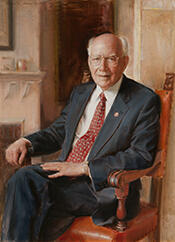
Here you will find contact information for Representative Vernon J. Ehlers, including email address, phone number, and mailing address.
| Name | Vernon J. Ehlers |
| Position | Representative |
| State | Michigan |
| District | 3 |
| Party | Republican |
| Status | Former Representative |
| Term Start | December 7, 1993 |
| Term End | January 3, 2011 |
| Terms Served | 9 |
| Born | February 6, 1934 |
| Gender | Male |
| Bioguide ID | E000092 |
About Representative Vernon J. Ehlers
Vernon James Ehlers (February 6, 1934 – August 15, 2017) was an American physicist and Republican politician who represented Michigan in the United States House of Representatives from 1993 until his retirement in 2011. Over nine terms in Congress, he became known as the first research physicist ever elected to the U.S. Congress and later was joined in that distinction by Rush Holt Jr. of New Jersey and Bill Foster of Illinois. Before his congressional service, he built a distinguished academic career in nuclear physics and held a series of local and state offices in Michigan, including service in both chambers of the Michigan Legislature.
Ehlers was born in Pipestone, Minnesota, on February 6, 1934. He grew up in the Midwest and pursued his early education in that region before enrolling at Calvin College in Grand Rapids, Michigan, a Christian liberal arts institution affiliated with the Reformed tradition. After three years at Calvin College, he transferred to the University of California, Berkeley, where he completed his undergraduate degree in physics. He continued at Berkeley for graduate study in nuclear physics, earning a Ph.D. in 1960. His doctoral dissertation, titled “The nuclear spins and moments of several radioactive gallium isotopes,” reflected his early specialization in nuclear and atomic physics and was later cataloged by University Microfilms International as document number 0227304.
Following receipt of his doctorate, Ehlers remained at the University of California, Berkeley, for six years as a member of the teaching and research staff. During this period he published several scientific papers in leading physics journals, including studies on hyperfine structure, nuclear magnetic moments, and nuclear spins of various isotopes, such as gallium and rubidium, in Physical Review and Physical Review A. In 1966 he returned to Michigan to join the faculty of Calvin College, where he taught physics for 16 years. At Calvin he advanced through the academic ranks, conducted further research, and eventually served as chairman of the Physics Department, helping to shape the college’s science curriculum and mentoring a generation of students.
Ehlers’s entry into public service began at the local level. He was elected to the Kent County Board of Commissioners, serving from 1975 to 1982 and gaining experience in county governance and public administration. Building on this local foundation, he won election to the Michigan House of Representatives, where he served from 1983 to 1985. He then moved to the Michigan Senate, serving from 1985 to 1993. Over these eight years in the state senate and two in the state house, he developed a reputation as a thoughtful legislator with a strong interest in education, science policy, and environmental issues, laying the groundwork for his later national legislative priorities.
In 1993 Ehlers entered national politics when he won a special election to the U.S. House of Representatives from Michigan’s 3rd Congressional District. The seat had been left vacant by the death of Congressman Paul B. Henry, who died six months into his fifth term. Ehlers’s victory sent him to Washington as a Republican representative from western Michigan, where he would serve until January 3, 2011. He won a full term in 1994 and was subsequently re-elected six more times, facing little significant Democratic opposition throughout his tenure. His service in Congress thus spanned a significant period in American history, encompassing the end of the Cold War era, the technology boom of the 1990s, the September 11 attacks, and the early years of the twenty-first century, during which he consistently participated in the legislative process and represented the interests of his constituents.
In the House of Representatives, Ehlers’s scientific background shaped his committee assignments and legislative focus. He served on the Committee on Science and Technology, including its Subcommittee on Energy and Environment and its Subcommittee on Research and Science Education, where he was Ranking Member. He also served on the Committee on Education and Labor, working on the Subcommittee on Early Childhood, Elementary and Secondary Education and the Subcommittee on Higher Education, Lifelong Learning, and Competitiveness, reflecting his long-standing interest in education policy. In addition, he was a member of the Committee on Transportation and Infrastructure, serving on the Subcommittee on Aviation, the Subcommittee on Coast Guard and Maritime Transportation, and the Subcommittee on Water Resources and Environment. He held a particularly prominent role on the Committee on House Administration, where he served as both Chairman and Ranking Member; he became chairman in the 109th Congress after the resignation of Bob Ney. A portrait of Ehlers from his tenure as chairman is part of the House’s official collection.
Ehlers emerged as a leading advocate for science, technology, and education policy in Congress. He co-chaired the STEM (science, technology, engineering and mathematics) Education Caucus, working to improve science and math education and to strengthen the nation’s scientific workforce. His views on science policy and education were reflected not only in legislation but also in his writings, including articles such as “The Future of U.S. Science Policy,” published in Science in January 1998, and “Science Education and Our Nation’s Future,” published in BioScience in September 2000. He was also associated with the Peak Oil Caucus, reflecting his interest in energy policy and long-term resource challenges.
Politically, Ehlers was generally regarded as a moderate Republican. The National Journal reported that in 2006 his voting record split approximately 50–50 between positions classified as “liberal” and “conservative.” He was strongly anti-abortion and supportive of lowering taxes, but he was willing to break with his party on environmental and certain government spending issues. He was a member of the Republican Main Street Partnership and Republicans for Environmental Protection, and he was notable within the Michigan delegation for his environmental stance: he was the only member of Michigan’s congressional delegation of either party to vote to raise fuel economy standards for automobiles in 2001 and 2005. At the same time, he was a staunch advocate of a federal prohibition on online poker, cosponsoring in 2006 H.R. 4411, the Goodlatte-Leach Internet Gambling Prohibition Act, and H.R. 4777, the Internet Gambling Prohibition Act. His social policy record included votes in favor of the Federal Marriage Amendment in 2004 and 2006 and votes against hate crimes legislation and measures prohibiting job discrimination based on sexual orientation, positions that contributed to a 0 percent rating from the Human Rights Campaign. However, in December 2010 he was one of fifteen Republican House members to vote in favor of repealing the U.S. military’s “Don’t Ask, Don’t Tell” policy on openly gay service members, and one of eight Republicans to vote for the DREAM Act, reflecting a nuanced approach to certain civil rights and immigration issues.
After announcing that he would not seek re-election, Ehlers retired from Congress at the end of his ninth term in January 2011, concluding 18 years in the U.S. House and more than three decades in public office at the local, state, and federal levels. In his later years he remained associated with issues of science education and public policy, drawing on his dual experience as a physicist and legislator. Vernon James Ehlers died on August 15, 2017, at the age of 83, leaving a legacy as a pioneering scientist-legislator who brought technical expertise and a measured, pragmatic approach to American politics.