Representative Victor V. Veysey
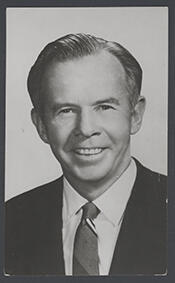
Here you will find contact information for Representative Victor V. Veysey, including email address, phone number, and mailing address.
| Name | Victor V. Veysey |
| Position | Representative |
| State | California |
| District | 43 |
| Party | Republican |
| Status | Former Representative |
| Term Start | January 21, 1971 |
| Term End | January 3, 1975 |
| Terms Served | 2 |
| Born | April 14, 1915 |
| Gender | Male |
| Bioguide ID | V000093 |
About Representative Victor V. Veysey
Victor Vincent Veysey (April 14, 1915 – February 13, 2001) was an American Republican politician who represented California in the United States House of Representatives for two terms from 1971 to 1975 and later served in both federal and state executive positions. A member of the Republican Party, he contributed to the legislative process during a significant period in American history and participated actively in the democratic process on behalf of his constituents.
Veysey was born on April 14, 1915, in Los Angeles, California. He spent his childhood and youth in Brawley, in the Imperial Valley, and in the Eagle Rock neighborhood of Los Angeles. He graduated from Eagle Rock High School before pursuing higher education in engineering and business. He received a Bachelor of Science degree in civil engineering from the California Institute of Technology (Caltech) in 1936. He then attended Harvard University, where he earned a Master of Business Administration degree in 1938, and subsequently undertook additional graduate work at Stanford University.
Following his academic training, Veysey embarked on a career in higher education. He served as a professor at Caltech from 1938 to 1940, then taught at Stanford University from 1940 to 1941, before returning to Caltech as a professor from 1941 to 1946. After his years in academia, he moved permanently to California’s Imperial Valley, where he engaged in farming. His experience as a farmer in this important agricultural region helped shape his later public service, particularly in matters related to education, agriculture, and rural development.
Veysey’s entry into public life began at the local level. In 1955 he became a member of the Brawley School Board, marking the start of his formal involvement in educational governance. He expanded his public service in the region by joining the Imperial Valley College Board in 1960. At the federal level, he was appointed to the U.S. Department of Agriculture Advisory Commission in 1959, reflecting his growing prominence as a voice for agricultural and rural issues. These roles laid the groundwork for his subsequent legislative career.
In 1962 Veysey was elected to the California State Assembly from the 75th district, taking office in 1963. He served in the Assembly from 1963 to 1971, during which time he built a reputation as a Republican legislator attentive to the needs of his largely rural and agricultural constituency. His state legislative service coincided with a period of rapid growth and change in California, and it provided him with the experience and visibility that would support his election to national office.
In 1970 Veysey was elected to the United States House of Representatives from California and took his seat in the 92nd Congress in January 1971. He was reelected in 1972, serving two terms in Congress from 1971 to 1975. During his tenure in the House of Representatives, he represented California during a turbulent era marked by the Vietnam War, the unfolding of the Watergate scandal, and significant domestic policy debates. He was a delegate to the 1972 Republican National Convention, underscoring his standing within the party. In the Watergate year of 1974, amid a difficult national climate for Republicans, he was narrowly defeated for reelection by Democratic West Covina Mayor James F. Lloyd, ending his congressional service at the conclusion of the 93rd Congress.
After leaving Congress, Veysey continued his public service in the executive branch. From 1975 to 1977 he served as Assistant Secretary of the Army under President Gerald Ford, holding the specific post of Assistant Secretary for Civil Works for the U.S. Army. In this capacity he oversaw civil works programs, including water resources development and related infrastructure, drawing on both his engineering background and legislative experience. Later, he returned to state-level executive service; in 1983 he served as Secretary for Industrial Relations for the State of California, a position that involved oversight of labor, workplace, and employment-related matters.
Victor Vincent Veysey spent his later years in California. He died on February 13, 2001, while living in Hemet, California. He was buried at Riverview Cemetery in Brawley, reflecting his long-standing ties to the Imperial Valley community where he had lived, farmed, and begun his public career.