Representative Vincent Boreing
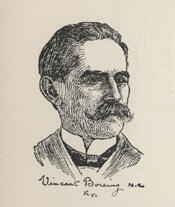
Here you will find contact information for Representative Vincent Boreing, including email address, phone number, and mailing address.
| Name | Vincent Boreing |
| Position | Representative |
| State | Kentucky |
| District | 11 |
| Party | Republican |
| Status | Former Representative |
| Term Start | December 4, 1899 |
| Term End | March 3, 1905 |
| Terms Served | 3 |
| Born | November 24, 1839 |
| Gender | Male |
| Bioguide ID | B000637 |
About Representative Vincent Boreing
Vincent Boreing (November 24, 1839 – September 16, 1903) was a U.S. Representative from Kentucky and a member of the Republican Party who served in the United States Congress from 1899 until his death in 1903. He was born near Jonesboro, Washington County, Tennessee, on November 24, 1839. In 1847 he moved with his father to Laurel County, Kentucky, a relocation that would shape his lifelong association with the state and his later political career.
Boreing received his early education in Kentucky and Tennessee. He attended Laurel Seminary in London, Kentucky, and later Tusculum College in Greeneville, Tennessee. With the outbreak of the Civil War, he enlisted as a private in the Union Army on November 1, 1861, in Company A, 24th Regiment, Kentucky Volunteer Infantry. His service was distinguished by meritorious conduct, and he was commissioned as a first lieutenant, reflecting both his leadership and his commitment to the Union cause during a period of intense national conflict.
After the war, Boreing turned to public service and civic leadership in Laurel County. From 1868 through 1872 he served as county superintendent of public schools, playing a central role in the organization and oversight of local education during the Reconstruction era. In 1875 he founded the Mountain Echo in London, Kentucky, the first Republican newspaper published in southeastern Kentucky. Through this publication he helped to establish and promote Republican Party influence in a region that was still politically fluid in the decades following the Civil War.
Boreing’s prominence in local affairs grew steadily in the 1880s as he assumed a series of important positions in law, business, and veterans’ affairs. He served as county judge in 1886, presiding over local judicial and administrative matters. In 1887 he became president of the Cumberland Valley Land Company, reflecting his involvement in regional development and land interests. The following year, in 1888, he was named president of the First National Bank of London, underscoring his standing in the financial community. In 1889 he served as department commander of the Grand Army of the Republic in Kentucky, a post that placed him at the head of the state’s leading Union veterans’ organization and further enhanced his public profile.
Building on this record of local and state leadership, Boreing was elected as a Republican to the Fifty-sixth, Fifty-seventh, and Fifty-eighth Congresses. He served in the U.S. House of Representatives from March 4, 1899, representing Kentucky and participating in the legislative process during a significant period in American history marked by industrial expansion, the aftermath of the Spanish-American War, and evolving national policies. During his three terms in office, he took part in the democratic process and represented the interests of his constituents in Kentucky, contributing to the work of Congress as the nation navigated the challenges of the turn of the twentieth century.
Vincent Boreing’s congressional service continued uninterrupted until his death in office. He died in London, Laurel County, Kentucky, on September 16, 1903, while still serving in the Fifty-eighth Congress. He was interred in Pine Grove Cemetery. His legacy in the region is reflected in the naming of the community of Boreing, Kentucky, in his honor, commemorating his role as an early Republican leader, Civil War veteran, and long-serving public official from southeastern Kentucky.