Representative Vincent Francis Harrington
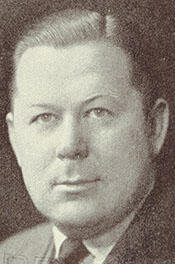
Here you will find contact information for Representative Vincent Francis Harrington, including email address, phone number, and mailing address.
| Name | Vincent Francis Harrington |
| Position | Representative |
| State | Iowa |
| District | 9 |
| Party | Democratic |
| Status | Former Representative |
| Term Start | January 5, 1937 |
| Term End | January 3, 1943 |
| Terms Served | 3 |
| Born | May 16, 1903 |
| Gender | Male |
| Bioguide ID | H000231 |
About Representative Vincent Francis Harrington
Vincent Francis Harrington (May 16, 1903 – November 29, 1943) was a Democratic U.S. Representative from Iowa who served in the United States Congress from 1937 to 1943. His congressional tenure spanned three terms and coincided with the later years of the Great Depression and the early period of World War II. A loyal Democrat who nonetheless broke with President Franklin D. Roosevelt on questions of neutrality before America’s entry into the war, Harrington ultimately resigned his seat to fulfill a personal pledge to serve in the armed forces, and he died on active duty in England during the conflict.
Harrington was born in Sioux City, Iowa, to Thomas F. and Maria Harrington. He attended Cathedral Grammar School in Sioux City and then Trinity College Academy, a local school built on land purchased from his parents by the Order of St. Francis. He went on to the University of Notre Dame in South Bend, Indiana, where he played football under the legendary coach Knute Rockne. Although a second-string player, he was a member of the famed 1924 “Four Horsemen” team that dominated its opponents and became one of the most celebrated squads in college football history. Harrington graduated from Notre Dame in 1925.
Following his graduation, Harrington began a career that combined education, athletics, and business. From 1926 to 1927 he served as an instructor and athletic director at Columbia University in Portland, Oregon (now the University of Portland), where he taught economics and history. After this brief academic appointment, he returned to Sioux City and joined his father at the Continental Mortgage Company. There he held a series of increasingly responsible positions, serving as treasurer and assistant manager and later as vice president and general manager. On June 7, 1927, he married Catherine O’Connor of Homer, Nebraska. The couple had two daughters, Catherine Tim and Patricia Ann Harrington.
Harrington entered public life as a member of the Iowa Senate, in which he served from 1933 to 1937. His rise in state politics coincided with the New Deal era, as Democrats gained influence in traditionally Republican Iowa. In June 1936 he secured the Democratic nomination for lieutenant governor of Iowa. The sudden death of Democratic U.S. Senator Richard Louis Murphy in a car accident the following month, however, reshaped the state’s political landscape. Democratic Congressman Guy M. Gillette, then seeking re-election in Iowa’s 9th congressional district, chose instead to run in the special election to complete Murphy’s Senate term. As a resident of the 9th district, Harrington withdrew from the lieutenant governor’s race to accept the Democratic nomination to replace Gillette on the ballot for the U.S. House of Representatives.
In the 1936 general election, Harrington defeated Republican Fred B. Wolf by more than 10,000 votes, winning a seat in the Seventy-fifth Congress and beginning his service in the U.S. House of Representatives in January 1937. He was re-elected in 1938 and 1940, both times facing Republican Albert F. Swanson. These subsequent contests were much closer than his initial victory: in 1938 he prevailed by only 269 votes out of more than 94,000 cast (a margin later reduced from 339 votes after the House disallowed 70 votes credited to him following Swanson’s challenge), and in 1940 he won by 2,140 votes out of more than 130,000 cast. During his three terms in Congress, Harrington participated actively in the legislative process and represented the interests of his constituents in western Iowa during a period of economic recovery and growing international tension.
After the 1940 census, Iowa lost one of its nine congressional seats, and the Republican-controlled 1941 Iowa General Assembly was required to redraw the state’s congressional districts. The old 9th congressional district, minus one county, was reconstituted as the new 8th congressional district. Monona County, which Harrington had carried in 1940 by a margin of about 1,000 votes, was shifted into the reconfigured 7th district, a change widely viewed as detrimental to his prospects for re-election in 1942. In the months leading up to the United States’ entry into World War II, Harrington declined to support Roosevelt’s moves away from strict neutrality. In the fall of 1941 he voted against additional funding for the Lend-Lease program, against repeal of the arms embargo, and against repeal of the ban on arming merchant ships. These positions, reflecting a strong neutrality stance, were in line with the views of many of his constituents at the time and with the declining popularity of Roosevelt in Iowa after 1936.
Harrington had publicly pledged during the 1940 campaign that if he ever voted for war, he would himself go to war. After the Japanese attack on Pearl Harbor on December 7, 1941, he voted to declare war and then acted on his promise. In May 1942 he entered the United States Army Air Forces, where he was commissioned as a captain. He took a leave of absence from Congress while simultaneously becoming a candidate for re-election, stating that “the decision as to my congressional status after January 3, 1943 is entirely up to the people of the district.” His dual status as a sitting member of Congress and a commissioned officer was soon overtaken by events. President Franklin D. Roosevelt, acting as commander in chief, issued an order requiring members of Congress serving in the armed forces to resign from one position or the other. To honor his commitment to military service, Harrington resigned from Congress on September 5, 1942, thus ending his tenure in the House after nearly six years.
Harrington’s resignation required voters in his district to cast two separate ballots in the 1942 general election: one to select a representative to complete the final two months of his term in the Seventy-seventh Congress, and another to choose a representative for the full term in the next Congress. Republican Harry E. Narey was elected to serve out the remainder of Harrington’s term in the disbanding 9th congressional district, while Republican Charles B. Hoeven won election to the seat in the newly configured 8th congressional district that Harrington had sought for the next term. Harrington, meanwhile, continued his service in the Army Air Forces overseas.
On November 29, 1943, while serving as a security control officer with the Army Air Forces in Rutland, England, Vincent Francis Harrington suffered a fatal heart attack and died on active duty. He was interred at the Cambridge American Cemetery in Cambridge, England, among other American servicemembers who lost their lives during World War II. In July 1944, his widow, Catherine Harrington, christened the Liberty Ship SS Vincent Harrington, named in his honor, commemorating both his service in Congress and his ultimate sacrifice as a member of the armed forces during the war.