Representative Ginny Brown-Waite
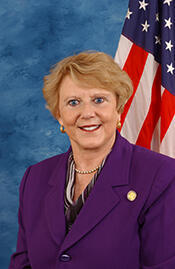
Here you will find contact information for Representative Ginny Brown-Waite, including email address, phone number, and mailing address.
| Name | Ginny Brown-Waite |
| Position | Representative |
| State | Florida |
| District | 5 |
| Party | Republican |
| Status | Former Representative |
| Term Start | January 7, 2003 |
| Term End | January 3, 2011 |
| Terms Served | 4 |
| Born | October 5, 1943 |
| Gender | Female |
| Bioguide ID | B001247 |
About Representative Ginny Brown-Waite
Virginia Frances Brown-Waite (born Virginia Frances Kniffen; October 5, 1943) is an American politician who served as a Republican U.S. Representative from Florida from 2003 to 2011. Representing Florida’s 5th congressional district, she served four terms in the United States House of Representatives during a significant period in American history, participating in the legislative process and representing the interests of a district that stretched across several counties in western and central Florida, including parts of the Tampa Bay metropolitan area. A founder of Maggie’s List, she became known as a conservative legislator with an independent streak on selected issues.
Brown-Waite was born in Albany, New York, on October 5, 1943. She attended Vincentian High School in Albany and was the first member of her family to earn a college degree. In 1976, she received a Bachelor of Science degree in interdisciplinary studies from Empire State College, State University of New York (Northeast Center). She later pursued graduate study in public administration, earning a master’s degree in that field from Russell Sage College. During her early adulthood she married and later divorced her first husband, and subsequently married Harvey Waite, a New York state trooper.
Before entering elective office, Brown-Waite built a lengthy career in legislative work in New York. She served as a staffer in the New York State Senate for 17 years, ultimately rising to the position of legislative director. Following Harvey Waite’s retirement from the state police in the mid-1980s, the couple relocated to Brooksville, Florida. Once settled in Florida, she became active in local Republican politics and civic affairs, laying the groundwork for her subsequent electoral career.
Brown-Waite’s first elected office was at the county level. In 1990 she won election as a county commissioner in Hernando County, Florida, and served one term from 1991 to 1993. In November 1992 she successfully challenged a 24-year incumbent and was elected as a Republican to the Florida State Senate. She served three terms in the state senate, where she advanced within the Republican leadership, serving as Senate Majority Whip from 1999 to 2000 and as president pro tempore of the Florida Senate from 2001 to 2002. During her state legislative career she was a vocal supporter of the death penalty. After witnessing the July 8, 1999 execution of death row inmate Allen Lee Davis, she stated that a nosebleed pattern she perceived as forming a cross was, in her view, either a sign that Davis had made peace with God or a message from God blessing the execution.
Following the 2000 Census, the Republican-controlled Florida legislature redrew the 5th congressional district to be more favorable to Republicans, and the new district substantially overlapped Brown-Waite’s state senate constituency. She entered the 2002 race for the U.S. House of Representatives, won the Republican primary, and then narrowly defeated Democratic incumbent Karen Thurman in the November general election. The campaign drew additional attention in October 2002 when police caught her husband, former New York state trooper Harvey Waite, stealing pro-Thurman lawn signs. Brown-Waite took office on January 3, 2003, and was subsequently re-elected three times: in 2004, when she received 66 percent of the vote against attorney Robert Whittell; in 2006, when she won 59 percent of the vote against Democrat John Russell; and in 2008, when she again defeated Russell with 61 percent of the vote. In the 2008 cycle she faced a primary challenge from Land O’ Lakes Republican Jim King, who attacked her from the right on national security, immigration, taxation, and support for the troops—one of her signature issues—and promoted the FairTax proposal. After years of hosting town hall meetings on tax reform and calling for full hearings on the implications of the FairTax, Brown-Waite formally endorsed the FairTax on September 24, 2007, a move King claimed was prompted by his advocacy.
In Congress, Brown-Waite served on the influential Committee on Ways and Means, including the Subcommittee on Health and the Subcommittee on Social Security, assignments that were particularly relevant to her district, which had one of the highest concentrations of retirees in the country. She also served as co-chair of the Unexploded Ordnance Caucus. Over her congressional tenure she earned a lifetime rating of 90 from the American Conservative Union, reflecting a generally conservative voting record. At the same time, she occasionally broke with her party’s leadership. She criticized President George W. Bush for staging town hall meetings with hand-picked audiences, contrasting them with what she described as her own open forums: “Let me tell you the difference between a GWB town-hall meeting – George W. Bush – and a GBW – Ginny Brown-Waite – town-hall meeting: I don’t load the audience with just the choir.” She was one of only five Republicans to vote against legislation that would have given the parents of Terri Schiavo the right to sue in federal court to keep their daughter alive, even though Schiavo’s home was located in her district. She joined centrist and moderate Republican organizations such as Christine Todd Whitman’s “It’s My Party Too,” Mike Castle’s Republican Main Street Partnership, and The WISH List.
Brown-Waite’s legislative positions reflected both her conservative ideology and the demographic profile of her district. In early 2005 she described the existing Social Security system as a “Ponzi scheme,” yet she expressed skepticism about President Bush’s proposal for personal retirement accounts, arguing that he had not effectively persuaded seniors of its merits. On April 6, 2005, she introduced the Jessica Lunsford Act in the House of Representatives, named for a nine-year-old girl from her district who was kidnapped, raped, and murdered in Homosassa, Florida, by John Couey. Modeled on a Florida law of the same name, the bill sought to impose tougher penalties on sex offenders and reduce their ability to reoffend. It attracted 107 cosponsors and was referred to a subcommittee of the House Judiciary Committee but was never brought to a vote and died at the adjournment of the 109th Congress. She was a staunch advocate of a federal prohibition on online poker, supporting H.R. 4411, the Goodlatte-Leach Internet Gambling Prohibition Act in 2006, and opposing H.R. 5767, the Payment Systems Protection Act of 2008, which would have placed a moratorium on enforcement of the Unlawful Internet Gambling Enforcement Act while regulators defined “unlawful Internet gambling.” An ardent opponent of gun control, she was known for proudly carrying a gun on trips through her district.
On foreign policy and defense issues, Brown-Waite supported the war in Iraq but urged accountability from the Iraqi government. After reports suggested she favored withdrawing U.S. troops within a year, her spokesman clarified that her comments had been taken out of context and that she had said that if Iraqi authorities did not meet troop and police development benchmarks, Congress should pressure them by threatening to deny reconstruction funds and possibly withdraw some forces. She indicated she would support “a properly-worded resolution” expressing no confidence in Secretary of Defense Donald Rumsfeld, who resigned in 2007. She also proposed the American Heroes Repatriation Act, legislation to move American soldiers buried in France and Belgium back to the United States, a proposal that drew criticism from some French officials and constituents.
Brown-Waite took several notable positions on domestic policy and ethics issues. She voted against an amendment that would have cut off funding for Planned Parenthood and other family planning organizations, a stance that distinguished her from many in her party. In September 2006, she became involved in the congressional page scandal surrounding Representative Mark Foley. After being informed of an incident from 2003 or 2004 in which an apparently inebriated Foley attempted to gain access to the pages’ dormitory, and following the publication on September 28, 2006, of an inappropriate e-mail Foley had sent to a former page, Brown-Waite launched her own inquiry. On September 29 she alerted Republican leadership both to the dorm incident and to reports that pages had been made uncomfortable by Foley’s behavior. Foley resigned that day, and the scandal quickly escalated with the release of explicit instant messages he had sent to former pages. During the financial crisis, Brown-Waite voted against the Emergency Economic Stabilization Act of 2008 on September 29, 2008, and also opposed the amended version that was ultimately enacted. When the House voted on the American Recovery and Reinvestment Act on January 28, 2009, she was the only Republican to abstain, while all other 177 House Republicans voted against the measure.
Brown-Waite occasionally drew controversy for her public statements. In early 2008, while commenting on President Bush’s proposed economic-stimulus package, she referred to the peoples of Puerto Rico and Guam as “foreign citizens,” even though residents of Puerto Rico are U.S. citizens and residents of Guam are U.S. nationals. She later sought to clarify and correct those remarks in an article in the Orlando Sentinel. Throughout her congressional service from 2003 to 2011, Virginia Brown-Waite remained a prominent Republican voice from Florida, combining a strong conservative record with periodic departures from party orthodoxy, and playing an active role in debates over social policy, fiscal policy, national security, and government ethics.