Senator Walker Brooke
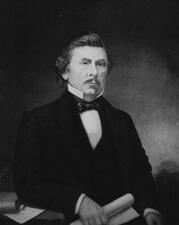
Here you will find contact information for Senator Walker Brooke, including email address, phone number, and mailing address.
| Name | Walker Brooke |
| Position | Senator |
| State | Mississippi |
| Party | Whig |
| Status | Former Representative |
| Term Start | January 1, 1852 |
| Term End | March 3, 1853 |
| Terms Served | 1 |
| Born | December 25, 1813 |
| Gender | Male |
| Bioguide ID | B000872 |
About Senator Walker Brooke
Walker Brooke (December 25, 1813 – February 18, 1869) was an American politician and lawyer who represented Mississippi in the United States Senate from 1852 to 1853 and later served as a Deputy from Mississippi to the Provisional Congress of the Confederate States from 1861 to 1862. A member of the Whig Party during his federal service, he participated in the legislative process at both the national and Confederate levels during a period of mounting sectional tension and civil conflict in the United States.
Brooke was born on December 25, 1813, in Clarke County, Virginia, the son of Humphrey Brooke and Sarah Walker Page. He attended public schools in Richmond, Virginia, and in Georgetown, in the District of Columbia. In his early years he worked as a schoolteacher, an occupation that preceded his formal professional training. Seeking higher education, he enrolled at the University of Virginia at Charlottesville, from which he graduated in 1835. He then studied law, preparing for a legal career that would form the foundation of his later political life.
After completing his legal studies, Brooke was admitted to the bar in 1838 and commenced the practice of law in Lexington, Mississippi. Establishing himself in the legal profession, he became active in state politics as the sectional crisis of the mid-nineteenth century intensified. He was elected to the Mississippi House of Representatives in 1848, marking his entry into public office. Building on this experience, he served as a member of the Mississippi Senate in 1850 and again in 1852, gaining legislative experience and visibility within the Whig Party and the state’s political leadership.
Brooke’s state-level service led to his elevation to the United States Senate. He was elected as a Whig to fill the vacancy caused by the resignation of Senator Henry S. Foote and served as a Senator from Mississippi from February 18, 1852, to March 3, 1853. Existing accounts also describe his tenure more broadly as extending from 1851 to 1853, reflecting the significant period in which he contributed to the legislative process during one term in office. In the Senate, he represented the interests of Mississippi constituents at a time of growing national division over slavery and states’ rights. He did not seek reelection at the expiration of his term and returned to private life, resuming the practice of law.
In 1857 Brooke moved to Vicksburg, Mississippi, where he continued his legal practice. As the secession crisis deepened, he remained engaged in public affairs. He served as a delegate to the Mississippi secession convention in 1861, participating in the deliberations that led the state to leave the Union. That same year he was elected a Deputy from Mississippi to the Provisional Congress of the Confederate States, where he served for one year, from 1861 to 1862. After his service in the Provisional Congress, he was appointed a member of the permanent military court of the Confederate States, extending his public role into the judicial and military-administrative structures of the Confederacy.
Brooke’s later years were spent in the post he had established for himself in Mississippi, where his career had encompassed teaching, law, state legislation, federal office, and Confederate service. He died on February 18, 1869. Contemporary and later accounts record that he died from choking on a very large oyster in an attempt to win a “friendly wager,” an unusual and sudden end to a life spent largely in public service during one of the most turbulent eras in American history.