Senator Wallace F. Bennett
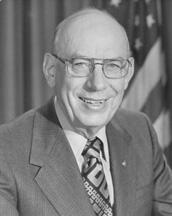
Here you will find contact information for Senator Wallace F. Bennett, including email address, phone number, and mailing address.
| Name | Wallace F. Bennett |
| Position | Senator |
| State | Utah |
| Party | Republican |
| Status | Former Representative |
| Term Start | January 3, 1951 |
| Term End | January 3, 1975 |
| Terms Served | 12 |
| Born | November 13, 1898 |
| Gender | Male |
| Bioguide ID | B000384 |
About Senator Wallace F. Bennett
Wallace Foster Bennett (November 13, 1898 – December 19, 1993) was an American businessman and politician who represented Utah in the United States Senate from 1951 to 1974. A member of the Republican Party, he served four terms in office and became known as a conservative, pro-business advocate and one of the nation’s leading fiscal and monetary experts. He was the father of Robert F. “Bob” Bennett, who later held his father’s former seat in the Senate, making them the first father-and-son combination elected to the U.S. Senate from Utah.
Bennett was born in Salt Lake City, Utah, to John Foster Bennett and Rosetta Elizabeth (née Wallace) Bennett. His grandparents were English immigrants who came to the United States in 1868. He attended local public schools and graduated from LDS High School in 1916. He then enrolled at the University of Utah, where he majored in English, won a varsity letter in debate, and joined the university’s Reserve Officers’ Training Corps. His college education was interrupted by World War I. Commissioned a second lieutenant of Infantry in September 1918, he served as an instructor in the Student Army Training Corps at Colorado College. After the war, he returned to the University of Utah and earned his Bachelor of Arts degree in 1919. For a year following graduation, he served as principal of San Luis Stake Academy in Manassa, Colorado.
In 1920, Bennett returned to Salt Lake City and entered the family business, Bennett’s Paint and Glass Company, which had been established by his father. He began as an office clerk and advanced through the positions of cashier, production manager, and sales manager. He became secretary-treasurer of the company in 1929 and, upon his father’s death in 1938, assumed the roles of president and general manager. Under his leadership, the company completed what he described as the most modern paint manufacturing plant in the West. He served as president and general manager until 1950, when he became chairman of the board. In 1922, he married Frances Marion Grant, the youngest daughter of Heber J. Grant, President of The Church of Jesus Christ of Latter-day Saints from 1918 to 1945. The couple had three sons—Wallace, David, and Robert—and two daughters, Rosemary and Frances. Frances Bennett was active in church service and for a time served as a member of the Primary General Board of the LDS Church.
Alongside his work in the paint and glass business, Bennett developed extensive interests in commerce and civic affairs. He organized a Ford automobile dealership, the Bennett Motor Company, and served as its president from 1939 to 1950. He was also president of the Cardon Jewelry Company and of the National Glass Distributors Association; vice president of the Glayton Investment Company and of the National Paint, Varnish and Lacquer Association; and a director of Zion’s Savings Bank and Trust Company, the Utah Oil Refining Company, and the Utah Home Fire Insurance Company. In 1949, he was elected president of the National Association of Manufacturers, spending his year-long tenure traveling the country and promoting what he called “the partnership of the men who put up the money, the men who do the work, and the men who tie the whole thing together.” Beyond business, he hosted a daily one-hour radio program, “The Observatory Hour,” on KSL from 1932 to 1933, served as president of the Salt Lake Civic Opera Company from 1938 to 1941, and led the Salt Lake Community Chest from 1944 to 1945. In 1935, he became treasurer of the Latter-day Saints Sunday School General Board. He directed the chorus of student nurses at LDS Hospital from 1942 to 1948 and wrote the words to the hymn “God of Power, God of Right,” which appears as Hymn No. 20 in the 1985 Latter-day Saints Hymnal. He also authored two books, “Faith and Freedom: The Pillars of American Democracy” (1950) and “Why I Am a Mormon” (1958).
Bennett entered electoral politics in March 1950, when he announced his candidacy for a U.S. Senate seat from Utah. After securing the Republican nomination, he challenged three-term Democratic incumbent Elbert D. Thomas in the general election. During the campaign he accused Thomas of holding communist positions and circulated pamphlets associating the incumbent with communist organizations and figures. In November 1950, Bennett defeated Thomas by a margin of 54 percent to 46 percent. He took office in January 1951 and was subsequently re-elected to three additional terms, serving in the Senate until 1974. His tenure in Congress coincided with a significant period in American history, encompassing the Cold War, the civil rights movement, and major shifts in domestic economic policy, during which he participated actively in the legislative process and represented the interests of his Utah constituents.
During his 23 years in the Senate, Bennett established a reputation as a conservative and a strong advocate for business interests, opposing extensive government regulation and supporting right-to-work laws. He served on the Senate Finance Committee and the Senate Banking and Currency Committee, as well as the Joint Committee on Atomic Energy and the Joint Committee on Defense Production, and he was vice chairman of the Senate Ethics Committee. Over time he rose to become the ranking Republican on both the Senate Banking, Housing and Urban Affairs Committee and the Senate Finance Committee, and he was widely recognized as one of the nation’s leading fiscal and monetary experts. He played a key role in shaping federal policy on silver and coinage. In the late 1950s and early 1960s, as the U.S. Treasury struggled to meet high demand for silver at a fixed price of $0.905 an ounce, Bennett warned that inadequate supply would deplete Treasury stocks. By 1961, those stocks had been unnecessarily drawn down, and by 1963 the government held only about 30 million ounces of free silver while annual coinage requirements exceeded 75 million ounces. With the market price of silver rising to $1.2929 per ounce, further government purchases risked driving the price above the statutory ceiling of $1.29. Bennett supported the Silver Purchase Act of 1963, which repealed existing silver purchase requirements and the tax on silver bullion, and authorized the Federal Reserve to issue $1 and $2 notes to replace silver certificates, thereby making approximately 1.6 billion ounces of silver available to the Treasury. At the 1963 convention of the American Mining Congress, he declared that the coin and silver problem had reached a catastrophic level, a position that drew significant criticism. Two years later, he worked with the Johnson administration on the Coinage Act of 1965, which revised the nation’s coinage system; he helped guide the measure through Congress and secure its enactment.
On social and civil rights issues, Bennett’s record reflected both his conservatism and a willingness to support key civil rights legislation. He voted in favor of the Civil Rights Acts of 1957, 1960, 1964, and 1968, as well as the Voting Rights Act of 1965 and the confirmation of Thurgood Marshall to the U.S. Supreme Court. He supported a measure prohibiting federal aid to schools that practiced racial discrimination. He did not vote on the proposed Twenty-fourth Amendment to the Constitution, which abolished the poll tax in federal elections. At the same time, he opposed the Partial Nuclear Test Ban Treaty, the creation of Medicare, and the Equal Rights Amendment. For Utah, he was instrumental in bringing the Central Utah Project, a major water development initiative, as well as defense and aerospace industries, to the state, thereby contributing significantly to its economic development. Over the course of his four terms, he became a prominent figure in the Senate’s deliberations on banking, finance, and monetary policy, and he was consistently identified with pro-business, fiscally conservative positions.
Bennett declined to seek re-election in 1974. He resigned his seat on December 20, 1974, shortly before the end of his term, to allow his elected successor, Republican Jake Garn, to assume office early and gain seniority. After leaving the Senate, Bennett returned to Salt Lake City, resumed his business pursuits, and continued to serve on a variety of corporate and civic boards. When his son Robert F. Bennett was elected to his former Senate seat in 1992, he remarked, “Bob and I have made Utah history. We are the first father and son combination to be elected to the U.S. Senate in this state.”
Wallace Foster Bennett died at his home in Salt Lake City on December 19, 1993, at the age of 95. He was buried in the Salt Lake City Cemetery. His long career in business, religion, and public service left a lasting imprint on Utah and on national economic and monetary policy, and his name is commemorated in federal facilities and legislative references such as the Wallace F. Bennett Federal Building and the so‑called Bennett Amendment.