Representative Walter Baring
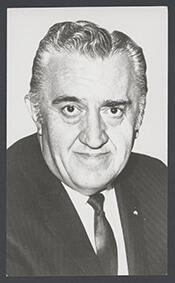
Here you will find contact information for Representative Walter Baring, including email address, phone number, and mailing address.
| Name | Walter Baring |
| Position | Representative |
| State | Nevada |
| District | At-Large |
| Party | Democratic |
| Status | Former Representative |
| Term Start | January 3, 1949 |
| Term End | January 3, 1973 |
| Terms Served | 10 |
| Born | September 9, 1911 |
| Gender | Male |
| Bioguide ID | B000141 |
About Representative Walter Baring
Walter Stephan Baring Jr. (September 9, 1911 – July 13, 1975) was an American politician and a member of the Democratic Party who served ten terms as a United States Representative from Nevada between 1949 and 1973. Over the course of his long congressional career, he represented Nevada’s at-large district during a transformative period in mid‑20th‑century American history and became known as a paradoxical figure whose political evolution and outspoken conservatism often put him at odds with his own party leadership while maintaining strong support among many Nevada voters.
Baring was born in Goldfield, Esmeralda County, Nevada, to Emily L. and Walter Stephan Baring. His paternal grandparents were immigrants from Germany, and his maternal grandfather was from Bohemia, giving him a family background rooted in central European ancestry. His father was active in local public affairs, serving for a time on the Esmeralda County Commission before moving the family to Reno, Nevada. After relocating, Baring’s father managed a furniture store, and the family became part of the growing Reno community in the interwar years. Baring attended Reno High School, from which he graduated in 1929, and he later obtained a high school teacher’s certificate, reflecting an early interest in education and public service.
Baring pursued higher education at the University of Nevada at Reno, where he completed two bachelor’s degrees, earning both a B.A. and a B.S. in 1934. His academic training provided him with a broad foundation in liberal arts and practical studies at a time when Nevada’s higher education system was still relatively small and closely tied to the state’s civic life. After graduating from the university, he entered federal service as a collector for the U.S. Internal Revenue Service, gaining experience in administration and taxation that would later inform his views on federal policy and government operations.
Baring’s formal political career began at the state level. In 1936, he was elected as a member of the Nevada Assembly, where he quickly established himself as an independent-minded Democrat. He was subsequently reelected to the Assembly and became known for his willingness to challenge national party leaders; during the presidency of Franklin D. Roosevelt, he strongly criticized Roosevelt’s proposal to expand, or “pack,” the United States Supreme Court, reflecting his concern over perceived executive overreach. After his legislative service, and following World War II, he was elected to the Reno City Council, further embedding himself in local governance and Nevada political life.
With the onset of World War II, Baring joined the United States Navy in 1943, serving his country during the global conflict. His wartime service added to his public stature in Nevada and aligned him with a generation of veterans who would go on to play prominent roles in postwar American politics. Returning to civilian life after the war, he resumed his political career at the municipal level before seeking national office.
Baring was first elected to the U.S. House of Representatives in the 1948 election, winning Nevada’s sole at‑large seat by narrowly unseating first‑term Republican incumbent Charles H. Russell by 761 votes. He took office in January 1949, beginning a congressional tenure that would ultimately span from 1949 to 1953 and then from 1957 to 1973. He was reelected in 1950, but in 1952 he was unexpectedly defeated for reelection by Republican Cliff Young, who won by a margin of 771 votes. Baring sought to regain the seat in 1954, again challenging Young, but Young prevailed in another close contest. In 1956, when Young ran for the U.S. Senate against incumbent Democrat Alan Bible, Baring once more sought the House seat. That year he defeated Las Vegas City Attorney Howard Cannon in the Democratic primary and went on to win the general election, returning to Congress. In 1958 he was reelected by a landslide, while Cannon himself was elected to the U.S. Senate, marking a notable year for Nevada Democrats.
During his first two terms in Congress, from 1949 to 1953, Baring compiled a generally liberal voting record consistent with much of the Democratic Party’s national agenda. However, after his return to the House in 1957, his political orientation shifted markedly to the right. He began to describe himself as a “Jeffersonian States’ Rights Democrat” and increasingly aligned his votes with the conservative Southern wing of the party. He was critical of President John F. Kennedy and opposed most of President Lyndon B. Johnson’s Great Society programs, including expansive federal social and economic initiatives. Baring frequently equated liberalism with socialism and Communism, and he was a staunch opponent of foreign aid in virtually all forms. His positions angered many Democratic leaders and activists, prompting him to remark that “No one likes Walter Baring but the voters,” a reflection of his belief that his primary loyalty was to his constituents rather than to party leadership.
Baring’s conservative stance was especially evident in his approach to civil rights and Cold War issues. He contended that the Civil Rights Movement was influenced by Communists and emerged as a leading opponent of the Civil Rights Act of 1964. His prominent role in resisting that landmark legislation nearly cost him renomination in the 1964 Democratic primary. Nevertheless, he managed to survive that challenge, in part because of his enduring popularity in rural Nevada. Throughout the 1960s, Baring often faced more serious threats in Democratic primaries than in general elections, as liberal and moderate Democrats sought to unseat him. He was, however, able to attract substantial support from registered Republicans, particularly in the northwestern part of the state, and he consistently ran up large margins in the so‑called “Cow Counties,” the rural areas of Nevada, which helped him offset deficits in Clark County (Las Vegas) and Washoe County (Reno).
By the early 1970s, demographic and political changes in Nevada, especially the rapid growth and increasing political influence of Clark and Washoe counties, began to erode Baring’s electoral base. In 1972, he was narrowly defeated in the Democratic primary by James Bilbray, a considerably more liberal Las Vegas attorney who would later serve in Congress himself. Bilbray’s strong margins in the urban counties proved insurmountable for Baring, whose rural support could no longer compensate for his losses in the state’s population centers. Claiming that Bilbray had smeared him during the campaign, Baring took the unusual step of endorsing the Republican nominee, David Towell, in the general election. Towell went on to win in an upset, underscoring the divisive nature of the primary and Baring’s complicated relationship with his own party.
After leaving Congress in 1973, Baring remained interested in public affairs and considered reentering electoral politics. He even flirted with the possibility of running for governor of Nevada in 1974, but his declining health intervened. He suffered from emphysema and heart strain, conditions that ultimately forced him to abandon any plans for a political comeback. Baring underwent surgery at Hollywood Presbyterian Medical Center in Los Angeles, California, where he died of heart and lung failure on July 13, 1975, at the age of 63. His long and often controversial career left a distinctive imprint on Nevada politics, reflecting both the state’s evolving political landscape and the tensions within the Democratic Party during the mid‑20th century.