Delegate Walter E. Fauntroy
Here you will find contact information for Delegate Walter E. Fauntroy, including email address, phone number, and mailing address.
| Name | Walter E. Fauntroy |
| Position | Delegate |
| State | District of Columbia |
| District | At-Large |
| Party | Democratic |
| Status | Former Representative |
| Term Start | January 21, 1971 |
| Term End | January 3, 1991 |
| Terms Served | 10 |
| Born | February 6, 1933 |
| Gender | Male |
| Bioguide ID | F000046 |
About Delegate Walter E. Fauntroy
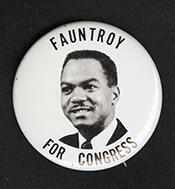
Walter Edward Fauntroy Jr. (born February 6, 1933) is an American pastor, civil rights activist, and politician who served as the Washington, D.C., delegate to the United States House of Representatives from 1971 to 1991. A member of the Democratic Party, he contributed to the legislative process during 10 terms in office and became a prominent advocate for civil rights, home rule, and voting representation for the residents of the District of Columbia. He was a candidate for the Democratic presidential nomination in 1972 and 1976 as a “favorite son” from the District, and as of July 2025 he is the last remaining survivor of the 13 co-founders of the Congressional Black Caucus.
Fauntroy was born in Washington, D.C., and grew up in the segregated capital, experiences that shaped his later commitment to civil rights and social justice. He attended local public schools and became active in church life at an early age, developing an interest in both ministry and public affairs. His upbringing in the nation’s capital, where residents lacked full voting representation in Congress, informed his later political agenda and his determination to secure greater autonomy and rights for the District’s citizens.
Fauntroy pursued higher education at Virginia Union University in Richmond, Virginia, where he studied religion and prepared for the ministry. He later undertook theological training at Yale Divinity School, further grounding his pastoral vocation in rigorous academic study. Ordained as a Baptist minister, he returned to Washington and became pastor of New Bethel Baptist Church, a historic congregation in the Shaw neighborhood. His pulpit quickly became a platform for activism, and he emerged as a key local leader in the burgeoning civil rights movement.
By the late 1950s and 1960s, Fauntroy was deeply involved in national civil rights efforts. He worked closely with the Reverend Dr. Martin Luther King Jr. and the Southern Christian Leadership Conference (SCLC), serving as the Washington, D.C., coordinator for the 1963 March on Washington for Jobs and Freedom and later for the 1968 Poor People’s Campaign. Through these roles he helped organize major demonstrations that brought national attention to racial inequality, economic injustice, and the unfinished work of civil rights. His dual identity as pastor and activist made him a central figure linking grassroots organizing, moral advocacy, and emerging Black political power.
Following the passage of legislation in 1970 that created a non-voting delegate position for the District of Columbia in the U.S. House of Representatives, Fauntroy ran for the new office and was elected as the District’s first modern congressional delegate. He took his seat in Congress in 1971 and served until 1991, winning reelection to a total of 10 terms. As a member of the House of Representatives, he participated in the democratic process and represented the interests of his constituents during a significant period in American history marked by the end of the Vietnam War, the Watergate scandal, the civil rights and women’s movements, and the conservative realignment of the 1980s. Although he did not have a vote on final passage of legislation, he served on committees, introduced bills, and used his position to press for D.C. home rule, full voting representation, and expanded federal support for urban communities.
In Congress, Fauntroy was one of the 13 founding members of the Congressional Black Caucus in 1971 and played a central role in shaping its agenda on civil rights, economic opportunity, and foreign policy, particularly regarding Africa and the global struggle against apartheid. He became known for his advocacy on issues affecting African Americans and the urban poor, as well as for his efforts to link domestic civil rights concerns with international human rights. His “favorite son” candidacies for the Democratic presidential nomination in 1972 and 1976 were designed to secure a voice for the District of Columbia and for Black voters within the party’s national deliberations, rather than to mount a full national campaign.
Fauntroy stepped down from his seat in Congress in 1990 to run for mayor of Washington, D.C. Seeking to translate his national experience into local executive leadership, he entered a crowded Democratic primary but was defeated by Sharon Pratt Kelly, finishing fifth with about 7 percent of the vote. Reflecting on the loss, he told The Washington Post: “I put together a very careful and thorough plan, but unfortunately that never got over. But I believe that all things work together for the good of those who love the Lord.” After leaving Congress, he returned to New Bethel Baptist Church, where he resumed a full-time ministry and rededicated himself to community service in the District.
In the years following his congressional service, Fauntroy remained active in public affairs through both religious and civic channels. He founded Walter E. Fauntroy & Associates, a consulting and lobbying firm that took on a variety of clients, the first and most prominent of which was Nelson Mandela’s African National Congress (ANC). Beginning in 1992, he lobbied Congress to pass legislation creating an “enterprise fund” for South Africa and worked to encourage new private U.S. investment there in the post-apartheid era. From his offices on Connecticut Avenue in Washington, he remarked to The Washington Post that he was “having a great time” in this new phase of his career and that the chances were “very slim” that he would again run for local office in the District.
Fauntroy also expanded his long-standing role in Black political organizing. He became president of the National Black Leadership Roundtable (NBLR), a national network vehicle of the Congressional Black Caucus that he had founded in 1977. In that capacity, he helped coordinate strategies among African American elected officials, clergy, and community leaders. As part of the NBLR’s Seven Point Program, he served as co-chair of the Sudan Campaign, chairman of Business Enterprise Development, LLC, and leader of a U.S.-based private sector effort to help cure extreme poverty in Africa by the year 2025, in alignment with the United Nations Millennium Development Goals. Working in partnership with the Zimbabwe Progress Fund, this initiative became known as the Millennium Villages Project and focused on development in villages across sub-Saharan Africa.
Fauntroy continued to engage in debates at the intersection of religion and politics. In 2005, along with fellow former African-American Democratic congressman and minister Floyd Flake, he joined U.S. Representative Walter Jones of North Carolina in supporting the Houses of Worship Freedom of Speech Restoration Act (H.R. 235). The proposed legislation would have allowed tax-exempt religious institutions to engage more directly in current political activity, reflecting Fauntroy’s long-held view that faith communities should play an active role in public life. Throughout this period he remained a frequent lecturer and commentator on civil rights, racism, and public policy, appearing in forums, oral history projects, and on C-SPAN.
Robust and athletic through most of his life, Fauntroy faced a serious health challenge in 1993 when he was diagnosed with tuberculosis. He underwent treatment and was cured, and he chose to speak publicly about his illness to demystify tuberculosis and reassure others that it was treatable. In his personal life, he and his wife, Dorothy, adopted an abandoned baby whom they named Melissa Alice, further reflecting his commitment to family and community. Through his decades as pastor, activist, legislator, and international advocate, Walter Edward Fauntroy Jr. has remained a significant figure in the intertwined histories of the District of Columbia, the civil rights movement, and African American political leadership.