Representative Wally Herger
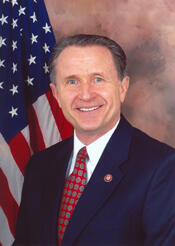
Here you will find contact information for Representative Wally Herger, including email address, phone number, and mailing address.
| Name | Wally Herger |
| Position | Representative |
| State | California |
| District | 2 |
| Party | Republican |
| Status | Former Representative |
| Term Start | January 6, 1987 |
| Term End | January 3, 2013 |
| Terms Served | 13 |
| Born | May 20, 1945 |
| Gender | Male |
| Bioguide ID | H000528 |
About Representative Wally Herger
Walter William Herger Jr. (born May 20, 1945) is an American politician who served as a Representative from California in the United States Congress from 1987 to 2013. A member of the Republican Party, he represented California’s 2nd congressional district for 13 consecutive terms. During his tenure, his district was the state’s largest congressional district by area, encompassing almost all of interior Northern California, including the cities of Chico, Redding, and Red Bluff. His service in Congress occurred during a significant period in American history, and he participated actively in the legislative process and the democratic institutions of the House of Representatives, representing the interests of his largely rural and agricultural constituency. On January 10, 2012, Herger announced that he would not seek re-election in November of that year, bringing to a close more than a quarter-century in federal office.
Herger was born in Yuba City, California, and is of Swiss, German, and Irish descent. His paternal grandfather emigrated to the United States from the canton of Uri in Switzerland in the late nineteenth century. He was raised on his family’s 200-acre cattle ranch and plum farm in the northern California community of Rio Oso, located between Yuba City and Sacramento. Growing up in an agricultural setting, he gained early experience in farming and ranching, and he later worked in his family’s oil and gas exploration business. Around the age of 20, he joined The Church of Jesus Christ of Latter-day Saints, a faith that would remain an important part of his personal life.
Herger pursued higher education at American River College, from which he graduated with an Associate of Arts degree. He subsequently attended California State University, Sacramento, for one year. While he did not complete a four-year degree, his combination of agricultural, business, and community experience helped shape his early public service. His political career began at the local level in 1976, when he was elected to the East Nicolaus School Board, reflecting an early interest in education and local governance in northern California.
Building on his local service, Herger was elected to the California State Assembly in 1980. He represented a northern California district in the Assembly from 1980 to 1986, during which time he developed a legislative profile attentive to rural issues, agriculture, and small business concerns. His tenure in the Assembly provided him with legislative experience and visibility that positioned him for a successful run for Congress. In 1986, he was elected to the U.S. House of Representatives from California’s 2nd congressional district and took office in January 1987.
During his 13 terms in the House of Representatives, Herger was consistently reelected, aided in part by a strong Republican voter registration advantage in his district, which was generally considered a “safe” Republican seat. Nonetheless, he faced competitive campaigns, particularly in his later years in office. In 2002 and 2004, he defeated Democratic challenger Mike Johnson, receiving 67 percent of the vote in 2004. In 2006, he ran against Arjinderpal Sekhon and secured 64 percent of the vote. In 2008, he faced Trinity County Supervisor Jeff Morris, who narrowed the margin somewhat, holding Herger to 57 percent. In 2010, Herger confronted a Republican primary challenge from retired Colonel Pete Stiglich and then ran in the general election against Democrat Jim Reed, a lawyer who divided his time between the Bay Area and Fall River; Herger prevailed with 57 percent of the vote. Throughout these contests, third-party candidates, including those from the Libertarian Party and, in the 1990s, the Natural Law Party, also appeared on the ballot, reflecting the district’s diverse political undercurrents despite its Republican tilt.
Herger’s congressional career was closely tied to his long-standing service on the influential House Committee on Ways and Means, on which he served for virtually his entire tenure in Congress. Under the rules of the House, his participation in full committee work was limited to Ways and Means, underscoring the centrality of tax, trade, and social policy to his legislative agenda. Within Ways and Means, he served on the Subcommittee on Trade and the Subcommittee on Income Security and Family Support, and he later chaired the Subcommittee on Income Security and Family Support (known as the Subcommittee on Human Resources during his chairmanship), beginning with the 107th Congress. In the 110th Congress, he was named the Ranking Member of the Republican delegation to the Trade Subcommittee. From these positions, he played a leading role in the reauthorization and expansion of the 1996 welfare reform law and sponsored the Criminal Welfare Prevention Act, which was enacted as part of the broader 1996 Welfare Reform Law. That measure provided additional financial incentives to law enforcement agencies to identify and prosecute fraudulent recipients of public assistance. He also served on the Ways and Means Subcommittee on Health, where he held the position of chair, further extending his influence over federal health and social policy.
Representing a district heavily driven by agriculture, Herger consistently supported legislation intended to bolster free and fair trade to benefit farmers, ranchers, and related industries in northern California. From his position on the Trade Subcommittee, he worked on the consideration of trade agreements with foreign nations, arguing that expanded export markets were vital to his constituency. He also co-authored the Herger-Feinstein Quincy Library Group Forest Recovery Act, which established a framework for managing federal forest assets on lands in Lassen, Plumas, and Tehama counties. The act emerged from a negotiated agreement among a diverse coalition that included environmental advocates and logging interests. It aimed to reduce vegetation density on U.S. Forest Service lands while expanding forest biodiversity and reducing the prevalence of monoculture forests. In addition, Herger joined with Representative Kendrick Meek of Florida to draft legislation to repeal a three percent withholding tax scheduled to begin in 2011, which would have required governments with more than $100 million in annual expenditures on services from for-profit companies to withhold three percent of contract payments and remit that amount to the Internal Revenue Service. Critics, including the National Association of Counties, argued that the withholding requirement would force vendors and contractors to raise bid prices and place counties at a competitive disadvantage, concerns that Herger highlighted in advocating repeal.
Herger’s long tenure was not without controversy. On August 18, 2009, he attended a town hall meeting in Redding, California, during a period of intense national debate over health care reform. At the event, an audience member introduced himself as a “proud right-wing terrorist.” The individual later told reporters, in a private interview ten days afterward, that he had misspoken and had intended to say “extremist.” At the time, however, Herger did not distance himself from the remark; after the constituent’s extended comment, he responded, “Amen. God bless you. There goes a great American.” His response drew criticism from many observers both inside and outside his district, who found his failure to challenge the language unacceptable. The incident attracted national media attention and was highlighted on the television program Countdown with Keith Olbermann on August 28, 2009.
Over the course of his congressional service, Herger also participated in several caucuses that reflected his policy interests and ideological orientation. He was a member of the Congressional Biomass Caucus and the Congressional Caucus on Turkey and Turkish Americans, and he belonged to the Republican Study Committee, a group of conservative House Republicans. He was also associated with the Tea Party Caucus during the period of heightened conservative activism in the late 2000s and early 2010s. These affiliations underscored his alignment with fiscal conservatism, limited government, and support for certain international relationships and energy policies.
In his personal life, Herger is married to Pamela Sargent. Together they have nine children and, as noted during his time in office, 19 grandchildren. A member of The Church of Jesus Christ of Latter-day Saints since his early adulthood, he has been open about the role of faith and family in his life. Following his decision not to seek re-election in 2012 and the conclusion of his service in January 2013, Herger stepped back from public office. His long record in local, state, and federal government—beginning with a school board seat in 1976 and culminating in 26 years in the U.S. House of Representatives—left a lasting imprint on the representation of interior northern California in Congress.